PART4
Despite everything, I laughed.
That sounded exactly like Ernestine.
Then Daniel’s expression became serious again.
“There’s one more thing.”
I looked at him.
He removed a folded document from the bottom of the folder.
“This was written in 1998.”
I recognized the date immediately.
1998.
The year I repaired the church roof again.
Daniel placed the document in front of Whitney.
It was an agreement signed by the church trustees, Reverend Barfield’s successor, and two members of the congregation.
The agreement stated that all proceeds from the roof fund, including interest and additional contributions, would remain dedicated to the sanctuary roof.
It also contained a provision.
If the sanctuary required repairs, the church was obligated to obtain an independent inspection before authorizing a major replacement project.
I looked at Whitney.
“Did your Atlanta company provide an independent inspection?”
She hesitated.
“They provided a professional assessment.”
“That wasn’t my question.”
She lowered her eyes.
“No. They were the company that submitted the replacement proposal.”
Daniel leaned back.
“That’s not all.”
He pulled out the original roofing estimate.
I looked at the number.
Three hundred and eighty thousand dollars.
Then I looked at the company’s name.
Something about it bothered me.
I had spent fifty-three years working with roofing suppliers, contractors, and inspectors across South Georgia.
I knew how much materials cost.
I knew how much labor cost.
And I knew what a church roof should cost.
“Who recommended this company?” I asked.
Whitney answered quietly.
“I did.”
“Do you know anybody who works there?”
“My husband knows one of their project managers.”
The room became silent.
Daniel looked at her.
“Is that why you selected them?”
“No. I received three proposals.”
“Where are the other two?”
Whitney opened a folder on her laptop.
“They were higher.”
I looked at her.
“How much higher?”
“One was four hundred and twenty thousand. The other was four hundred and six thousand.”
I shook my head.
“Then why did you say this company was giving us a competitive price?”
“Because it was the lowest bid.”
I picked up the estimate.
“Whitney, did anybody climb onto that roof?”
She frowned.
“What?”
“Did anybody physically inspect the flashing around the bell tower?”
“The company said they conducted a complete inspection.”
“Did you watch them?”
“No.”
“Did you speak to the inspector?”
“No.”
“Did they remove any shingles?”
“I don’t know.”
I put the estimate down.
“Then you don’t know what you’re buying.”
For the first time, Whitney looked genuinely uncomfortable.
But Daniel wasn’t finished.
He opened another document.
This one was a bank statement.
And beside the account number was a handwritten note from Ernestine.
Do not let anyone spend this money without knowing what the roof actually needs.
I felt something tighten in my chest.
My wife had thought of everything.
Almost everything.
Because nobody had thought that, fifty-two years later, a young finance chair would decide that the entire fund didn’t exist.
The special meeting was scheduled for Thursday evening.
Word had spread throughout Pleasant Grove.
People who hadn’t attended a council meeting in years suddenly showed up.
Mrs. Clara Jenkins came with her daughter.
Faye Pope arrived with a notebook.
Henry Mills’s son, who had grown up watching his father work beside me, sat in the second row.
Even some of the younger families came.
The fellowship hall was full.
Whitney stood at the front with her laptop.
Pastor Jordan opened the meeting with prayer.
Then Daniel Pope explained the history of the roof fund.
He showed the original agreement.
He showed the passbook.
He showed Ernestine’s handwritten ledger.
He explained that the account had been maintained separately from the church’s operating budget for decades.
When he finished, Pastor Jordan looked at me.
“Mr. Gaskins, would you like to say something?”
I stood slowly.
My knees weren’t what they used to be.
I held onto the back of the chair.
“I don’t have a speech,” I said. “I’m not much of a speechmaker.”
A few people smiled.
“I just want everybody to understand something. In 1974, this church had a leaking roof. We didn’t have money to fix it. Reverend Barfield came to my house, and I told him what the work would cost.”
I paused.
“He couldn’t afford it. So I did it for free.”
I looked around the room.
“My wife and I loved this church. We got married here. We raised our children here. We buried friends here. We sat in these pews when life was good, and we sat in these pews when life was hard.”
I swallowed.
“When my wife got sick, I still brought my ten dollars every Sunday. When she died, I kept bringing it.”
Nobody moved.
“Some people might think ten dollars isn’t much. And maybe it isn’t. But ten dollars every week for fifty-two years is more than money. It’s a promise. It’s a promise that somebody will still care about this place when the people who built it are gone.”
I looked toward Whitney.
“I never expected a plaque. I never expected my name on a wall. I didn’t even expect anybody to thank me.”
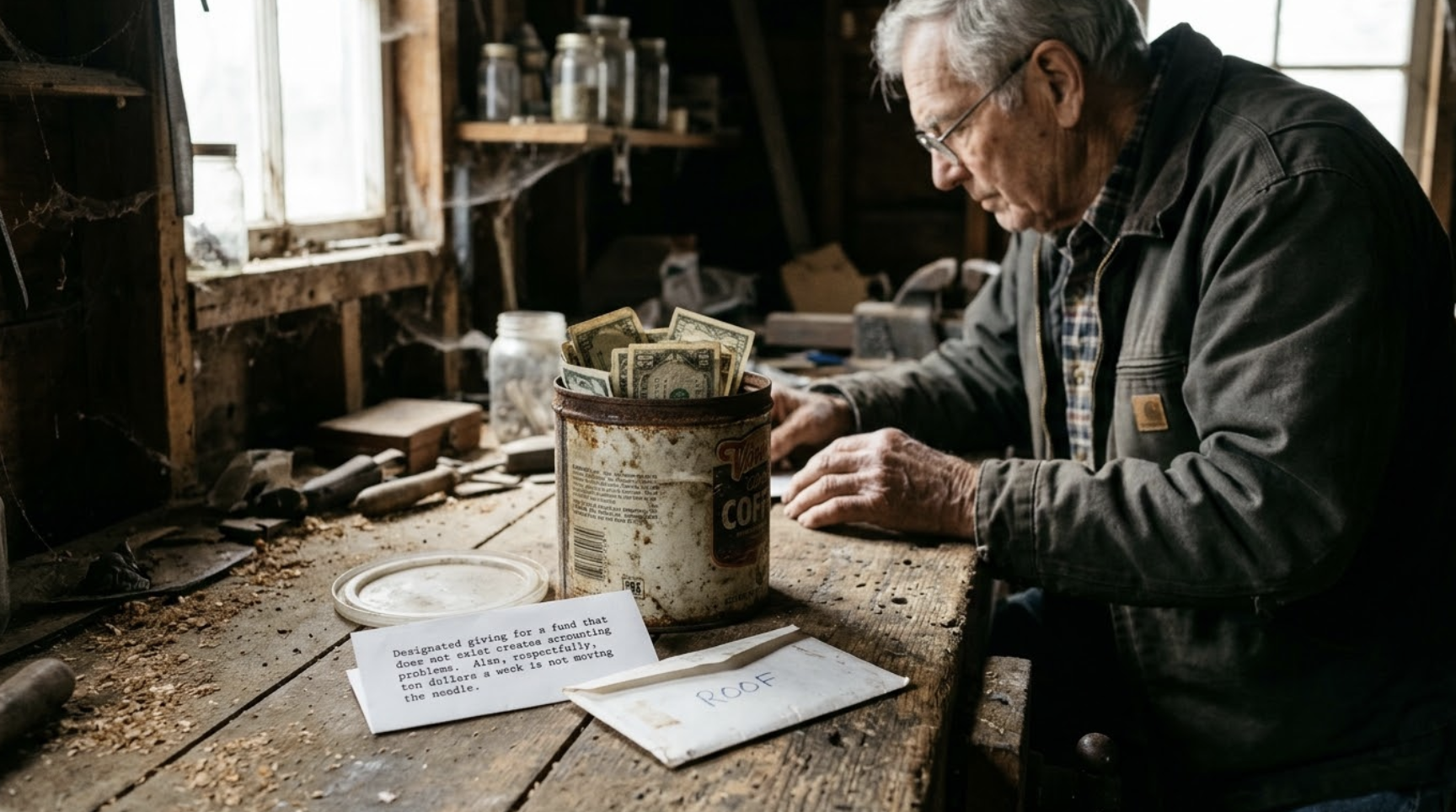
Then I held up the typed letter she had sent me.
“But I never expected to be told that my gift wasn’t moving the needle.”
A few people lowered their heads.
I continued.
“That money was never mine to spend. It wasn’t yours, Whitney. It wasn’t Pastor Jordan’s. It wasn’t even the church council’s money to use however it pleased.”
I pointed toward the documents.
“It was given for one purpose. To keep the roof over this congregation.”
Then I sat down.
For several seconds, nobody spoke.
Finally, Whitney stood.
“Mr. Gaskins, I want to respond.”
I nodded.
She walked to the front.
“I want to apologize.”
Her voice was different now.
Not the polished voice she used during presentations.
Not the confident voice she used when explaining spreadsheets.
This was the voice of someone who had realized she’d made a serious mistake.
“When I took over as finance chair, I found incomplete records. I couldn’t locate a formally established roof fund in the current accounting system. I believed the weekly envelopes were informal donations.”
She looked at me.
“I should have investigated before returning your envelope. I should have asked questions. I should have spoken to the people who had been managing the church’s finances before me.”
She paused.
“And I should never have described your contribution as insignificant.”
Nobody interrupted.
Whitney continued.
“I also need to disclose something. My husband knows one of the managers at the Atlanta roofing company. I believed that relationship was harmless because I received multiple bids. But I now understand that I should have disclosed it to the council before recommending the company.”
Daniel leaned forward.
“Did you receive anything from that company?”
“No.”
“Did your husband?”
“No.”
“Are you certain?”
“Yes.”
Pastor Jordan raised his hand.
“Let’s keep this constructive. We need to establish the facts before making accusations.”
I appreciated that.
I wasn’t interested in destroying anybody’s reputation.
I wanted the church to have a sound roof.
But there was still one question.
I raised my hand.
“Pastor, can I ask something?”
“Of course.”
I looked at Whitney.
“Did that company actually inspect the roof?”
She nodded.
“According to their report, yes.”
“Then let’s get somebody who has no connection to anybody here to inspect it.”
Whitney nodded.
“I agree.”
And for the first time that evening, the entire room seemed to breathe again.
The council voted unanimously to suspend the three-hundred-and-eighty-thousand-dollar proposal until an independent inspection could be completed.
They also voted to have the roof fund’s legal and banking status reviewed.
But before the meeting ended, Mrs. Clara Jenkins stood up.
She was eighty-six years old and walked with a cane.
“I have something to say,” she announced.
Everybody turned.
“I was here in 1974. I remember when Ozell fixed that roof. I remember Ernestine bringing sandwiches. I remember putting five dollars into that coffee can because I couldn’t afford more.”
She reached into her handbag.
Then she pulled out a small envelope.
“I’ve been putting away a little money every year since then.”
She placed it on the table.
“Ten dollars at Christmas. Sometimes twenty. I don’t know how much is in there now. But I always thought it was for the roof.”
Whitney looked at her.
“Mrs. Jenkins, did you know about the savings account?”
Clara smiled.
“Of course, child. Ernestine told me about it.”
Then she looked at me.
“She told all of us. She just didn’t want anybody making a fuss.”
I felt my eyes become wet.
For fifty-two years, I’d thought I was keeping a promise.
Now I realized there had been an entire congregation quietly keeping it with me.
The independent inspection took place the following Tuesday.
The church hired a licensed roofing consultant from Valdosta who had no connection to the Atlanta company.
I went along.
I didn’t climb onto the roof.
At eighty-one, I knew better.
But I stood on the ground with my old binoculars and watched the inspection.
The consultant spent nearly four hours examining the sanctuary.
He checked the shingles.
He examined the flashing.
He inspected the bell tower.
He looked inside the attic.
He even took moisture readings around the choir loft.
At the end, he asked me to meet him in the parking lot.
“Mr. Gaskins?”
“Yes, sir.”
“I understand you used to do roofing.”
“Fifty-three years.”
He nodded.
“Then you’ll probably appreciate this report.”
He handed me a preliminary assessment.
The sanctuary roof did not need complete replacement.
The shingles were old, but most were still serviceable.
There were several areas of deteriorated flashing, damaged sealant around the bell tower, and a section of underlayment that needed attention.
The consultant estimated the necessary repairs at approximately twenty-eight thousand dollars.
A full replacement, if properly planned in the future, would likely cost significantly more, but there was no immediate justification for the proposed three-hundred-and-eighty-thousand-dollar project.
I read the report twice.
Then I looked at him.
“Are you sure?”
“Yes, sir. I wouldn’t put my license behind it if I weren’t.”
I thanked him.
When I returned to the fellowship hall, Whitney was waiting.
“Well?”
I handed her the report.
She read it.
Then she sat down.
“Twenty-eight thousand dollars?”
“That’s what the independent consultant says.”
She looked toward the ceiling.
“I don’t understand.”
I sat across from her.
“What’s there to understand?”
“The Atlanta company said the entire roof was failing.”
“Maybe they saw something the independent consultant didn’t. But that’s why you get another opinion before spending that kind of money.”
She looked at the report again.
“Mr. Gaskins, I owe you another apology.”
I didn’t answer immediately.
Then I said, “You don’t owe me an apology just because the numbers were wrong. You owe this congregation a better process.”
She nodded.
“I know.”
For the first time, I believed her.
The church council eventually received the consultant’s full written report.
They contacted the Atlanta company and requested clarification.
The company defended its proposal but could not provide sufficient evidence to support the claim that the entire sanctuary roof required immediate replacement.
The church decided not to proceed with the contract.
There were some uncomfortable conversations.
The pastor requested that all future contractor relationships be disclosed.
The council adopted a written policy requiring independent inspections and multiple bids for major construction projects.
And Whitney volunteered to lead the revision of the church’s financial procedures.
She also asked Daniel to help reconstruct the old records.
It took several weeks.
But slowly, the pieces came together.
And then came the biggest surprise.
The bank completed its review of the old account.
The original passbook showed a balance of just over six hundred dollars in 1974.
There had been regular contributions.
There had been deposits from church members.
There had been occasional interest credits.
And there had been no withdrawals.
The bank confirmed the account’s balance.
Verified account balance
$347,862.41
I stared at the number.
Three hundred and forty-seven thousand, eight hundred and sixty-two dollars.
I thought about the ten-dollar bills.
I thought about Ernestine.
I thought about the people who had quietly contributed over the years.
And I thought about all the Sundays when I’d walked into that church carrying an envelope while nobody paid attention.
I wasn’t rich.
I had never been rich.
But that little white church had more than enough money to repair its roof.
And it had been there all along.
One Sunday morning, after the service, Whitney approached me.
She wasn’t carrying a laptop or a stack of papers.
She was holding two cups of coffee.
“Mr. Gaskins?”
“Yes, ma’am?”
“Would you mind sitting with me for a few minutes?”
I followed her to the fellowship hall.
She placed one cup in front of me.
Then she sat across from me.
“I’ve been thinking about something,” she said.



One Comment on “PART4: I Put $10 in a Church Roof Fund Every Sunday for 52 Years. The New Finance Chair Called It Worthless—Until I Opened an Old Coffee Can.”
Comments are closed.