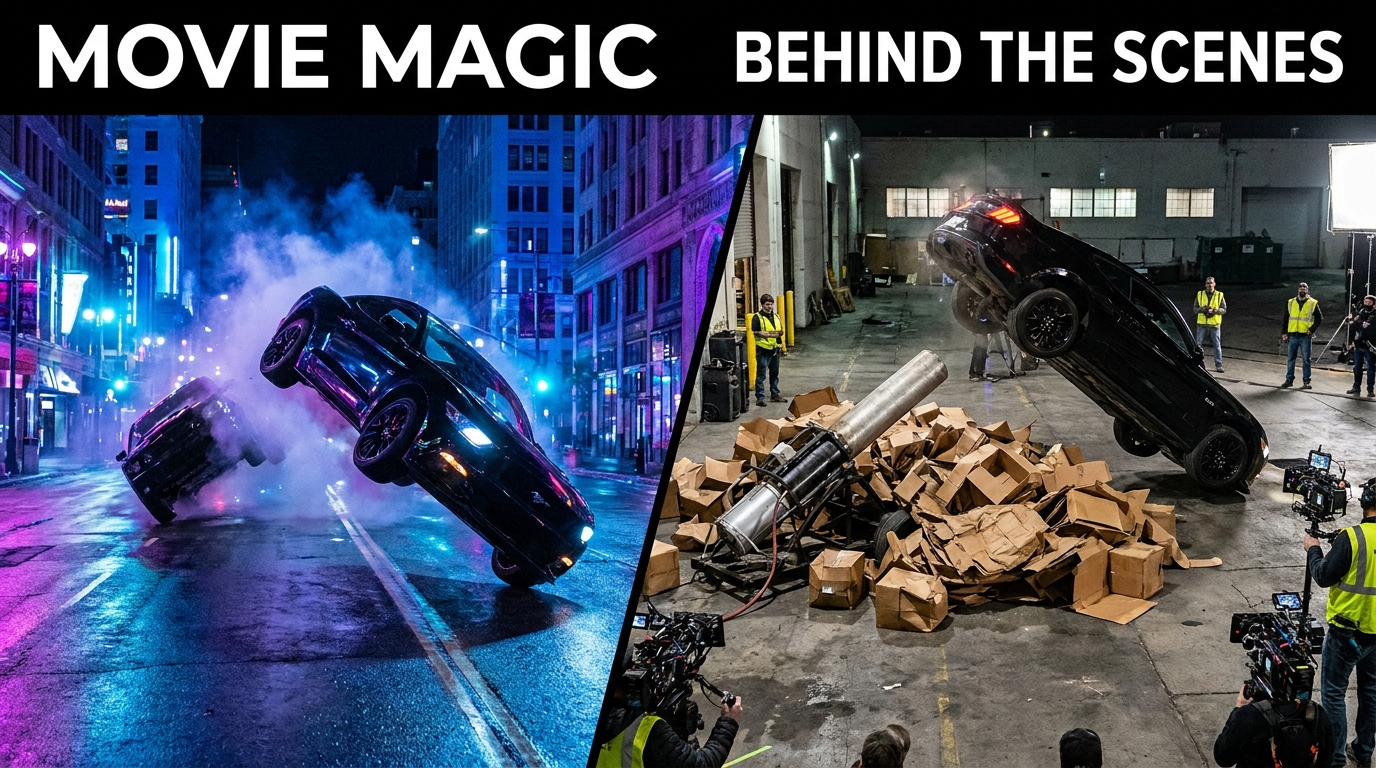
If you just watched that crazy short video on your feed showing a car flipping violently through the air, you are probably asking yourself: “How on earth does a stunt driver survive a crash like that?”
The answer isn’t Computer-Generated Imagery (CGI) or movie magic. It is a brilliant combination of extreme physics and a six-figure practical effects technique known as the “Pneumatic Cannon Roll.” Today, we are breaking down the entire process of how Hollywood pulls off its most dangerous stunts!
1. No Explosives, Just a “Pneumatic Cannon”
In the old days of filmmaking, crews used actual explosives to flip cars. However, this was incredibly unpredictable and highly dangerous for the stunt drivers. In modern Hollywood, stunt coordinators have switched to the Pneumatic Cannon.
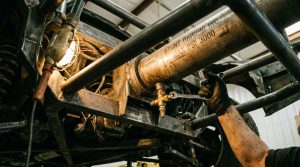
This device is a massive steel cylinder filled with highly compressed air. It is welded directly to the underside of the stunt car. When the driver hits their mark at high speed, they press a trigger. The cylinder fires a massive steel ram directly into the asphalt with explosive force, launching the car into the air and sending it into a violent, cinematic spin.

2. Ultimate Safety Inside the “Roll Cage”
Even though the outside of the car looks completely destroyed during the crash, the driver inside remains incredibly safe. Before filming, the stunt car is completely gutted. Mechanics remove the engine, interior, and anything unnecessary to reduce weight.
Next, a heavy-duty steel Roll Cage is welded inside the cabin. The stunt driver is strapped into a custom racing seat using a 5-point safety harness. This ensures that no matter how many times the car rolls, the cabin remains intact and the driver doesn’t move an inch.
3. The Secret of the “Cardboard Boxes”
You might be wondering: once the car is airborne, how do they stop it from being completely crushed upon landing? The secret lies in something surprisingly simple: Empty Cardboard Boxes.
The stunt crew will meticulously stack hundreds of empty cardboard boxes exactly where the car is calculated to land. Why not use giant inflatable airbags? Because airbags cause the car to bounce uncontrollably, which is highly dangerous. Cardboard boxes, on the other hand, crumple gradually under the weight of the car, absorbing the kinetic energy and providing a relatively soft, controlled landing.
4. The Massive Cost of a 5-Second Shot
Pulling off a stunt like this is no joke. The stunt coordination team spends weeks calculating the physics, entry speed, wind resistance, and cannon pressure. Prepping a single car with a cannon, roll cage, and safety gear can cost anywhere from tens of thousands to hundreds of thousands of dollars.
And the most stressful part? They usually only get one take. If the timing is off by a fraction of a second, the shot is ruined, the money is gone, and they have to start all over with a brand new car.
Conclusion: The next time you are sitting in a movie theater or scrolling on social media and see a car flying through the air, take a moment to appreciate the incredible stunt drivers and the massive crew of mechanics and engineers who risk their lives to create ultimate movie magic!