FINAL PART
I didn’t hate that old blanket. It had kept my daughter warm when I had little else.
But the new one reminded me that our circumstances could change.
We were no longer trapped in the worst moment of our lives.
Then, one afternoon, Miles called with the update we had been waiting for.
A settlement and recovery process had resulted in the return of a substantial portion of the funds. Additional proceedings were still necessary to address the remaining losses and determine the consequences for those responsible.
He was careful not to promise more than the records supported.
But for the first time, I could see a path toward financial stability.
Grandma invited me and Maisie to spend a weekend at her home.
On Saturday morning, she took us to a small park near her house.
Maisie had recently learned to stand while holding someone’s hands, and she kept bouncing excitedly whenever Grandma smiled at her.
Watching them together filled me with a warmth I hadn’t felt in a long time.
Grandma sat beside me on a bench.
“I used to believe money could solve almost any practical problem,” she said. “I thought if I sent enough, you would be safe.”
“You tried to help.”
“I did. But I should have checked on you myself. I should have made sure you were receiving what I sent.”
I looked at her.
“You can’t be responsible for every terrible choice another person makes.”
“No,” she agreed. “But I can learn from mine.”
She took my hand.
“I hope you learn something, too.”
“What?”
“That accepting help doesn’t make you weak. And protecting your peace doesn’t make you cruel.”
I thought about how many times I had refused to tell anyone I was struggling because I feared being judged.
I had believed that asking for help meant admitting failure.
Now I understood that surviving a crisis was not a test of how silently I could suffer.
It was a process of learning when to ask, whom to trust, and when to walk away.
Grandma leaned over and kissed Maisie’s head.
“Your husband would be proud of you,” she said.
I looked at my daughter.
“I hope so.”
“He would be. And someday, when she’s old enough to understand, tell her that her mother kept going even when the world became terribly unfair.”
I smiled through my tears.
“I will.”
But there was still one thing left to resolve.
The family had spent months arguing about money, responsibility, and who deserved forgiveness.
I wanted to know whether we could ever sit together again without pretending the past had never happened.
The answer came at a small gathering in June.
Grandma invited a few relatives to her home for lunch. She told everyone beforehand that there would be no discussion of the investigation unless I chose to raise it.
My mother arrived with a homemade pie.
Paige brought flowers.
Glenn did not attend.
Vivian sent a letter.
I didn’t open it immediately.
Instead, I watched my mother help Maisie stack wooden blocks on the living-room floor while Paige laughed at the tower collapsing.
It was a simple scene.
But after everything we had endured, ordinary happiness felt extraordinary.
Eventually, I opened Vivian’s letter.
She wrote that she had been ashamed of her debts and frightened of losing her home. She admitted that she had made decisions to protect her own comfort and had allowed those decisions to harm me.
She did not ask me to tell the authorities to stop their work.
She did not demand immediate forgiveness.
At the end, she wrote:
I cannot ask you to trust me again. I can only accept that I broke your trust and spend the rest of my life deciding what kind of person I will be from now on.
I folded the letter and put it away.
I wasn’t ready to forgive her completely.
Perhaps I never would be.
But I no longer needed to decide her entire future in order to move forward with mine.
I could acknowledge her apology without pretending the damage had disappeared.
I could hope she changed without giving her access to my finances, my private life, or my daughter’s future.
And I could choose peace without calling the past acceptable.
That afternoon, as the sun began to set, Grandma stood beside me near the garden.
“Do you think our family can heal?” she asked.
I looked through the window at my mother and Paige playing with Maisie.
“Some parts of it already are.”
“And the rest?”
I thought carefully before answering.
“The rest will depend on what people do next.”
Grandma smiled.
“That sounds right.”
For the first time, our future felt uncertain in a way that didn’t frighten me.
Not every relationship had been repaired. Not every dollar had been recovered. Not every consequence had been decided.
But I had a home, a job, a daughter who was growing stronger every day, and people who were finally learning to tell the truth.
That was enough to begin again.
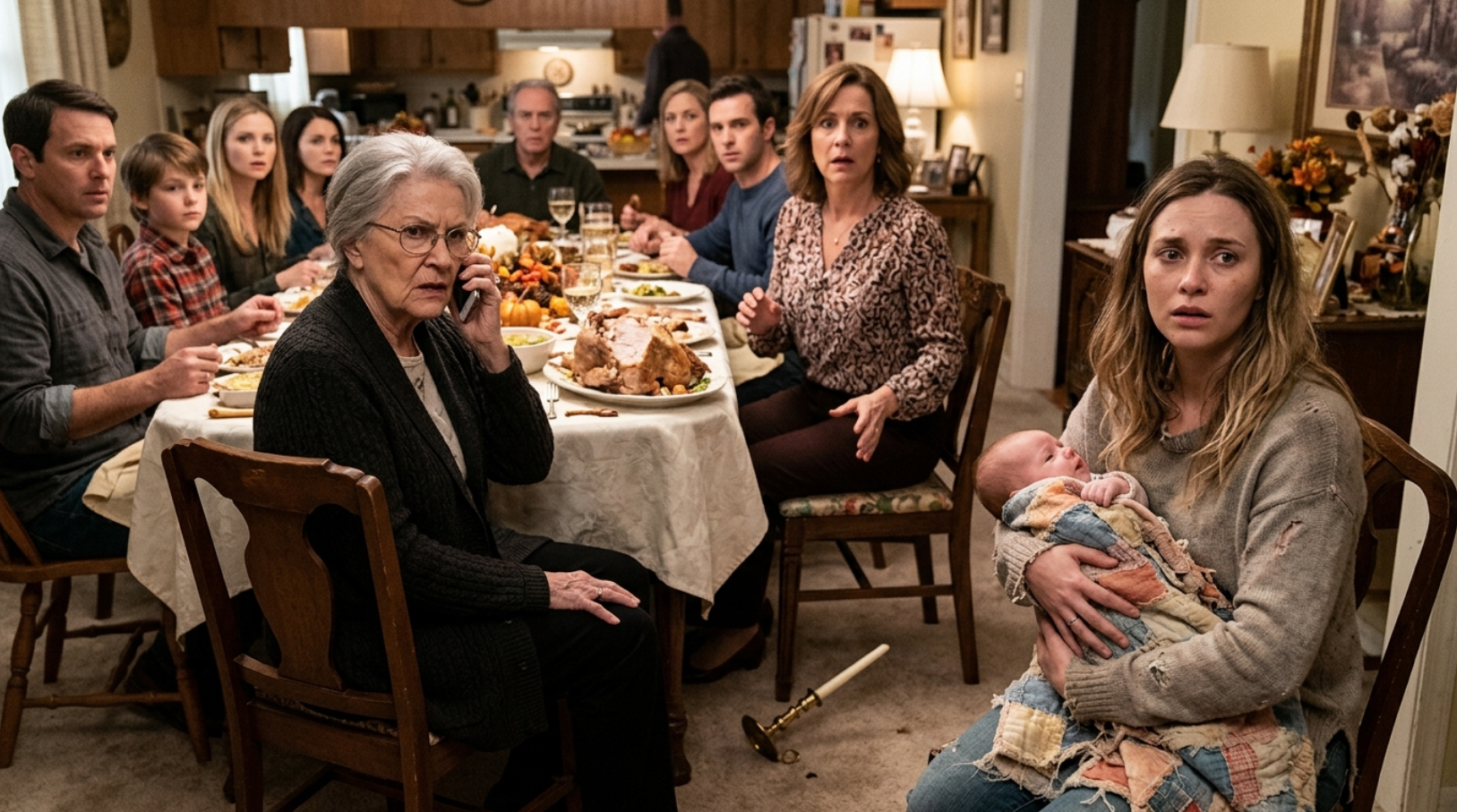
One year after that terrible Thanksgiving, Grandma invited everyone to her house again.
I almost declined.
The memory of Vivian dropping the candle, Miles spreading the bank records across the coffee table, and my family staring at me as if my suffering had suddenly become real was still vivid.
But this time, I arrived wearing a navy-blue dress and carrying a homemade apple pie.
Maisie was twenty-one months old.
She toddled through the front door holding my hand, wearing tiny shoes that Grandma had bought for her birthday.
The first thing Grandma did was kneel to greet her.
“My goodness,” she said, laughing as Maisie wrapped her arms around her neck. “Look how much you’ve grown!”
I watched them together, feeling Owen’s absence as sharply as ever.
He should have been there.
He should have been carrying Maisie on his shoulders, stealing pieces of pie before dinner, and making everyone laugh with his terrible jokes.
Grief had not disappeared simply because my life had improved.
But it had changed.
It no longer filled every room.
I could remember Owen without immediately feeling as though I were drowning.
And sometimes, when Maisie laughed, I could almost hear his laughter beside hers.
The family gathered around the table.
My mother sat beside me.
Paige helped Maisie arrange her crayons.
Grandma occupied her usual seat at the head of the table.
Vivian did not attend.
Her legal and financial matters had continued through the appropriate processes, and the family relationships remained complicated. Some relatives had chosen to maintain contact with her; others had not.
I had decided that I would not spend my life organizing my decisions around her.
I could wish her well from a distance.
I could protect my daughter.
And I could refuse to pretend that trust was something people were entitled to receive simply because they shared my last name.
Before dinner, Grandma raised her glass.
“A year ago, we discovered something painful about this family,” she began. “We discovered that money had been sent to help someone who was suffering, but that person never received it.”
The room grew quiet.
“I wish we had discovered the truth sooner. I wish Natalie had not spent those months struggling alone. And I wish we had remembered that love means more than sending money, making promises, or calling ourselves family.”
She looked at me.
“Love means paying attention. It means asking questions. It means having the courage to hear answers we don’t want to hear.”
My mother reached for my hand beneath the table.
Grandma continued.
“Today, I don’t want us to celebrate money recovered or arguments won. I want us to celebrate the things that cannot be transferred between bank accounts: honesty, courage, responsibility, and the chance to begin again.”
She lifted her glass.
“To Natalie and Maisie. To Owen, whose memory remains with us. And to the kind of family we choose to become.”
Everyone raised their glasses.
I looked around the table.
Some things were different forever.
Some relationships would never return to what they had been.
But there was no pretending anymore.
And that, I realized, was a kind of freedom.
After dinner, Grandma handed me a small envelope.
Inside was a letter and a photograph of Owen holding Maisie on the day she was born.
I stared at the photograph, unable to speak.
“I found it among the things you left at my house after the funeral,” Grandma explained. “I thought you might want it.”
I ran my fingers over the photograph.
Owen looked tired and happy, his face glowing with the wonder of becoming a father.
On the back, he had written a few words:
My girls. My whole world.
I pressed the photograph against my chest.
For months, I had thought the most important thing stolen from me was the $180,000.
That money could have changed my circumstances. It could have paid my bills, protected my health, and given Maisie and me the security we desperately needed.
Its disappearance had been a terrible betrayal.
But the deepest wound had been the belief that I had been forgotten.
I had spent months thinking I wasn’t important enough for anyone to notice that I was suffering.
Now I understood that my worth had never depended on how much money I had, how expensive my clothes were, or whether I could provide my daughter with a perfect life.
I had been worthy of love when I was counting coins.
I had been worthy of help when I was selling my wedding ring.
I had been worthy of dignity when I was wearing worn-out shoes and carrying my daughter in a secondhand blanket.
Nothing about my circumstances had changed that.
Later that evening, I carried Maisie to the car while Grandma followed us to the driveway.
She hugged me tightly.
“I’m proud of you,” she whispered.
“I couldn’t have done it without you.”
“You did the hardest part yourself. You kept going.”
I kissed her cheek.
Then I placed Maisie in her car seat, tucked her new star-patterned blanket around her, and closed the door.
As I drove home, I thought about the woman I had been one year earlier.
She had arrived at Thanksgiving believing she had failed at life.
She had thought her worn clothes revealed her weakness, her empty bank account proved her inadequacy, and her inability to provide everything for her daughter meant she was somehow less deserving than everyone around her.
But she had been wrong.
She had survived the loss of her husband, a devastating accident, financial hardship, and a betrayal she never could have imagined.
She had asked questions when silence would have been easier.
She had told the truth when lying might have protected the family.
And she had learned that forgiveness did not require surrendering her boundaries.
When we reached home, Maisie was asleep.
I carried her inside, laid her gently in her crib, and stood beside her for a moment.
The apartment was quiet.
For the first time in a long time, that quiet felt peaceful rather than lonely.
I turned off the light and whispered the words Owen had once written.
“My girls. My whole world.”
Then I went to bed knowing that tomorrow would bring ordinary challenges, unexpected expenses, and moments when grief might return without warning.
Life would never become perfect.
But it would be ours.
And nobody would ever again convince me that struggling meant I deserved less.
Because the greatest thing Grandma gave me was not the money she sent.
It was the chance to discover that I had never been a burden.
I had been a daughter, a wife, a mother, and a human being who deserved help when life became unbearable.
And when the truth finally came to light, I didn’t need revenge to prove my worth.
I needed courage to rebuild, wisdom to establish boundaries, and love to keep moving forward.
That was the real inheritance I carried into the future.
And it was worth more than $180,000.


One Comment on “FINAL PART: My Grandma Sent Me $180,000 After My Husband Died—My Aunt Took It All, Until One Thanksgiving Changed Everything”