FINAL PART
“Because I was scared.”
“Scared of what?”
“Of losing everything. The house. The money. My marriage.”
I looked at my son.
“Colin, you were willing to risk your mother’s security to protect your lifestyle.”
He started crying.
“I know.”
I had imagined this conversation many times.
In some versions, I shouted.
In others, I told him never to come back.
But now that he was sitting across from me, crying like the little boy who used to scrape his knees in the backyard, all I could feel was sadness.
Not hatred.
Sadness.
“Your father loved you,” I said.
“I know.”
“He wanted you to have a good life. He worked hard because he wanted you to have opportunities he never had.”
Colin nodded.
“But he also wanted you to become a good man.”
“I know, Mom.”
I reached into the cabinet and took out the envelope Martin had addressed to him.
It was still sealed.
I placed it on the table.
“Your father wrote this for you.”
Colin stared at it.
“He left me a letter?”
“Yes.”
“Have you read it?”
“No. It was meant for you.”
He carefully opened the envelope.
Inside was a handwritten letter.
I watched his face as he read.
At first, he looked confused.
Then his lips began trembling.
By the time he reached the final paragraph, tears were running down his cheeks.
He read the last lines aloud.
My son,
I don’t expect you to become wealthy. I don’t expect you to own a beautiful house or drive an expensive car.
I only ever wanted you to become someone your mother could depend on.
Your mother has spent her entire life loving you. Don’t mistake that love for permission to hurt her.
If you lose money, you can earn it again. If you lose a house, you can build another home.
But if you destroy your mother’s trust, you may spend the rest of your life wishing you had protected it.
I love you, son. But I cannot protect you from every consequence of your decisions.
One day, I hope you understand that.
Dad.
Colin covered his face.
For several minutes, he couldn’t speak.
Then he looked at me.
“I never got to say goodbye properly.”
I reached across the table.
“Neither did I.”
“I thought there would be more time.”
“So did I.”
He cried harder.
And for the first time in a long while, I allowed myself to hold my son without pretending everything was fine.
The months that followed were not easy.
Colin and Kara’s marriage eventually fell apart.
There were arguments about money, disagreements over the documents, and painful conversations about what had happened.
Kara eventually moved out.
The investigation into the unauthorized financial requests was handled through the appropriate legal channels. The evidence was preserved, and the relevant parties were required to cooperate with the process.
I did not use Martin’s money to rescue anyone from the consequences of those decisions.
That was the hardest part.
For years, I had believed that helping my family meant solving their problems.
But sometimes helping someone means refusing to keep paying for the same mistakes.
Colin eventually acknowledged his responsibility for the unpaid loan.
Through Daniel, we arranged a formal repayment agreement based on his actual financial circumstances.
He also agreed to cooperate fully with the review of the unauthorized transfer request.
I didn’t forgive everything immediately.
Trust doesn’t return simply because someone says they’re sorry.
It returns slowly, through honesty, consistency, and actions repeated over time.
And Colin finally began to understand that.
One year after Martin’s death, Christmas came again.
I wasn’t sure how I would feel.
The previous Christmas had been the loneliest night of my life.
I almost considered traveling somewhere warm.
But on December 24, I found myself taking Martin’s red dress from the wardrobe.
I held it against my chest.
The pearl buttons were still perfectly intact.
I smiled through my tears.
“You were right about this dress, Martin.”
That afternoon, I made a smaller dinner.
A glazed ham.
Roasted vegetables.
Warm rolls.
And one pecan pie.
I set the table for two.
At 2:45 p.m., the doorbell rang.
I opened it.
Colin stood outside.
He wasn’t wearing an expensive coat or carrying an elaborate gift basket.
He was holding a small wooden bird feeder.
“Hi, Mom.”
I looked at the feeder.
“What’s that?”
“I made it.”
He smiled nervously.
“I thought the old one might need replacing.”
I looked past him toward the backyard.
The original feeder Martin had built was still hanging from the tree.
It was weathered now, but I had repaired its hinges and kept filling it every winter.
“I thought you could use another one,” Colin explained.
I felt tears forming.
“Your father would have liked that.”
“I know.”
He stepped inside.
Then he stopped when he saw the dining table.
Two plates.
Two glasses.
Two folded napkins.
He looked at the red dress I was wearing.
“Mom…”
I smiled.
“Your father loved this dress.”
Colin’s eyes filled.
“I remember.”
We ate dinner together.
There was no pretending that the previous year hadn’t happened.
There were no promises that everything would suddenly become perfect.
But Colin listened when I spoke.
He asked about my health.
He helped carry the dishes into the kitchen.
And before leaving, he walked into Martin’s study and stood quietly beside his father’s old chair.
“I miss him,” he whispered.
“So do I.”
“I wish I’d listened to him sooner.”
I placed my hand on his shoulder.
“Then listen now.”
He nodded.
Over the following year, things gradually changed.
Colin began visiting regularly.
Not because he needed money.
Not because he wanted help with paperwork.
Sometimes he came simply to have coffee.
Sometimes he brought groceries.
Sometimes he sat with me in the backyard while we watched the birds gather around Martin’s feeder.
He also began repaying the money he owed.
It wasn’t quick, and it wasn’t easy.
But he made the payments consistently.
I never asked him to pretend that the past hadn’t happened.
And he never asked me to forget it.
Our relationship wasn’t exactly what it had been before.
In some ways, it was different.
But it was becoming more honest.
And I had learned that honesty was worth more than a perfect-looking family photograph.
Two years after Martin’s death, I returned to the bank.
I wanted to make a few changes to the arrangements for the family trust.
Daniel accompanied me.
The money Martin had carefully invested remained secure.
I decided to use part of the funds to support a local organization that provided companionship and practical assistance to elderly people living alone.
The organization helped seniors with grocery shopping, transportation to appointments, and small home repairs.
I knew exactly how lonely an empty house could feel.
I also knew that sometimes the smallest kindness could make someone feel remembered.
I kept enough money for my own security and future needs.
I did not give everything away.
Martin had worked too hard for me to become financially dependent on anyone.
When I signed the final documents, I felt peaceful.
For the first time, the money wasn’t a secret waiting to destroy a family.
It was something I could use to build a meaningful life.
One evening, almost three years after that terrible Christmas, I was sitting in the backyard when Colin arrived.
He brought two cups of coffee.
He placed one beside me and sat in Martin’s old garden chair.
For a while, we watched the birds.
Then he spoke.
“Mom, can I ask you something?”
“Of course.”
“Do you think Dad would be proud of me now?”
I looked at him.
He wasn’t asking about money.
He wasn’t asking about the house.
He was asking whether the man who had raised him would have been proud of the person he was becoming.
I took a moment before answering.
“I think your father would be proud that you’re finally taking responsibility for your life.”
Colin nodded.
“But I also think he would tell you that being a good man isn’t something you accomplish once. It’s something you choose every day.”
He smiled sadly.
“That sounds like him.”
“It does.”
We sat quietly.
Then Colin reached into his coat pocket and handed me a small photograph.
It was an old picture of Martin and me on our wedding day.
I had never seen that particular copy before.
On the back, Colin had written:
Thank you for teaching me that love means more than getting what you want.
I held the photograph against my chest.
And for the first time in years, I felt something close to complete happiness.
That night, after Colin left, I went into Martin’s study.
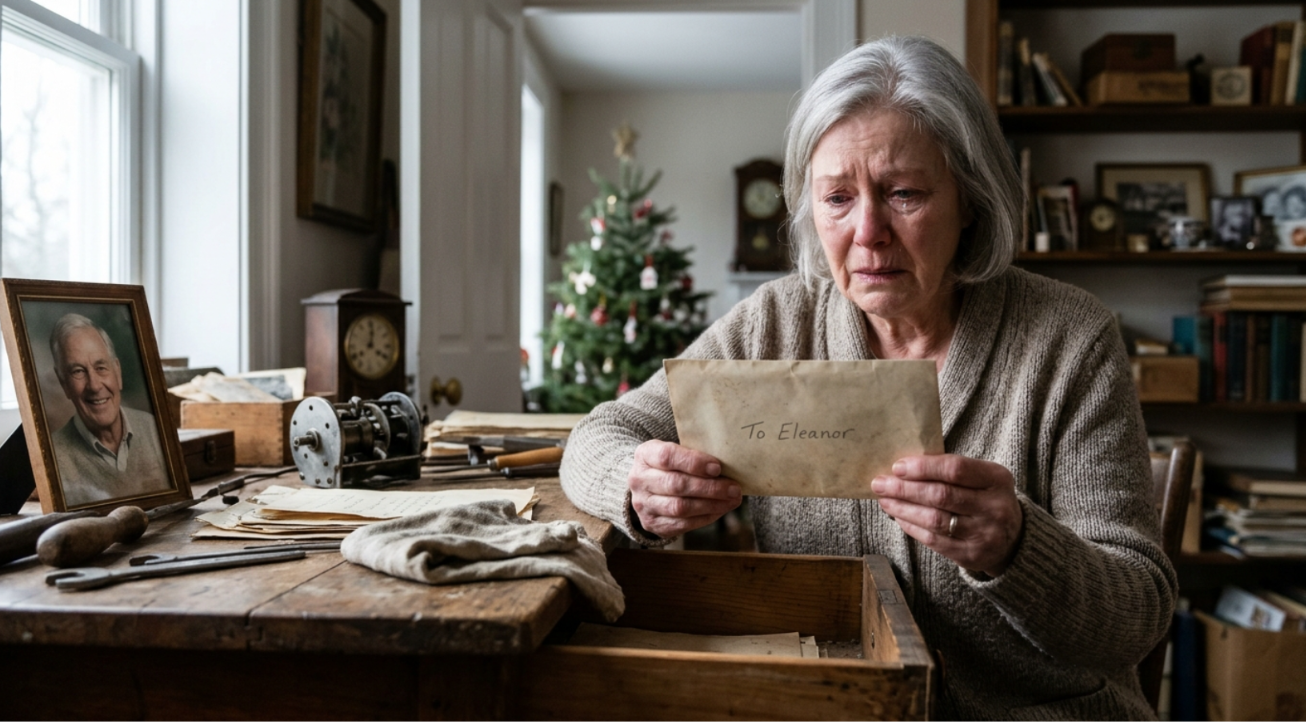
I opened the bottom drawer and looked at the small space where I had found his first letter.
I could almost imagine him sitting in his leather chair, wearing his reading glasses, writing those instructions with his mechanical pencil.
I took out the original letter again.
Don’t let the rest of your life become a waiting room for people who don’t appreciate having you in theirs.
I read those words slowly.
Then I looked toward the window.
The bird feeder was visible beneath the moonlight.
A small bird landed on its wooden roof, looked around, and began eating.
I smiled.
“Martin, I finally understand.”
I had spent so many years believing that being a good mother meant always forgiving, always helping, and always making room for people who disappointed me.
But Martin had wanted something different for me.
He wanted me to understand that I could love my son without allowing him to hurt me.
I could forgive someone without handing them control of my life.
I could miss my husband without allowing grief to become the only thing I had left.
And I could grow older without becoming invisible.
I turned off the study light and walked toward the kitchen.
The house was still quiet.
But it no longer felt empty.
Because I had finally stopped waiting for someone else to make me feel valued.
I had started valuing myself.
And that, I realized, was the greatest gift Martin had ever left me.