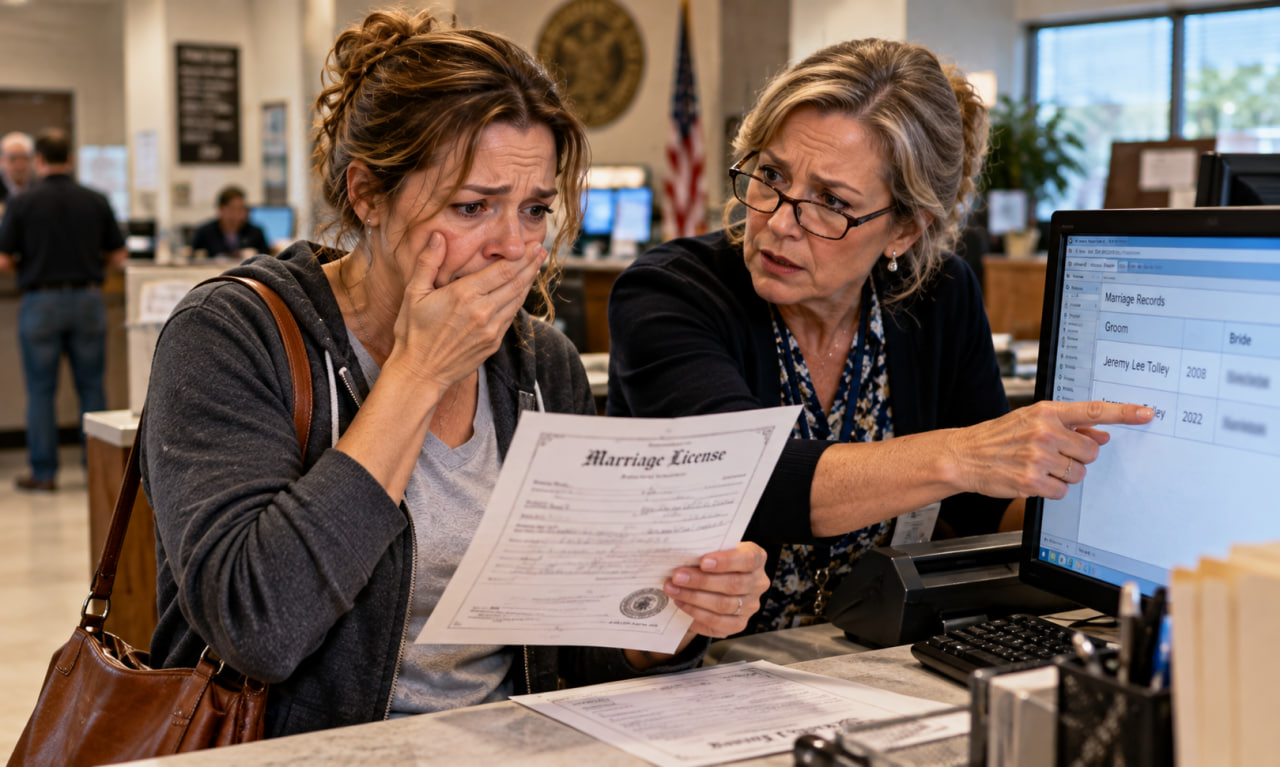
We talked about the marriage.
About trust.
About secrets.
About how sometimes a person can do something for a good reason and still cause terrible damage.
There were days I hated him.
There were days I missed him even while sitting across from him.
There were nights I slept in the guest room.
There were mornings when he left coffee outside the door.
No notes.
No “Jill-girl.”
Just coffee.
He understood that some things had to be earned again.
Slowly.
One day, six months after Lacey’s death, I opened the mailbox.
There was a letter.
My name was handwritten on the envelope.
I recognized the handwriting immediately.
Lacey.
My hands shook as I opened it.
Inside was one page.
She had written it before she died.
It said:
Jill,
If you’re reading this, I’m gone.
I know you’re probably angry with Jeremy. You have every right to be.
But please don’t let my death become another secret between you.
I don’t want you to stay with him because you feel sorry for him.
And I don’t want you to leave him because you think you owe me something.
Choose for yourself.
I stopped reading.
I wiped my eyes.
Then continued.
You once thought you stole my future.
You didn’t.
I made choices too. Jeremy made choices too. We all lived with them.
The only thing I want from you is this: don’t spend the rest of your life trying to repay a debt that no longer exists.
If you love him, rebuild.
If you don’t, walk away.
But whatever you do, do it because it’s your life.
Not mine.
At the bottom was one final line.
And please stop hiding behind the bread aisle when you see someone you owe an apology to.
I laughed through my tears.
Then I cried harder.
Because she knew me.
She had known me better than I realized.
A year after Lacey died, Jeremy and I drove to Nashville.
We went to her favorite park.
We sat beneath a tree.
He brought two coffees.
He handed one to me.
“Jill-girl.”
I looked at him.
He smiled carefully.
“Can I still call you that?”
I smiled for the first time in a long time.
“Only if you mean it.”
“I do.”
We sat quietly.
Then he took something from his pocket.
A small box.
My heart stopped.
“What is that?”
“Open it.”
Inside was my original wedding ring.
The one I had stopped wearing for months.
I stared at it.
“I thought you lost this.”
“I kept it.”
“Why?”
“Because I hoped someday you’d decide whether you wanted it back.”
I looked at him.
“I don’t want the old marriage.”
His face fell.
I reached into my purse.
Then I pulled out a small envelope.
I handed it to him.
“What is this?”
“Something new.”
He opened it.
Inside was a copy of a new marriage agreement we’d prepared with our attorney.
Not a romantic document.
A practical one.
Complete financial transparency.
Separate accounts.
Joint decisions.
No secrets.
No hidden debts.
No hidden properties.
No hidden marriages.
At the bottom, I had written one sentence.
If we stay, we stay honestly.
Jeremy read it.
Then looked at me.
“Is this your way of saying yes?”
I shook my head.
“No.”
He looked confused.
“Then what is it?”
“It’s my way of saying we get to decide again.”
He smiled.
And for the first time in twenty-two years, I understood the difference.
The first time, I had fought for Jeremy because I wanted to win.
The second time, I stayed because I wanted to choose.
I still have Lacey’s letter.
I keep it in the same drawer where I keep our original marriage license.
Sometimes I take it out.
Sometimes I read it.
And every time, I remember the day I walked into the county clerk’s office thinking I was going there to prove I was Jeremy’s wife.
Instead, I discovered I wasn’t the only woman who had ever loved him.
I discovered a secret marriage.
A dying woman.
A lost child.
Twenty-two years of guilt.
And a husband who had made a terrible choice while trying to do something he believed was compassionate.
None of that made his lie acceptable.
None of it erased what he had done.
But it taught me something I wish I’d understood when I was twenty.
Life isn’t a courtroom where every mistake has to be repaid with an equal punishment.
Sometimes people hurt each other.
Sometimes they forgive.
Sometimes they don’t.
And sometimes the only honest thing you can do is stop rewriting the past and decide what you want to do with the years you have left.
Jeremy and I are still married.
We’re not the same couple we were before the courthouse.
Maybe that’s a good thing.
We talk more.
We ask harder questions.
We don’t hide uncomfortable things anymore.
And every Tuesday, he comes home early.
Not because I demand it.
Because he wants to.
Sometimes we make pork chops.
Sometimes we eat takeout.
Sometimes we sit at the kitchen table without saying anything.
And every now and then, when he catches me looking at him, he reaches across the table and takes my hand.
“Jill-girl,” he says.
And I know what he means now.
Not you’re mine.
Not I got away with it.
Not forget what happened.
He means:
I’m here.
And after everything we’ve survived, sometimes that is enough.
As for Lacey’s money, I didn’t keep it all.
I used part of it to pay off our mortgage.
The rest went into a medical fund at the hospital where she spent her final years.
It’s called the Lacey Burcham Patient Support Fund.
It helps patients who are fighting cancer and don’t have enough money for transportation, lodging, medication, or meals.
The first time I signed the paperwork, the administrator asked me why I wanted to do it.
I told her the truth.
“Because someone once made sure a woman I never understood didn’t have to die alone.”
Then I looked at the name on the form.
Lacey Marie Burcham.
Not Tolley.
Not my rival.
Not the other wife.
Just Lacey.
A woman who had been part of my story long before I understood it.
And perhaps that was the final thing she gave me.
Not money.
Not a marriage.
Not an apology.
Perspective.
Because when I walked into that courthouse, I thought I was going there to find out whether my husband had betrayed me.
Instead, I found out something much harder.
People can love each other and still hurt each other.
People can make terrible choices for reasons that aren’t entirely selfish.
And forgiveness doesn’t mean pretending the wound never happened.
It means deciding the wound doesn’t get to own the rest of your life.
I once believed the Lord had finally sent me the bill for stealing another woman’s man.
But standing at Lacey’s grave one year later, I finally understood.
It wasn’t a bill.
It was a lesson.
And the lesson wasn’t about punishment.
It was about what we do after the truth finally finds us.
I placed a small bouquet beside her headstone.
Then I whispered the words I’d been too afraid to say twenty-two years earlier.
“I’m sorry, Lacey.”
The wind moved softly through the trees.
I stood there for another minute.
Then I turned toward Jeremy.
He was waiting beside the car.
I walked toward him.
He opened the passenger door.
I got in.
He closed it gently.
And as we drove home, I looked out the window at the Tennessee hills and realized something I never expected to feel again.
Peace.
Not because the past had changed.
It hadn’t.
Not because the hurt had disappeared.
It hadn’t.
But because the truth was finally where it belonged.
Out in the open.
And for the first time in my life, I wasn’t running from it.