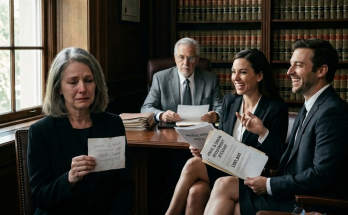
“We need to talk.”
“We have talked.”
“No. I mean really talk.”
I looked at him.
“You had four years.”
He recoiled slightly.
“That’s cruel.”
“No.”
I shook my head.
“It’s true.”
He rubbed the back of his neck.
“What are we supposed to do?”
Jessica looked at me too.
For one brief, strange second, they both looked like frightened children.
I loved them.
That was the hard part.
Leaving people you hate is easy.
Leaving people you still love because staying with them is destroying you is much harder.
“You’ll find another rental,” I said.
“In thirty days?”
“Yes.”
“That isn’t much time.”
I met his eyes.
“You still get to choose where you go.”
He froze.
Jessica turned away.
Colin’s mouth opened.
Then closed.
He understood the comparison.
I could see it.
I walked toward the door.
His voice followed me.
“Are you cutting us out of your life?”
I stopped with my hand on the doorknob.
“No.”
He looked surprised.
“I’m leaving this house, Colin.”
I turned toward him.
“I’m not resigning from being your mother.”
His eyes filled.
“Then stay.”
I swallowed.
“Don’t.”
“Please.”
“Colin.”
“We can fix this.”
Tears spilled onto his cheeks.
That nearly broke me.
He had cried like that only a few times in his life.
When he was nine and Arthur’s dog died.
When he was seventeen and didn’t get into the college he wanted.
When his father died.
And now.
Because I was leaving.
I wanted to cross the room.
I wanted to hug him.
I wanted to say never mind.
I wanted, for one dangerous second, to return to the old pattern.
Comfort him.
Fix it.
Make it easier.
That had been my role.
Always.
Then I remembered the Oakridge brochure.
The smiling silver-haired couple walking along a landscaped path.
The staged dining room.
The schedule for “family visiting hours.”
The room number written in Jessica’s pen.
214B.
They had chosen 214B.
Without me.
So I stayed where I was.
“I spent four years hoping somebody in this house would ask me what I wanted.”
My voice shook.
“I should not have needed eleven million dollars before my wishes mattered.”
Colin covered his face.
Jessica stared at the floor.
I opened the door.
Then Jessica spoke.
“What about the money?”
Colin dropped his hands.
“Jessica.”
Her face flushed.
“What? I’m just asking.”
“Now?”
“It matters.”
I almost smiled.
There she was.
At least she was consistent.
“What about it?” I asked.
She hesitated.
“What happens to the kids?”
“Lucas and Sophie already have education trusts.”
Both of them looked at me.
“What?”
“They’ve been fully funded.”
Colin blinked.
“How much?”
“Enough.”
Jessica looked stunned.
“You did that before all of this?”
“Yes.”
“Even after—”
“They are my grandchildren.”
I tightened my hand around the suitcase handle.
“Their future is not a weapon.”
Something in Jessica’s face crumpled.
I could tell she had expected punishment.
Maybe she would have punished me that way.
Maybe that realization hurt her.
Colin stepped closer.
“Mom.”
I looked at him.
He suddenly looked five years old.
Messy dark hair.
Freckles.
Grass-stained knees.
Running toward me because he had fallen off his bicycle.
I put the suitcase down.
For one moment.
Just one.
I crossed the distance between us and kissed his cheek.
“I love you.”
He started crying harder.
“Then stay.”
I placed my palm against his face.
“I love you enough not to let resentment finish what your father’s death started.”
He stared at me.
“If I stay now, I will hate you.”
His eyes widened.
“And eventually you’ll hate me too.”
He shook his head.
“No.”
“Yes.”
I picked up the suitcase again.
“I want to leave while there is still something between us worth saving.”
Then I walked outside.
The rain had stopped.
Everything smelled clean.
Wet grass.
Pavement.
Early spring air.
The taxi driver stepped out and opened the trunk.
I didn’t look back until my suitcase was loaded.
Colin stood in the doorway.
Jessica stood behind him.
He raised one hand.
I raised mine.
Then I got into the taxi.
As we pulled away, I watched the house disappear through the rear window.
Strangely, I did not feel triumphant.
People imagine freedom feels like fireworks.
Sometimes it doesn’t.
Sometimes freedom feels like grief.
Sometimes it feels like sitting in the backseat of a taxi at seventy-three years old with tears running silently down your cheeks because choosing yourself means disappointing people you once built your entire life around.
I cried all the way to the airport.
Not because I regretted leaving.
Because I wished it had never become necessary.
At the gate, I sat alone with a cup of terrible coffee and watched families hurry past.
Children dragged rolling suitcases.
Couples argued over boarding passes.
A young mother bounced a baby against her shoulder.
I thought about Colin at that age.
I thought about every version of him.
The baby who slept only if I hummed.
The boy who used to crawl into my bed during thunderstorms.
The teenager who pretended he didn’t need me.
The young father who placed Lucas in my arms and whispered, “Mom, I have no idea what I’m doing.”
Neither did I, I had told him.
You figure it out with love.
For a long time, I believed love meant sacrifice without limit.
Arthur disagreed.
Toward the end of his life, he had once told me, “Maggie, you keep giving pieces of yourself away and acting surprised when you feel empty.”
I had laughed at him.
“I’m a mother.”
“You’re also Margaret.”
At the time, I thought he was being sentimental.
Six years later, sitting alone at an airport with eleven million dollars and one small suitcase, I finally understood what he meant.
I was also Margaret.
The flight south took less than two hours.
Helen met me at the airport wearing oversized sunglasses and waving both arms like she was directing traffic.
“There she is!”
I laughed despite myself.
She hugged me so hard my ribs complained.
“You actually did it.”
“I actually did.”
“You left?”
“I left.”
“You told them?”
“Oh, I told them.”
Her eyes widened.
“And?”
“Colin cried.”
Helen’s expression softened.
“Did you?”
“All the way to the airport.”
She hugged me again.
“No shame in that.”
“I know.”
“Doesn’t mean you were wrong.”
“I know.”
“Doesn’t mean you should go back.”
“I know.”
She pulled back and stared at me.
“Do you actually know?”
I laughed.
“Yes.”
“Good.”
She grabbed the handle of my suitcase.
“Then welcome home, Margaret.”
Home.
The word startled me.
It shouldn’t have.
But it did.
When we reached the cottage, late afternoon sunlight spilled over the porch.
The yellow siding glowed.
Wild roses climbed along the white fence.
The rocking chair I had ordered online waited under the front window.
Helen had placed a ceramic pot of red geraniums beside the door.
“You did that.”
“I may have.”
“Helen.”
“A house needs flowers.”
“There are literally flowers everywhere.”
“Those are yard flowers. These are porch flowers.”
I laughed.