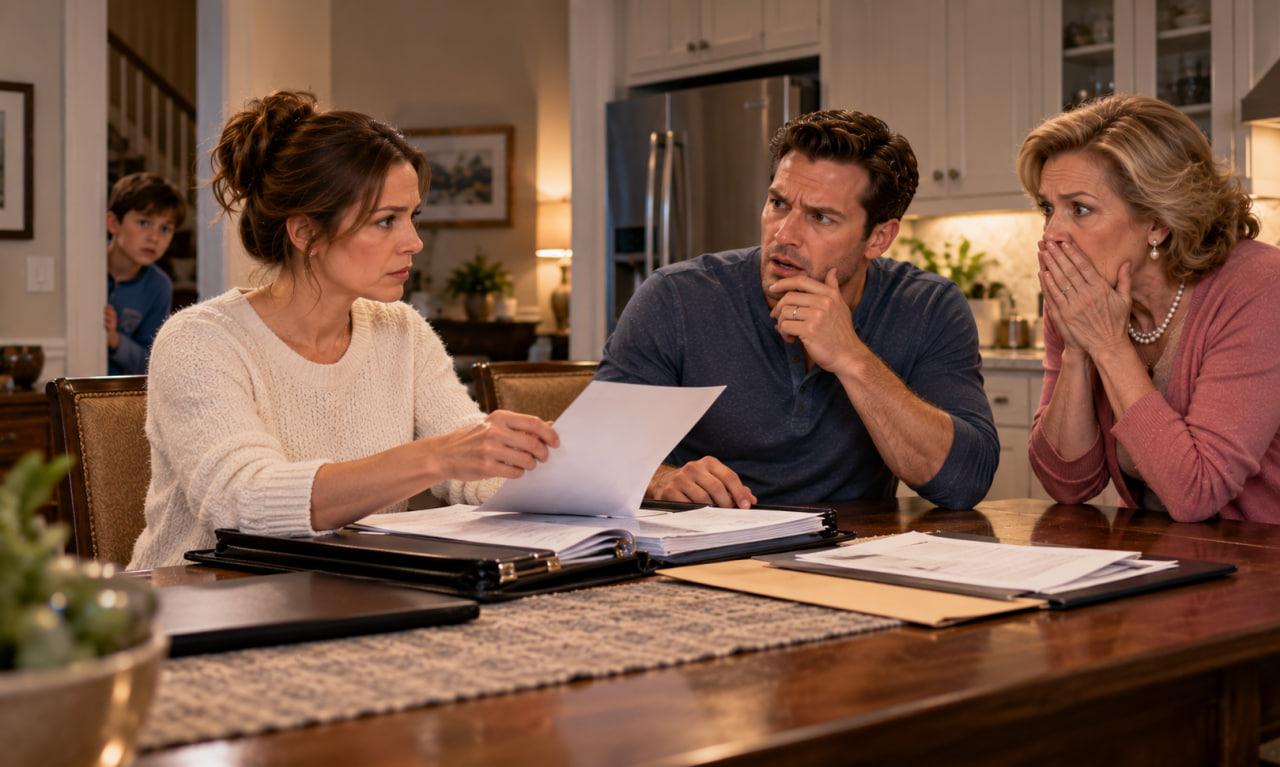
“What?”
“She asked whether I wanted you dead.”
My heart tightened.
“What did you say?”
“I said no.”
“Good.”
“I told her I’d rather die myself than hurt you.”
I looked down.
For a moment, I remembered the man I had married.
Then I remembered the folder.
The debt.
The lies.
Ethan’s frightened face.
“I don’t know if I can forgive you,” I said.
“You don’t have to.”
That surprised me.
“I just want you and Ethan safe.”
His voice was quiet.
“I finally understand that being a husband means protecting your family, not using them to protect your mother.”
I closed my eyes.
That was the first mature thing Mark had said in years.
But it didn’t erase anything.
The investigation lasted six weeks.
During those six weeks, Mark moved into a small apartment.
Barbara was ordered to stay away from me.
My bank accounts were secured.
Every credit report was frozen.
The fraudulent accounts were flagged.
The insurance policy was canceled.
And then Detective Alvarez found the missing piece.
It came from a bank in Indiana.
Barbara had been receiving money from an account connected to Richard Collins.
Mark’s father.
The man Barbara had claimed was dead to the family.
Except he wasn’t.
He was alive.
And he had been sending Barbara money for years.
I stared at Detective Alvarez.
“Why?”
“Because he knew what she’d done.”
“Why didn’t he come forward?”
“He tried.”
She handed me a file.
Inside was a letter.
Written twenty-one years earlier.
Richard had written:
Mark,
Your mother will tell you I abandoned you. I didn’t. I fought for custody. I fought to stay in your life. I was told that if I challenged her publicly, she’d make sure you hated me forever.
I chose silence because I was afraid of losing you completely.
I regret that choice every day.
I couldn’t stop tears from filling my eyes.
Not because of Barbara.
Because of Mark.
A boy who had grown up believing his father didn’t love him.
A man who had spent his entire adult life trying to earn his mother’s approval.
A man who had confused obedience with love.
I understood him.
But understanding didn’t mean excusing him.
Two months later, Barbara was arrested.
The charges included identity theft, fraud, forgery, financial exploitation, and insurance fraud.
The apartment she supposedly needed so desperately?
Seized.
The property she claimed she couldn’t afford?
Sold.
The accounts she had hidden?
Frozen.
The money she had taken?
Being recovered.
For the first time in thirty years, Barbara had no one to rescue her.
And Mark didn’t.
That was the most important decision he ever made.
When she called him from jail, he refused to answer.
When she sent letters, he returned them unopened.
When relatives told him he was abandoning his mother, he gave them one sentence.
“She abandoned me first.”
As for me?
I didn’t move back into the house with Mark.
Not immediately.
I filed for divorce.
But something unexpected happened during the process.
Mark stopped fighting me.
He didn’t fight over the house.
He didn’t fight over the savings.
He didn’t fight over the car.
He didn’t demand alimony.
He didn’t even ask for half the furniture.
Instead, he signed everything necessary for Ethan and me to remain in the home.
At first, I didn’t understand.
Then he explained.
“I spent my whole life taking.”
He looked at me.
“I want to spend the rest of it learning how to give.”
I appreciated the words.
But I still needed time.
So we divorced.
Quietly.
Without screaming.
Without revenge.
Without destroying each other.
The judge finalized everything nine months after that night.
As I walked out of the courthouse, Mark stood beside me.
We were no longer husband and wife.
But we were still Ethan’s parents.
And perhaps, one day, we could become something healthier than what we had been.
Friends.
Maybe.
Nothing more.
A year passed.
I worked fewer overtime shifts.
I started eating dinner at the table with Ethan again.
I stopped checking my bank account every hour.
I stopped apologizing whenever I spent money on myself.
And I learned something I wish I had understood much earlier.
Being generous doesn’t mean allowing people to use you.
Being kind doesn’t mean tolerating disrespect.
And being someone’s wife doesn’t mean becoming their financial safety net.
One Saturday morning, Ethan and I were planting tomatoes in the backyard when someone knocked on the gate.
It was Mark.
He stood there holding a small paper bag.
Ethan ran toward him.
“Dad!”
Mark smiled.
“Hey, buddy.”
They hugged.
I watched them.
Mark looked different.
He had lost weight.
He looked healthier.
More awake.
More present.
He handed Ethan the bag.
“Your favorite.”
Ethan pulled out a chocolate-covered donut.
“Mom says sugar isn’t breakfast.”
Mark smiled.
“That’s why I brought two.”
I laughed despite myself.
Ethan ran inside.
Mark stayed by the gate.
“Can I talk to you?”
I nodded.
He looked nervous.
“I got a promotion.”
“Congratulations.”
“Thanks.”
He looked toward the house.
“I’ve been putting money aside.”
“For what?”
“For Ethan.”
I smiled.
“That’s good.”
“I also started therapy.”
I raised an eyebrow.
“Really?”
“Really.”
He laughed.
“I figured I had thirty-eight years of bad habits to unpack.”
“That might take a while.”
“It will.”
He paused.
“Sarah?”
“Yeah?”
“I know I’ll never get those years back.”
I looked at him.
“But I want to make sure Ethan doesn’t lose his.”
That sentence stayed with me.
Because that was the one thing I cared about most.
Our son.
“I appreciate that,” I said.
Mark nodded.
Then he turned to leave.
“Wait.”
He looked back.
“You can come inside for breakfast.”
His eyes widened.
“Really?”
“Don’t make it weird.”
He smiled.
“I won’t.”
And for the first time in a very long time, Mark walked through the front door without bringing chaos with him.
He brought breakfast.
He brought peace.
And most importantly, he brought accountability.
Years later, Ethan graduated high school.
He was eighteen.
Tall.
Kind.
Confident.
And nothing like the frightened little boy who had stood in our hallway clutching a stuffed T-Rex.
After the ceremony, he hugged me.
“Mom?”
“Yes?”
“Thank you.”
“For what?”