
My Parents Abandoned Me at a Greyhound Station When I Was 8—22 Years Later, They Sued Me for the $3.8 Million Inheritance Left by the Stranger Who Raised Me…
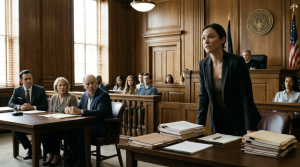
PART 3
My father’s face changed. Not dramatically. Not enough for someone unfamiliar with him to notice.
But I noticed. His jaw tightened, and his right hand moved toward his tie. I had seen that gesture before.
I had seen it when I was a little boy and accidentally broke a glass. I had seen it when I asked why we couldn’t visit Grandma. I had seen it when I asked whether he loved me.
It was the gesture he made whenever he knew something was about to go wrong.
Judge Wynn began reading. “‘Evelyn believes the arrangement is the only way to get our finances under control. The boy will be difficult to explain, but once he is gone, we can finally start over without another mouth to feed.’”
My mother immediately shook her head. “That’s not what it means!”
The judge raised one hand. “Mrs. Marsh, you will have an opportunity to respond. Please allow me to finish.”
I looked at my mother.
For a brief moment, I saw the woman who used to tuck me into bed.
The woman who once kissed my forehead when I had a fever.
The woman whose face I had searched for through the glass doors of a Greyhound station for four endless hours.
Then I remembered the granola bar.
It was still the smallest detail I remembered from that afternoon.
Not the station.
Not the buses.
Not even the cold.
The granola bar.
My mother had given me something to eat before leaving me to die in a place where nobody knew my name.
Judge Wynn continued.
“‘The insurance company has confirmed that the policy will remain active if the child is reported missing. We should avoid any direct contact after the disappearance. Arthur will handle the police statement.’”
The courtroom became completely silent.
Wyatt stopped leaning back.
He sat forward and looked at his parents.
“Mom?” he whispered.
My mother didn’t look at him.
My father finally stood.
“Your Honor, that letter is being taken out of context. It was a private conversation between husband and wife. It has nothing to do with the inheritance.”
Judge Wynn looked over her glasses.
“Mr. Marsh, sit down.”
He sat.
I took a breath.
“Your Honor, I have another document.”
I handed the second binder to the bailiff.
Inside were copies of the insurance application, payment records, correspondence with the insurance company, and the original police report filed the night I disappeared.
The insurance policy was for $62,000.
That might not sound like much compared to the $3.8 million estate they were now fighting over.
But in 1994, it was enough to change a struggling family’s financial situation.
The policy had been taken out eighteen months before my abandonment.
My father had listed himself as the primary beneficiary.
My mother was the secondary beneficiary.
And the most disturbing part was the section describing what would happen if I disappeared.
There was a waiting period.
A process.
A specific set of conditions.
My parents had known exactly what they needed to do.
They had not made a desperate decision on a cold afternoon.
They had prepared for it.
I turned toward the judge.
“The insurance company paid the claim two years after I disappeared. My parents received $62,000. They never contacted the authorities to correct their original statement. They never reported that they knew where I was. They never attempted to locate me.”
My mother began crying.
Not quietly.
She pulled a tissue from her handbag and pressed it against her face.
“Matthew, please.”
I didn’t respond.
“Matthew, honey, we were young. We were struggling. We made mistakes.”
I looked at her.
“You were forty-one years old, Mother.”
She stopped crying for a second.
“You had a house. Two cars. A bank account. You had another child. You had eighteen months to cancel that insurance policy. You had four hours at that bus station to change your mind.”
My voice began to shake.
“But you didn’t.”
My mother lowered her tissue.
“I never stopped loving you.”
For the first time that morning, I almost laughed.
Not because it was funny.
Because there was something so cruel about hearing those words from someone who had never once tried to find out whether I was alive.
“Then why didn’t you come back?”
She opened her mouth.
Nothing came out.
I turned away.
I wasn’t finished.
The third binder contained the investigation into the events that happened after I was abandoned.
And this was where the case became much more complicated.
My private investigator, a woman named Denise Carter, had spent eleven weeks locating records that should have been easy to find but had somehow remained scattered across different agencies.
She had found an old insurance investigator’s report.
A bank statement.
Several letters.
And something that surprised even me.
A second person had been involved in the plan.
My mother had a sister named Lorraine.
I remembered Aunt Lorraine.
She had visited our house a few times when I was little. She wore oversized glasses, smelled like lavender, and always brought cinnamon cookies.
I hadn’t thought about her in decades.
According to the documents, Lorraine had been contacted by my parents shortly before my disappearance.
They had told her I was being sent away to live with relatives.
They had asked her not to interfere.
But Lorraine hadn’t believed them.
She had called the local police station two days after I disappeared and asked whether a missing-child report had been filed.
The answer was yes.
She then contacted my parents.
The conversation was documented in a letter she had kept for years.
She had written:
Arthur, I know what you did. I know you left that little boy at the station. I know you told everyone he ran away. I don’t care what excuse you have. That child deserves better than this.
And my father’s response was even worse.
He wrote:
Stay out of our affairs. If you contact the police again, we will make sure you never see Wyatt.
I looked toward my younger brother.
Wyatt was staring at the paper.
His face had lost all color.
He slowly turned toward my mother.
“Is this real?”
My mother shook her head.
“Wyatt, don’t listen to him. He’s trying to make us look terrible.”
But Wyatt wasn’t looking at me anymore.
He was looking at the woman who had raised him.
“Did you really leave him?”
She didn’t answer.
“Mom, did you?”
My father leaned toward him.
“Son, this is a legal matter. Don’t get involved.”
Wyatt pulled his arm away.
“Stop telling me what to do!”
The outburst surprised everyone.
Even the judge looked up.
Wyatt stood and walked toward the aisle.
“Your Honor, may I say something?”
The judge studied him.
“Are you a witness in this matter?”