Some of my father’s letters were angry. Others were coldly practical.
One sentence stayed with me.
If you insist on leaving everything to Emily, don’t expect me to pretend this arrangement is fair.
I stared at the words.
Grandpa had been right.
My parents had returned because they believed there was something to gain.
And now that they had discovered the house wasn’t theirs, I suspected they would not simply disappear.
I was right.
Two days later, Dad called.
I almost let the call go to voicemail.
But I answered.
“What do you want?”
His voice sounded different from the day before.
Less angry.
More careful.
“Emily, we need to talk.”
“About what?”
“About the family.”
I almost laughed.
“What family?”
There was a long silence.
Then he sighed.
“Your mother is very upset. Brianna is upset, too. This whole situation has become unnecessarily hostile.”
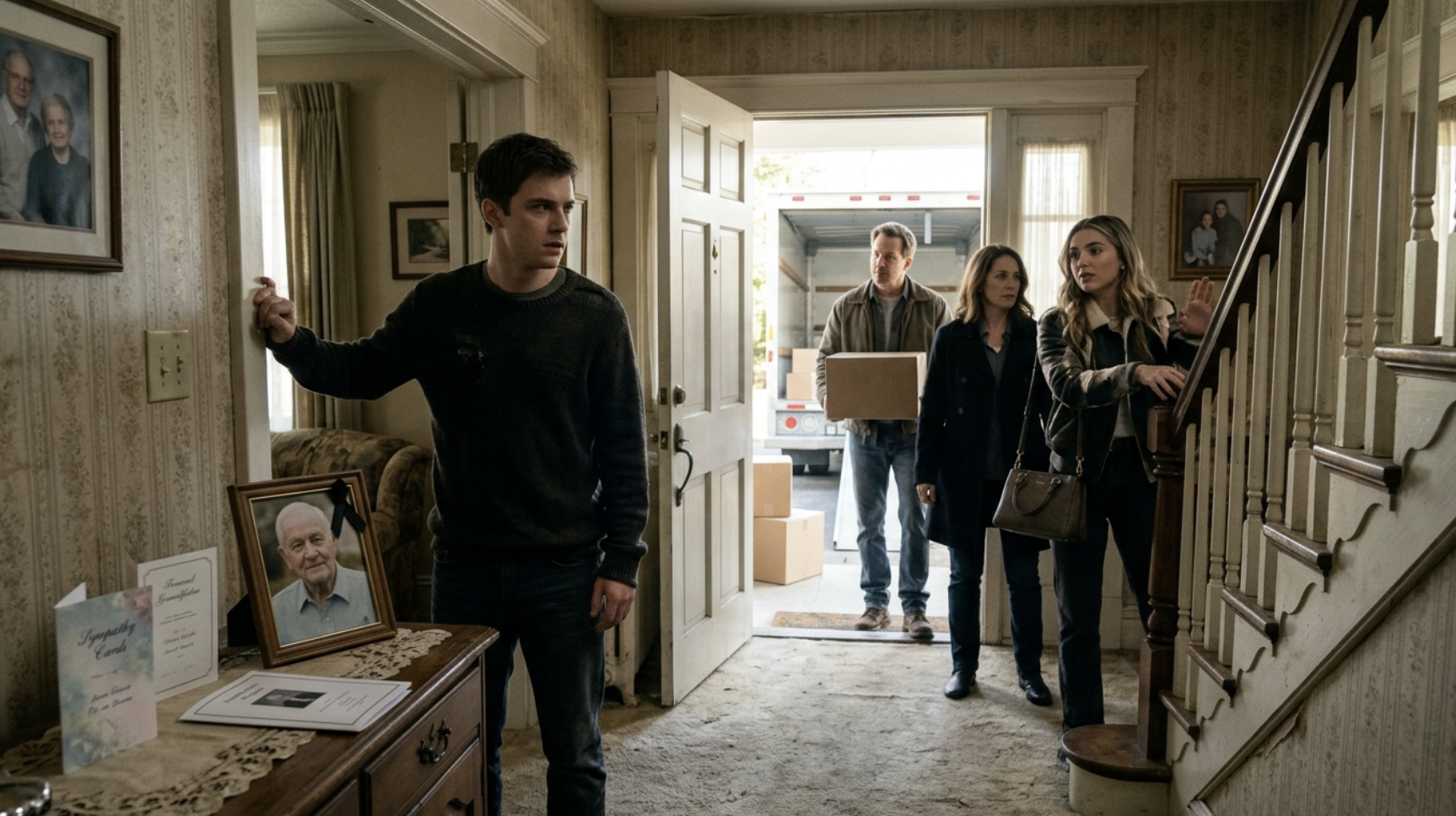
“You brought a moving truck to Grandpa’s house the morning after his funeral.”
“We thought the property would eventually come to us.”
“You never even asked whether I was okay.”
“Emily, we made mistakes.”
“You said that already.”
Another silence followed.
Finally, he said, “We want to come over and talk things through.”
I looked out the kitchen window.
Grandpa’s garden was beginning to lose its autumn color. The tomato plants had withered, and a few dry leaves rested on the stone path he had built himself.
I remembered how he used to kneel beside those plants, showing me how to prepare the soil for the following season.
“You can come,” I said. “But we’re not discussing the house as if it belongs to you.”
Dad agreed quickly.
Too quickly.
That evening, my parents arrived without the moving truck.
Mom carried a box of pastries from a bakery. Dad brought a bottle of wine he knew I would never drink.
They sat at the kitchen table where Grandpa had taught me to do my homework.
For several minutes, nobody spoke.
Then Mom reached across the table.
“Emily, sweetheart, we know things have been difficult.”
I pulled my hand back.
She paused.
“We should have visited more often.”
“More often?” I repeated.
Her expression tightened.
“I know we made mistakes.”
“You didn’t visit me once.”
“We were dealing with our own problems.”
“I was five years old.”
Mom looked away.
“I know.”
“No, I don’t think you do.”
My voice was quiet, but I could feel years of buried hurt rising to the surface.
“I used to think you were coming back every weekend. Grandpa told me you needed more time. When Christmas came, I thought you would surprise me. When I turned ten, I thought maybe you had forgotten my birthday. When I turned sixteen, I stopped expecting you to come.”
Mom’s eyes filled with tears.
“I was young,” she whispered.
“So was I.”
She covered her mouth.
For a moment, I saw something that might have been genuine shame.
Then Dad interrupted.
“We can’t change the past. We need to focus on the future.”
I looked at him.
“What does that mean?”
He cleared his throat.
“Your grandfather left you a substantial estate. You’re young, and managing property and investments can be complicated. We thought it might be sensible for us to help you.”
There it was.
The real reason for the visit.
I felt the last of my uncertainty disappear.
“You want control of the inheritance.”
“That’s not what I’m saying,” he replied quickly. “We’re your parents. We have experience with these things.”
“You left me with Grandpa and disappeared for seventeen years. What experience do you have managing my life?”
Dad’s face hardened.
“You’re being disrespectful.”
“No. I’m finally being honest.”
Mom started crying.
“Emily, please. We are still your family.”
I looked at her for a long time.
“Then why did you come back with a moving truck instead of a hug?”
She had no answer.
Dad stood abruptly.
“If this is how you’re going to behave, there’s no point in talking.”
He headed toward the door.
Mom followed him, wiping her eyes.
At the threshold, she turned back.
“You’ll understand when you’re older,” she said.
I watched her leave.
For years, I had imagined that hearing those words from my mother would hurt less if she said them gently.
It didn’t.
After the door closed, I sat alone at the kitchen table.
Then I noticed something on the floor.
Mom had left the bakery box behind.
I opened it.
Inside were six pastries, carefully arranged in a row.
Beneath them was a small envelope.
My name was written on it.
I opened the envelope and found a photograph of Brianna and me as toddlers. We were sitting together on a blanket in a garden, and Brianna was holding my hand.
On the back, Mom had written:
I know I don’t deserve forgiveness. But I hope one day you’ll let me explain why I left.
I stared at the photograph.
For the first time, I wondered whether there was something about that day seventeen years ago that I still didn’t know.
But I also understood something important.
An explanation might help me understand the past.
It would not automatically excuse it.
I placed the photograph in a drawer beside Grandpa’s letter.
Then I went upstairs to the room where I had grown up.
And I began to make plans for my future.