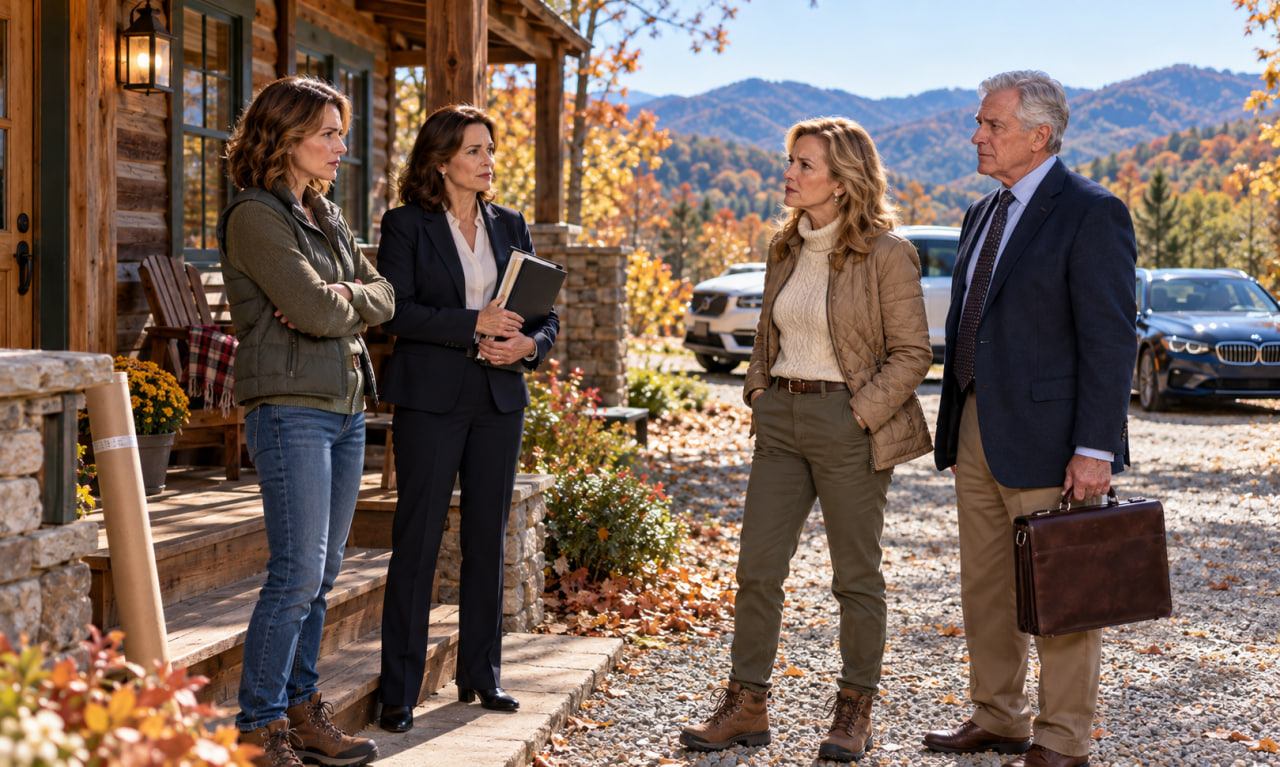
We sat on the porch overlooking the ridge while he opened his satchel.
Inside were carefully protected copies of census records, church registries, and faded photographs.
He pointed to one black-and-white image of a rough farmhouse.
“This was Elias Whitmore’s land.”
I looked closely.
The mountains behind it were different.
Different valley.
Different creek.
Different county.
Nearly thirty miles away.
“So Grandpa’s story was real?”
Samuel nodded.
“Yes. Your great-great-grandfather lost that farm during the Depression after unpaid taxes. It was heartbreaking… but it was never this property.”
A strange feeling settled over me—not triumph, not sadness.
Relief.
Our family legend had been true.
Our conclusion had simply been wrong.
Samuel smiled kindly.
“Stories survive generations. Addresses usually don’t.”
Before leaving, he handed me a small envelope.
“These belong with your branch of the family.”
Inside was a restored photograph of my grandfather as a little boy standing beside his parents in front of the original Whitmore farmhouse.
On the back, someone had written in careful cursive:
Home is the people who stay, not the land we lose.
I had to blink away tears.
Dara’s letter
In August, almost a year after the confrontation, another envelope arrived in my mailbox.
This one was addressed in handwriting I recognized immediately.
Dara.
There was only one page.
Evelyn,
I almost called instead of writing, but I realized I’ve interrupted you enough for one lifetime.
I keep thinking about that reunion list. It wasn’t the biggest mistake I made, but it was the first one I can’t blame on anyone else. Leaving your name off that message was the moment I decided I had the right to choose who belonged.
I’m sorry.
Richard once told me something after he dropped my case: “The law can settle ownership. It cannot repair relationships.” I hated hearing it then. I understand it now.
Thank you for letting me come back.
Love, Dara
I folded the letter carefully and placed it inside the same cedar box where I kept the photograph Samuel had given me.
Some things deserved preserving—not because they erased the past, but because they proved people could grow beyond it.
Five years later
Five summers passed faster than I expected.
The cabin changed with them.
The little saplings I planted along the creek grew tall enough to cast afternoon shade. The porch swing Dad built became everyone’s favorite seat. Alicia’s twins learned to fish in the stream, insisting my cabin had “the smartest trout in North Carolina.”
Mom’s peach pie became the official reunion dessert.
And Dara?
She never organized another reunion.
Instead, every January, someone different volunteered.
Sometimes Alicia.
Sometimes Uncle Ben.
Once even Dad surprised everyone by creating the group chat himself, proudly asking, “Did I attach the map correctly?” despite attaching six unrelated photos of his garden.
Nobody complained.
It became our favorite family joke.
The biggest change wasn’t who planned the reunion.
It was that every invitation began exactly the same way:
To everyone in the family—you belong here.
The final promise
On my sixtieth birthday, I walked alone to the highest point of my forty acres.
The overlook faced layer after layer of blue mountains fading into the horizon.
I carried two things: my grandfather’s photograph and the recorded deed to my cabin.
One represented the home my family had lost.
The other represented the home I had built.
I tucked the photograph back into its envelope and whispered, almost as if Grandpa could hear me.
“We found our way back. Just not to the place we expected.”
The wind moved gently through the trees.
Below me, smoke curled from the cabin chimney where my family was waiting with birthday cake, laughter, and far too much peach pie.
I turned and walked downhill toward them—not toward an inheritance, not toward an argument, but toward the family we had finally learned to choose.
The End.