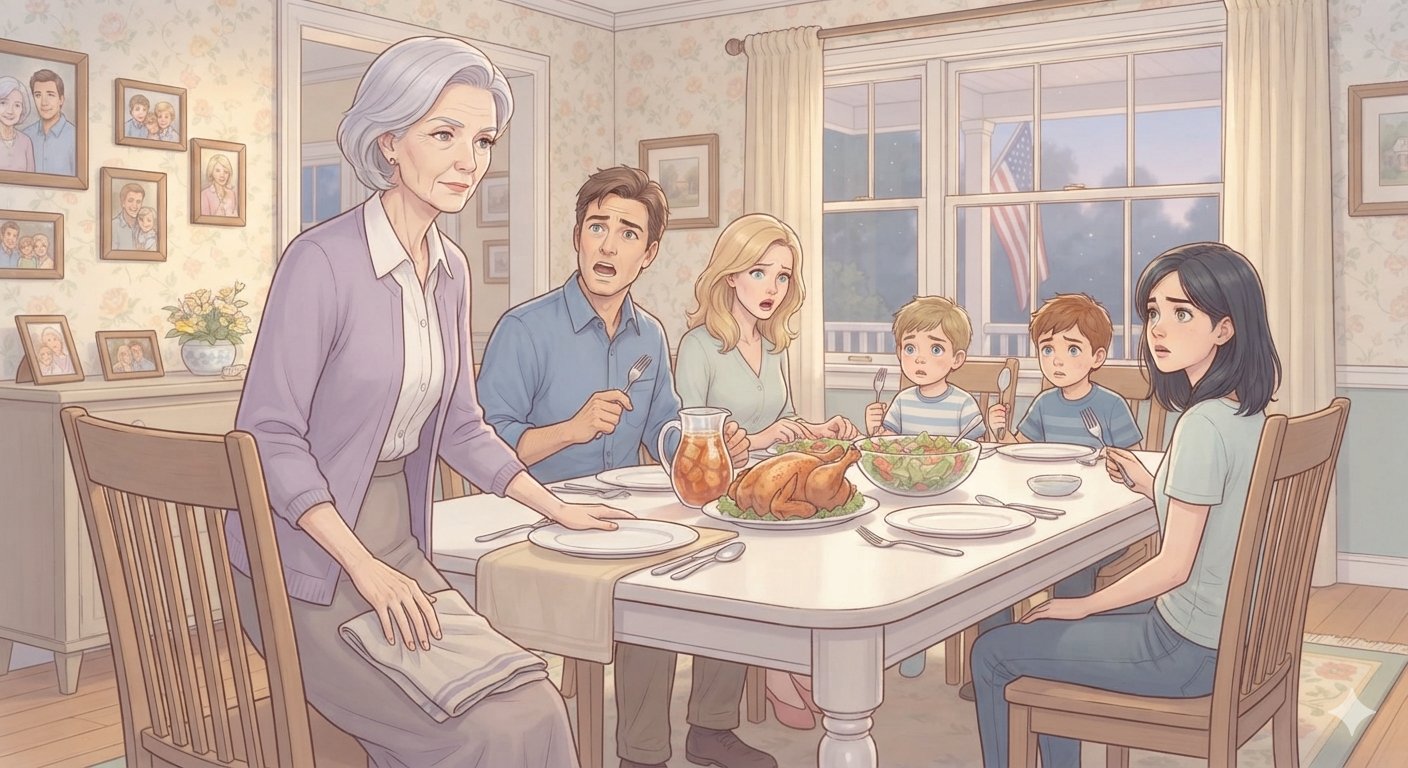
PART 2 – My son told me leave if I refused free babysitting. So I did—and changed everything.

PART 2 — THE ENVELOPE CLARE HID
“Grandma,” Clare whispered, glancing toward the dining room, “before you leave… there’s something you need to see.”
Her voice was so serious that my hand stopped inches from the suitcase handle.
“What is it?”
She looked over her shoulder.
Michael was still in the dining room talking to Jessica in a low, angry voice.
Then Clare stepped inside and quietly shut the door.
“I found something in Dad’s office.”
My stomach tightened.
“Clare, if this is private—”
“It’s about you.”
Those three words changed everything.
She reached beneath her sweatshirt and pulled out a large yellow envelope, folded in half.
Across the front, in Michael’s handwriting, were two words.
MOM — HOUSE.
For several seconds, I simply stared at it.
I recognized the envelope.
I had seen it on Michael’s desk weeks earlier when I went into his office to leave a stack of folded shirts.
At the time, I had assumed it contained papers from the sale of my house.
Michael had helped arrange much of the transaction.
He knew the realtor.
He recommended the attorney.
He even insisted the sale money should temporarily pass through an account he could “help me manage” until I decided what to do next.
I had refused that last part.
Or at least, I thought I had.
“Where did you get this?” I whispered.
“Dad’s desk.”
“Clare.”
“I know. I shouldn’t have gone through his things.”
She swallowed.
“But I heard him and Mom fighting last night.”
My heart began pounding harder.
“About what?”
“Money.”
That did not surprise me.
Michael earned more than my husband ever had, yet somehow there was never enough.
New cars.
Expensive vacations.
Restaurants where a glass of wine cost what I once spent feeding a family for three days.
Michael had always possessed the remarkable ability to make a large salary disappear while complaining that everything was expensive.
Clare continued.
“Mom said something about the mortgage. Dad told her not to worry because they had your money.”
The room suddenly felt smaller.
“My money?”
Clare nodded.
“I thought maybe I heard him wrong. So after they went downstairs, I looked in his desk.”
She held out the envelope.
“Please read it.”
My hands were steady when I took it.
That surprised me.
Maybe there comes a point in life when betrayal stops shocking you.
Maybe eventually you simply become tired of pretending you cannot recognize it.
Inside were copies of bank statements.
Loan documents.
A printout from the closing company that handled the sale of my house.
And beneath them was something that made my knees weaken.
A document bearing my signature.
Except I had never signed it.
I sat down slowly on the edge of the bed.
“What is this?”
Clare pointed to the top.
“It says limited power of attorney.”
I read the words again.
Then again.
The signature at the bottom looked almost exactly like mine.
Almost.
But the curve of the E was wrong.
My husband used to tease me because I always made the first letter of Eleanor too large.
This signature was neat.
Controlled.
Careful.
Fake.
I looked at the date.
Two days before the closing on my house.
On that date, I had been packing dishes in Hudson.
Michael had told me he needed several documents so his lawyer could “check everything.”
I remembered signing one form concerning movers.
Another concerning insurance.
Had another page been slipped beneath them?
Had he copied my signature?
Had I signed something without understanding what it was?
For the first time that evening, fear entered my anger.
“How much?”
Clare looked confused.
“What?”
“How much money did he take?”
She handed me another paper.
I looked down.
The sale price of my house had been $347,000.
After the remaining mortgage, taxes, fees, and expenses, I should have had a little more than $284,000.
I knew that.
I had checked the numbers myself.
But according to the bank records inside Michael’s envelope, $160,000 had been transferred into an account connected to his name less than forty-eight hours after closing.
My breath caught.
One hundred sixty thousand dollars.
I had spent my entire life being careful with money.
My husband and I saved coupons.
We drove used cars.
We paid our bills before buying anything unnecessary.
We raised Michael to understand that money represented hours of a person’s life.
And my son had apparently taken $160,000 as casually as he took leftovers from my refrigerator.
“Grandma?”
Clare touched my arm.
I realized I had stopped breathing normally.
“I’m all right.”
“You don’t look all right.”
“I said I’m all right.”
The words came sharper than I intended.
Clare stepped back.
Immediately, I softened.
“I’m sorry.”
She shook her head.
“You don’t have to apologize to me.”
That sentence nearly broke me.
Because for three months, I had been apologizing constantly.
Sorry dinner was late.
Sorry the boys’ baseball uniforms were not dry.
Sorry I bought the wrong cereal.
Sorry I needed a ride to the pharmacy.
Sorry I occupied space.
Sorry I was old.
Sorry I existed inconveniently inside the house my money was apparently helping support….