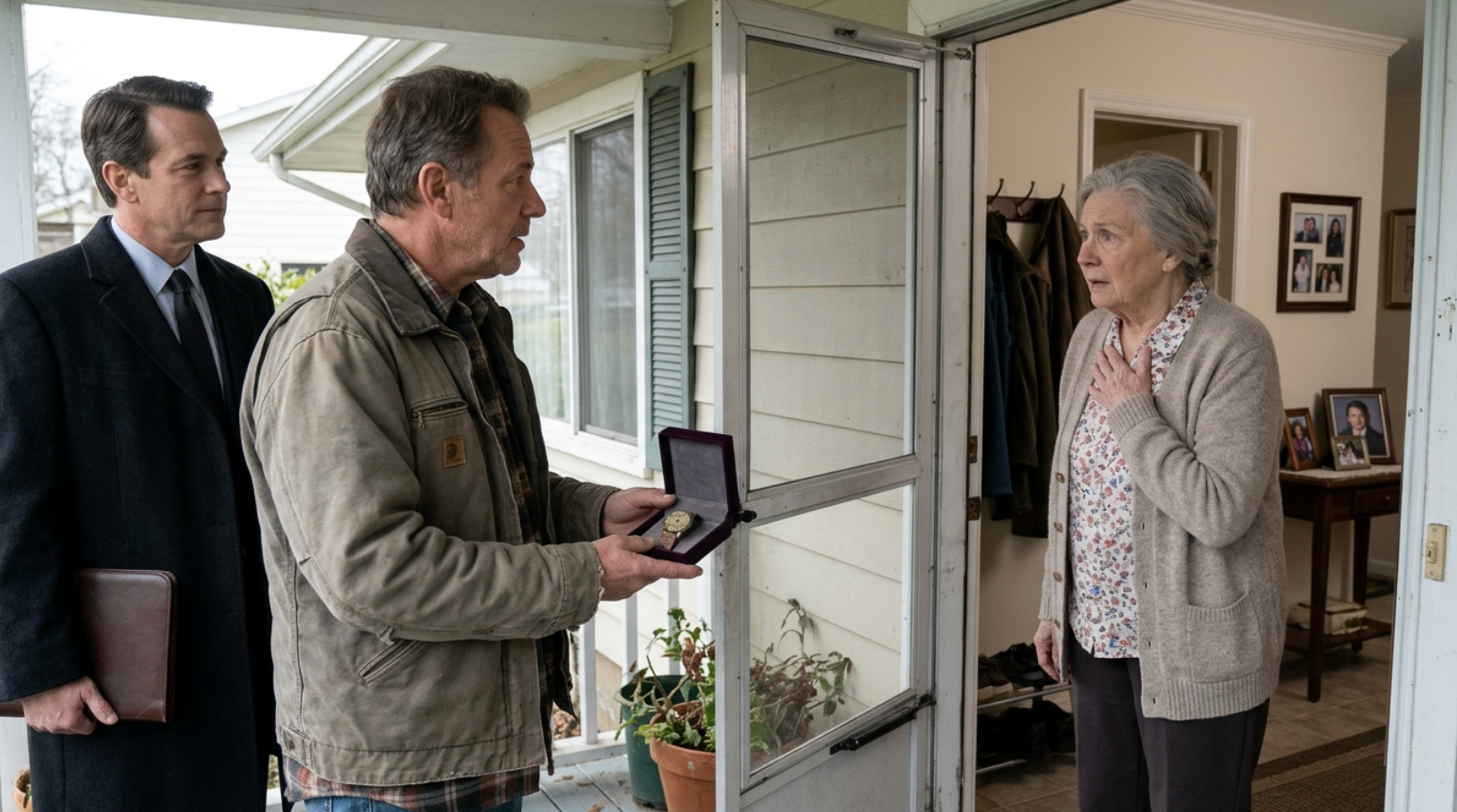
PART10
“Once. I went there in 1984, but the property manager told me the old locker rooms had been closed. I was frightened, and I left.”
She sat down again.
“Then, in 1985, I received a telephone call from a man who said he was calling on behalf of Robert Vale. He told me that continuing to search for Daniel would only bring trouble to my daughter.”
Patricia’s voice broke.
“I was a mother. I was terrified. I had already lost my husband. I couldn’t risk losing my child too.”
Mom reached across the table and held her hand.
For a moment, the two women sat together, bound by a grief that had begun decades before I was born.
Then Patricia looked at me.
“Did Harold leave anything else?”
I thought about Dad’s watch.
The note.
The ledger.
The notebook.
And the final entry.
Find her before they do.
“Yes,” I said quietly. “He left a message.”
I told her about the words Dad had written shortly before his death.
Patricia began to cry again.
“He was looking for me.”
“Yes.”
She lowered her head.
“After all these years, he was still trying to make things right.”
I looked at the old key resting on the table.
For the first time, the pieces of the mystery were beginning to fit together.
But there was still one question we hadn’t answered.
Why had Dad waited until the end of his life to reveal what he knew?
And what exactly had happened to Daniel Whitaker on the night he disappeared?
Mr. Cole gathered the documents.
“I believe we have enough evidence to request a formal review of the original investigation. The ledger, the anonymous letter, and the key may help establish what happened. But we need to proceed carefully.”
Patricia nodded.
Then she reached into the wooden box one final time.
“There was something else in the package,” she said.
She pulled out a folded piece of paper.
“I never showed anyone this because I didn’t understand what it meant.”
She handed it to Mr. Cole.
He unfolded it.
There was a single sentence, written in handwriting none of us recognized.
The man who took the money was not the man who signed the papers.
Mr. Cole looked at the ledger.
Then at the signature beside the final payment.
Margaret Brennan.
He went very still.
Because if the sentence was true, someone had used my mother’s name to authorize a transaction she knew nothing about.
And that meant the woman who had spent forty-five years believing her husband had hidden a secret might have been made part of that secret without ever knowing it.
Over the following weeks, Mr. Cole worked with investigators and independent document examiners to establish the authenticity of the ledger.
The process was slow.
There were no dramatic arrests, no sudden confessions, and no convenient discovery that solved everything overnight.
Instead, there were old records, interviews, handwriting comparisons, and hours spent checking names against company archives.
It was frustrating.
But for the first time, the truth was being examined by people who had the authority to investigate it.
The handwriting examiner confirmed that the ledger contained entries made by at least three different people.
Some were written by Dad.
Others appeared to match Daniel’s handwriting.
The signature beside the final payment, however, did not match Mom’s signature on any verified document.
It appeared to have been forged.
That discovery changed everything.
The investigators also found that the company named on the payment records had been registered shortly before the money disappeared.
Its listed address was a vacant office.
Its bank account had been closed within months.
And one of the individuals authorized to approve its payments was Robert Vale.
The missing funds had passed through several accounts before disappearing.
The original amount was approximately $186,000.
The ledger recorded transfers totaling almost exactly that figure.
It wasn’t proof of every detail, but it was a substantial lead.
Then investigators uncovered something else.
A former mill accountant, now in his eighties, had kept copies of several reports from 1981.
He had saved them because he feared he might someday be blamed for transactions he hadn’t approved.
In one report, Dad’s name appeared beside a handwritten note.
Employee refused to certify equipment delivery. Requested independent inspection.
In another, Daniel had submitted a written complaint about missing funds and safety equipment.
Both complaints had been marked as resolved.
Neither had been properly investigated.
I read those reports at Mr. Cole’s office, sitting beside Mom.
The words blurred before my eyes.
My father had spent decades being remembered as a quiet man who fixed things around the house and never complained about his work.
But he had once stood up to people who were more powerful than he was.
He had refused to sign a document he believed was false.
And when he realized that someone was using his coworkers’ safety as a way to steal money, he had tried to stop it.
Mom held one of the reports.
“He never told me.”
Mr. Cole sat across from us.
“Perhaps he thought keeping you uninvolved would protect you.”
Mom looked up.
“But it didn’t protect him.”
“No,” he said quietly. “It may not have.”
She placed the paper on the table.
“Harold spent his life believing that if he worked hard, told the truth, and treated people fairly, things would eventually turn out right.”
She shook her head.
“He never understood how cruel people can be when they think no one will ever hold them accountable.”
I took her hand.
“Maybe he understood better than we think.”
She looked at me.
“He kept the evidence.”
I nodded.
“He didn’t give up.”
For the first time, Mom smiled.
It was a small, tired smile.
But it was real.
And it was the first time since Dad’s funeral that I felt we were moving toward something other than grief.
The investigation into Daniel’s disappearance took longer.
The original police file was incomplete, and several witnesses had died.
Robert Vale was dead.
Eleanor Vale was dead.
And nobody could produce a verified account of what had happened to Daniel after he left work on September 17, 1981.
But the ledger and the old letters prompted investigators to reopen the case.
They interviewed former employees, examined archived personnel records, and searched for information that had been overlooked decades earlier.
One former security guard remembered seeing Daniel leave the mill that evening.
He also remembered seeing Robert Vale’s car near the employee parking lot.
The guard had never mentioned it during the original investigation because he believed it was irrelevant.
Another employee recalled that Daniel had been summoned to a meeting with senior management that afternoon.
The meeting wasn’t listed on the official calendar.
And the man who had arranged it was Robert Vale.
These accounts were not enough to establish what had happened to Daniel.
But they were enough to challenge the old assumption that he had simply abandoned his family.
Then came the discovery that changed the direction of the investigation.
A retired mechanic contacted the authorities after hearing about the reopened case.
In 1981, he had worked at a repair garage outside town.
He remembered a dark sedan arriving late one night with damage to its front bumper.
The driver had paid cash and asked for the repairs to be completed without paperwork.
The mechanic had recognized the car as belonging to a senior executive at the mill.
He couldn’t remember whether it was Robert Vale’s car, but he had kept an old appointment book containing the date and the license plate number.
The authorities compared the information with archived vehicle records.
The car had been registered to a company associated with Robert Vale.
The date of the repair was September 18, 1981.
The day after Daniel disappeared.



One Comment on “PART10: My Brother Sold Dad’s 51-Year-Old Watch for $40—Then a Shop Owner Found a Secret Inside That Changed Our Family Forever”
Comments are closed.