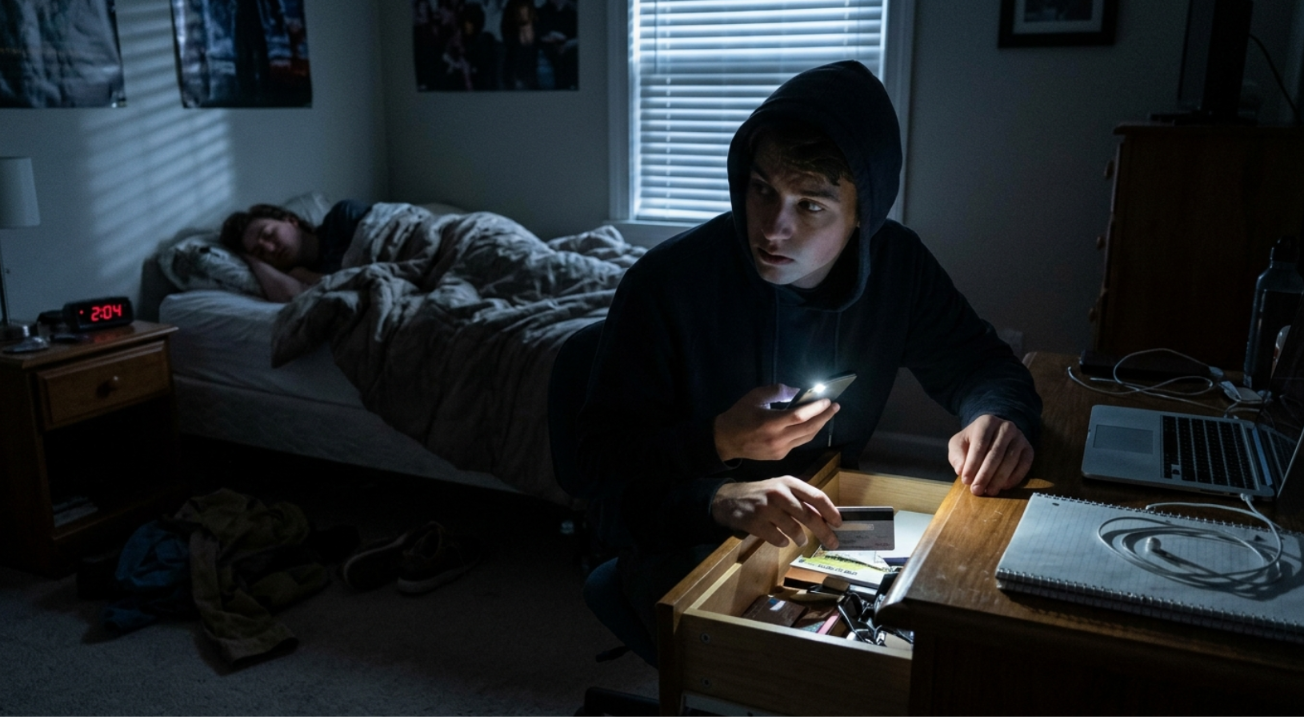
PART4
JULIAN — COLLEGE FUND
I pulled it out.
Inside were several documents.
One was a letter from my father’s attorney, dated two months before he died.
I read it once.
Then again.
The letter explained that my father had established an education and development trust for me.
The original amount was $32,000.
The money was supposed to be held for my education and early adult life.
My mother had been named trustee.
I sat on the floor.
Thirty-two thousand dollars.
Not fifteen thousand.
Not the amount she had told me was gone.
Thirty-two thousand.
And there was something else.
The final paragraph explained that I was entitled to receive an annual statement of the trust’s activity.
I had never received one.
Not once.
I turned the page.
There was a handwritten note from my father.
I recognized his handwriting immediately.
He had written it in blue ink, with the letters slightly leaning to the right.
It said:
Julian,
If you’re reading this, I hope you’ve grown into a man who understands that money is not the most important thing in life. But independence matters. I want you to have the chance to build something of your own without feeling that you owe anyone your freedom.
Your mother will help you manage this until you’re old enough to understand it yourself.
Never be afraid to ask questions about your future.
Love, Dad.
I pressed the paper against my chest.
For a moment, I wasn’t twenty-six.
I was seventeen again.
I remembered standing in the kitchen while my mother told me the college fund was gone.
I remembered her crying.
I remembered promising myself I would never ask her for another dollar.
And now I wondered whether I had spent nine years paying for a lie.
My phone vibrated.
It was an unknown number.
I answered.
“Hello?”
“Is this Julian Miller?”
“Yes.”
“My name is Patricia Evans. I was your father’s attorney. I don’t know whether you remember me, but I handled some of his estate documents.”
I sat up.
“Yes. I found a letter from your office today.”
There was a pause.
Then she asked:
“Did you recently discover something concerning the money your father left you?”
I looked down at the folder.
“How did you know?”
Her voice became serious.
“Because I received a call yesterday from someone asking whether your father’s trust had ever been properly closed.”
My heart started beating faster.
“Who called you?”
She hesitated.
Then she said:
“Your mother.”
I couldn’t speak.
Patricia continued.
“She told me you were having financial difficulties and might be making accusations against her. She wanted to know whether the original trust documents could be changed.”
“Can they?”
“No,” she replied firmly. “Not without following the legal requirements. And Julian, there’s something else you need to understand.”
I gripped the phone.
“What?”
“I still have the original trust records.”
I looked at my father’s handwriting.
Then toward the closed bedroom door.
Patricia lowered her voice.
“According to the last statement in my file, the trust was not empty when you turned eighteen.”
My entire body went cold.
“How much was left?”
She took a breath.
“That’s something I want you to see in person. But I can tell you this much: the records show a substantial withdrawal shortly before your mother told you the money was gone.”
I closed my eyes.
“Where did the money go?”
Patricia didn’t answer immediately.
Then she said:
“Julian, I believe you should come to my office tomorrow morning. Bring every document you’ve found. And please, don’t confront your mother again until we’ve reviewed the records.”
“Why?”
Her answer was quiet.
“Because the withdrawal wasn’t made for your college expenses.”
I stared at the folder.
“What was it made for?”
“I’d rather show you the paperwork in person.”
The call ended.
I sat there for a long time.
Downstairs, I could hear Caleb laughing at something on his phone.
My mother was talking to Arthur.
The house sounded completely normal.
But nothing was normal anymore.
At 10:18 p.m., I received a text from my mother.
It contained only eleven words.
We need to talk tomorrow. Don’t go looking into your father’s money.
I read it several times.
Then I took a screenshot.
Because for the first time, I understood something.
My mother wasn’t afraid of the police report.
She was afraid of what I might discover next.
And tomorrow morning, I was finally going to find out why.
I barely slept that night.
My mother’s text remained on my phone.
We need to talk tomorrow. Don’t go looking into your father’s money.
I read it again and again, trying to understand how a mother could tell her son not to investigate money his own father had left for him.
At 7:15 the next morning, I got dressed, placed every document I had found into a folder, and left the house.
I didn’t tell anyone where I was going.
For once, I wasn’t asking permission.
I was going to find out the truth.
Patricia Evans’s law office was in a quiet building downtown. She was an older woman with silver hair, glasses, and the kind of expression that suggested she had spent decades watching people lie to themselves.
When I walked into her office, she stood up.
“Julian. I’m glad you came.”
She offered me a seat.
On her desk was a thick brown envelope.
“I’ve kept these records for years,” she explained. “Your father specifically instructed me to preserve the trust documents until the matter was properly settled.”
“Why didn’t you contact me?”
She looked uncomfortable.
“I tried. Several times. But your mother informed me that you had received everything you were entitled to and had no interest in further correspondence.”
I stared at her.
“She told you that?”
“Yes.”
“I never received anything.”
Patricia slowly nodded.
“I suspected there might have been a problem, but without your cooperation or additional information, there wasn’t much I could do.”
She opened the envelope.
Inside were bank statements, trust documents, withdrawal records, and several signed forms.
She arranged them across the desk.
“Your father deposited $32,000 into the trust. The money was intended to support your education and provide a financial foundation when you became an adult.”
I nodded.
“I know. I found his letter.”
“Good. Now look at this.”
She handed me a statement dated three months before my eighteenth birthday.
The balance was $31,842.
Then she gave me another statement.
The balance was $4,217.
I looked at the dates.
“What happened?”
Patricia pointed to three withdrawals.
The first was $8,500.
The second was $11,000.
The third was $8,000.
All three had been transferred into an account I didn’t recognize.
The total was $27,500.
I swallowed.
“Who owned that account?”
Patricia turned another page.
“Your mother.”
I sat completely still.
My father had left me thirty-two thousand dollars.
My mother had transferred nearly all of it into her personal account.
“Did she have permission?”
Patricia folded her hands.
“Your mother was the trustee. That gave her certain responsibilities, but it did not give her permission to use the money for unrelated personal expenses. Every withdrawal was supposed to benefit you or follow the terms of the trust.”
I looked at the documents again.
“Did she ever return the money?”
“Not according to the records I have.”
My voice became barely audible.
“Where did it go?”
Patricia opened a separate file.
“I don’t have complete access to the receiving account, but I do have copies of the original transfer descriptions.”
She pointed to the first withdrawal.
“Private school tuition.”
The second.
“Vehicle purchase.”
The third.
“Household expenses.”
I leaned back.
The private school.
Caleb’s private school.
The car my mother and Arthur had purchased when Caleb was sixteen.
And household expenses that I had never been told about.
I looked at Patricia.
“Did any of this money pay for my education?”
She shook her head.
“Not according to these records.”
I couldn’t find words.
For nine years, I had believed my father had left me a small amount of money that had disappeared because life was difficult.
I had worked warehouse shifts.
I had taken out student loans.
I had skipped meals.
I had spent weekends building websites for strangers while my classmates went on vacations.
And all that time, the money meant to help me had been used for someone else’s life.
“Can I get it back?” I finally asked.
Patricia looked directly at me.
“We need a complete accounting. If the records support what we’re seeing, there may be grounds for legal action against your mother for breach of her responsibilities as trustee.”
I nodded.
“Then I want a complete accounting.”
“Are you certain?”
I looked at my father’s letter.
He had wanted me to have independence.
I wasn’t going to let anyone take that away again.
“Yes.”
Patricia closed the folder.
“Then we’ll begin.”
Before I left, she gave me copies of everything.
As I walked to my car, my phone began ringing.
Mom.
I ignored it.
It rang again.
Then Arthur.
Then Caleb.
I finally switched the phone to silent.
For the first time in years, I didn’t feel guilty about refusing to answer.
I was finished being available whenever someone needed something from me.
When I returned home that afternoon, all three of them were waiting in the living room.
My mother was standing beside the fireplace.
Arthur sat on the couch.
Caleb was leaning against the wall, wearing his new sneakers.
The same sneakers he had purchased with my stolen money.
My mother looked at the folder in my hand.
“Where were you?”
“Meeting with my father’s attorney.”
Her face immediately changed.
Arthur stood up.
“Julian, we already told you this is a family matter.”
I placed the folder on the coffee table.
“Apparently, it was a family matter when my father’s money was being spent, too.”
My mother stepped forward.
“What did Patricia tell you?”
I opened the folder and removed the first statement.
“She told me Dad left me thirty-two thousand dollars.”
Nobody spoke.
“She also told me that twenty-seven thousand five hundred dollars was transferred out of the trust before I turned eighteen.”
My mother’s eyes filled with tears.
“Julian, please.”
I continued.
“The money went into your personal account.”
Arthur looked at her.
She looked away.
Caleb slowly straightened.
“Wait. What money?”
I turned toward him.
“The money Grandpa left me. The money Mom said was gone.”
Caleb frowned.
“I thought you didn’t get anything.”
“Exactly.”
My mother began crying.
“I was under enormous pressure back then. Your father had died. Arthur and I were trying to keep everything together. Caleb needed a good school. There were bills. Things were difficult.”
I looked at her.
“So you used my father’s money?”
“I was going to replace it!”
“When?”
She wiped her cheeks.
“When things got better.”
I nodded.
“And did things get better?”
She didn’t answer.
I pulled out another document.
“Did you know the bank still had records showing the transfers?”
My mother stared at the paper.
Then she said something I will never forget.
“You already had everything you needed, Julian. Caleb needed more help.”
I felt my jaw tighten.
“I was seventeen years old. I needed help, too.”
“You were always independent.”
“No, Mom. I was forced to become independent.”
The room went silent.
I looked at Caleb.
“You know what the worst part is? I spent years thinking I was the reason this family couldn’t afford things. I thought asking for help would make me selfish.”
Caleb looked down at his shoes.
I continued.
“Meanwhile, you were getting private school, a car, expensive clothes, and now almost nine thousand dollars in things you didn’t earn.”
He finally spoke.
“I didn’t know about Grandpa’s money.”
I looked at him.
“Maybe you didn’t. But you knew about my debit card.”
He had no answer.
My mother reached for my arm.
“Julian, we can fix this. We can sit down and work something out.”
I stepped away.
“No. You can speak with my attorney.”
Her expression hardened.
“Are you threatening your own mother?”
“No. I’m setting boundaries with someone who has repeatedly taken advantage of me.”
Arthur moved toward the coffee table.
“That’s enough. You’re not going to bring lawyers into this house.”
I looked at him.
“I’m not asking for your permission.”
He stared at me.
“You live under this roof.”
I nodded.
“Not for much longer.”
The following week was difficult.
The bank completed its initial fraud investigation and confirmed that the transactions were unauthorized.
They began working with the merchants to reverse eligible charges and recover the funds.



One Comment on “PART4: My 18-Year-Old Brother Stole Nearly $9,000 From My Business Account—My Parents Protected Him, Until I Discovered What My Mother Had Done With the $32,000 My Father Left Me”
Comments are closed.