PART4
The next morning, Camille and I arrived at Eleanor Whitmore’s office fifteen minutes early.
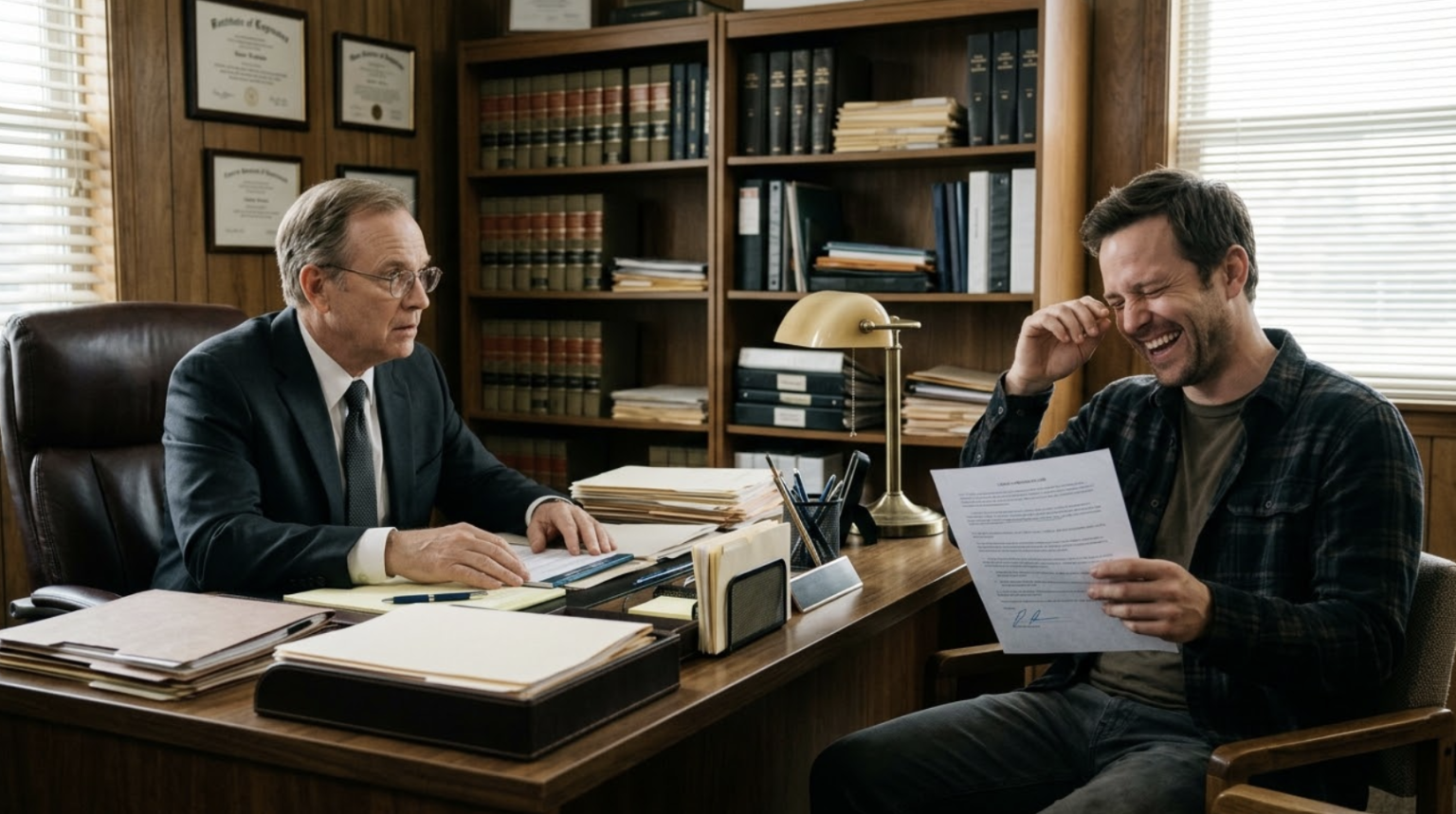
Her office was in an old brick building overlooking a quiet street in Albany. It wasn’t particularly impressive, but there was something comforting about the place. Wooden bookshelves covered one wall, and framed photographs of New York State court buildings hung behind her desk.
Eleanor was waiting for us.
She was in her late sixties, with silver hair, sharp eyes, and the kind of calm expression that made me think she had spent decades dealing with people who believed money could solve every problem.
She stood when we entered.
“Warren. It’s good to finally meet you.”
I shook her hand.
“Thank you for seeing us.”
She looked at Camille.
“And you must be Camille. Cyrus spoke very highly of you.”
Camille smiled politely.
“He did?”
“Oh, yes. He told me you were the first person who made Warren understand that he didn’t have to spend his entire life trying to earn somebody else’s approval.”
I felt my throat tighten.
Even after all these years, Grandpa somehow found ways to make me feel less alone.
Eleanor gestured toward the chairs.
“Please sit. We have quite a bit to discuss.”
She opened a cabinet and removed a thick brown envelope.
It had been sealed with red wax.
My grandfather’s initials were pressed into it.
C.C.
I recognized his handwriting immediately.
Eleanor placed it in front of me.
“Your grandfather delivered this to my office four years before he died. He gave me very specific instructions. I was to keep it sealed until your father or brother attempted to interfere with the hunting cabin.”
I stared at the envelope.
“What’s inside?”
“Several documents. Some relate to the cabin. Others concern your grandfather’s remaining estate.”
I looked at Camille.
She gently touched my arm.
I broke the seal.
Inside were three documents, a handwritten letter, and a small photograph.
The photograph showed Grandpa standing in front of the cabin with me when I was about twelve years old.
I was holding a fishing rod almost as tall as I was. He had one hand resting on my shoulder.
On the back, he had written:
The boy who never asked for much deserved more than he ever received.
I put the photograph down.
Eleanor waited until I had read the first document.
It was a certified statement confirming that the hunting cabin and forty-seven surrounding acres had been transferred into the trust.
The second document was a detailed inventory of the remaining property and investments Grandpa had owned.
The third was a financial statement.
I looked at the numbers.
Then I looked again.
“Is this correct?”
Eleanor nodded.
“Your grandfather had accumulated considerably more wealth than most people realized.”
The document listed investment accounts, agricultural land, several commercial properties, and shares in a private manufacturing company.
The estimated value was approximately $4.8 million.
I sat back.
“Grandpa owned all this?”
“He did. He lived modestly, but he was a careful investor. He bought properties when they were inexpensive, invested in local businesses, and held onto his assets for decades.”
I couldn’t believe it.
My grandfather had spent his life wearing old work boots, driving a pickup truck with a dented door, and repairing things instead of replacing them.
I remembered him bringing sandwiches to the cabin because he didn’t want to waste money eating at restaurants.
I had never imagined he possessed millions of dollars.
“Who inherited it?” I asked.
Eleanor folded her hands.
“That’s why we’re here.”
She slid another document toward me.
It was the final distribution schedule of Cyrus’s estate.
I read the first paragraph.
Then I stopped.
My name appeared repeatedly.
I looked up.
“What does this mean?”
Eleanor answered carefully.
“Your grandfather established a separate estate plan. You are the primary beneficiary of his remaining assets, subject to the terms of the trust and the estate administration. Your father received a limited inheritance, and Dexter received a smaller amount.”
I stared at the paper.
“How much?”
“Your father received $150,000. Dexter received $75,000, with the distribution subject to certain conditions. The remaining assets were designated for you.”
I couldn’t speak.
Camille reached for my hand.
Eleanor continued.
“Your grandfather didn’t make these decisions impulsively. He had several meetings with independent legal and financial advisers. He wanted to make sure the arrangements reflected his wishes.”
“Why didn’t he tell me?”
“Because he didn’t want money to change your relationship with him. He also didn’t want your father or brother to pressure you while he was alive.”
I looked down at the letter.
“Did he know they would do this?”
Eleanor took a breath.
“He was concerned they might.”
She pushed the handwritten letter closer.
I opened it.
Warren,
I have never been particularly good at explaining my feelings. I spent most of my life working with engines, tools, and machines. Those things were easier to understand than people.
But I understood you.
I understood how often you came to the cabin after a difficult day. I understood why you stayed outside repairing the fence long after the work was finished. Sometimes you just needed somewhere quiet.
I watched your father compare you with Dexter. I watched you try harder every year, hoping that one day your effort would be enough.
I want you to know that it always was.
I have left you these things because I trust the man you have become. Not because I think you need money, but because I believe you will understand that wealth is a responsibility, not a weapon.
Do not use it to punish anyone.
Do not allow anyone to use it to control you.
Build something good. Protect the people who love you. And never forget the boy standing beside me in that photograph.
You were enough then.
You are enough now.
Grandpa.
I lowered the letter.
For several seconds, nobody spoke.
Then Eleanor cleared her throat.
“There’s one more matter we need to address.”
She opened another folder.
“This concerns Dexter’s claim that he possesses a document proving your grandfather promised him the cabin.”
I nodded.
“What about it?”
“Yesterday, Dexter sent me a scanned copy of what he claims is a letter from Cyrus.”
She placed a printed copy on the desk.
I read it.
The letter supposedly stated that Grandpa had promised Dexter the hunting cabin and intended to transfer it to him after his death.
But something immediately bothered me.
The handwriting looked familiar, but not quite right.
I had spent years reading Grandpa’s notes, grocery lists, fishing instructions, and repair diagrams.
I knew his handwriting.
This wasn’t it.
“That’s not his writing,” I said.
Eleanor nodded.
“I reached the same conclusion.”
She pointed to the date.
“There’s another problem. This letter is dated three months after the cabin was transferred into the trust.”
I looked at her.
“So Dexter fabricated it?”
“We cannot make that conclusion without a proper examination. But there are substantial inconsistencies. We’ve preserved the original submission and are arranging for a handwriting expert to examine it.”
Camille frowned.
“Why would he do something like this?”
Eleanor looked at me.
“That’s a question your brother may have to answer.”
I felt a heavy sadness settle over me.
Not surprise.
Not even anger.
Just sadness.
Dexter had spent his entire life believing that somebody else would eventually pay for his mistakes.
Apparently, even death hadn’t changed that belief.
Two days later, my phone rang.
It was my mother.
I stared at the screen for a long time.
Sylvia.
Two years without a single conversation.
Two years without an apology.
Two years of hearing through relatives that I was unstable, selfish, and controlled by my wife.
I answered.
“Hello?”
“Warren.”
Her voice sounded strained.
“Your father told me what happened.”
I said nothing.
“How could you do this to us?”
I closed my eyes.
“Do what?”
“Take your grandfather’s money and leave your own parents with nothing!”
I almost laughed.
“Mom, Dad received $150,000. Dexter received $75,000. Nobody left them with nothing.”
“That’s not the point!”
“Then what is the point?”
She took a breath.
“Your father says you manipulated the situation. He says you convinced Cyrus to leave everything to you.”
I looked across the room at Camille.
She was sitting on the sofa, reading a book.
“Grandpa made his decisions. I didn’t ask him to leave me anything.”
“But you’re his grandson. Dexter is his grandson too!”
“Then why are you calling me instead of asking Dexter about the letter he claims Grandpa wrote?”
Silence.
I continued.
“Did you see the letter, Mom?”
Another pause.
“I don’t know what you’re talking about.”
“Dexter says Grandpa promised him the cabin.”
“I haven’t seen it.”
“Then perhaps you should ask him.”
She became defensive.
“Your brother is under enormous pressure. His business is failing. He has creditors threatening him. Your father is trying to protect the family.”
I felt my patience slipping.
“Mom, where were you when Dad threw Camille and me out into the snow?”
She didn’t answer.
“Where were you when he called my wife white trash?”
“Warren, that was a difficult evening.”
“No. It was Christmas Eve. I remember it perfectly.”
“Your father was upset.”
“So was I. But I didn’t throw my parents out of their house.”
Her voice softened.
“We’re still your family.”
I looked down at my wedding ring.
“Family doesn’t mean you get to hurt someone forever and expect them to keep coming back.”
She began crying.
I didn’t feel happy hearing it.
I didn’t feel victorious.
I just felt tired.
“Your father wants you to come home,” she whispered.
I shook my head.
“I have a home, Mom.”
“Can’t we just talk about this?”
“We can talk when you’re ready to acknowledge what happened. Not when you need something from me.”
I ended the call.
Camille came over and sat beside me.
“Are you okay?”
I nodded slowly.
“I think I am.”
She rested her head against my shoulder.
For the first time, I understood that sometimes the hardest part of leaving a toxic family wasn’t walking away.
It was refusing to return when they finally needed something.
Three weeks later, the situation became much worse for Dexter.
Eleanor called me on a Friday afternoon.
“Warren, we have an update.”
I stepped away from my desk.
“What happened?”
“The handwriting examiner completed the preliminary review of Dexter’s document.”
“And?”
“The signature and several portions of the letter are inconsistent with authenticated samples from your grandfather.”
I felt my stomach tighten.
“Does that mean it’s fake?”
“The examiner has identified significant evidence suggesting the document was altered. The final report will be available shortly.”
I rubbed my forehead.
“What’s Dexter saying?”
“He has withdrawn his request to challenge the trust, but he hasn’t explained where the document came from.”
I looked out the office window.
“Is that the end of it?”
“Not quite. There is another issue.”
She explained that the property sale had been presented to a potential buyer as though my father had full authority to transfer the cabin.
The buyer had already paid a deposit.
When the buyer’s attorney discovered the trust, the transaction was suspended.
Now the buyer was demanding the return of the deposit and threatening legal action.
My father had created a problem that he couldn’t simply shout his way out of.
“Can he still sell it?” I asked.
“Not without complying with the trust documents and obtaining whatever approvals are legally required. Your independent attorney will need to handle any further correspondence.”
I thanked her.
When I told Camille, she shook her head.
“They really thought you would sign without reading anything.”
“They thought I was still twenty-two.”
She smiled faintly.
“Not anymore.”
But the next development came from an unexpected direction.
My father’s attorney contacted Eleanor and requested a private meeting.
He wanted to discuss a settlement.
And this time, Harlon wasn’t asking for the cabin.
He was asking me for money.
The meeting took place the following Monday.
This time, I didn’t go alone. Eleanor attended with my independent attorney, Daniel Brooks.
Harlon arrived with Sylvia and Mr. Sterling.
Dexter wasn’t there.
My father looked older than I remembered. His expensive suit was slightly wrinkled, and the confident expression he’d worn during our previous meeting had disappeared.
He sat down without greeting me.
Sterling opened his briefcase.
“Your father would like to discuss a financial arrangement,” he began.
I looked at Harlon.
“What kind of arrangement?”
My father cleared his throat.
“Your brother needs help. The brewery is finished. The creditors are coming after him, and the bank is preparing to take action.”
I waited.
Harlon continued.
“You have inherited considerably more than we expected. There’s no reason you can’t help your brother get back on his feet.”
I almost smiled.
“Are you asking me for money?”
“I’m asking you to remember where you came from.”
I looked at him for several seconds.
“Where I came from?”
“Yes.”
I leaned forward.
“I remember exactly where I came from. I remember paying for my own education while you bought Dexter a car. I remember working double shifts while you financed his brewery.
I remember being told I was selfish because I wouldn’t hand over fifty thousand dollars. I remember Christmas Eve.”
My mother lowered her eyes.
I continued.
“I remember standing outside in the snow with my wife while you watched us leave.”
Harlon shifted in his chair.
“That was two years ago.”
“Yes. And apparently, you haven’t learned anything since.”


One Comment on “PART4: My Father Threw Me Out on Christmas and Called My Wife “White Trash”—Two Years Later, He Demanded My Signature to Sell Grandpa’s Cabin, But One Hidden Letter Changed Everything…”
Comments are closed.