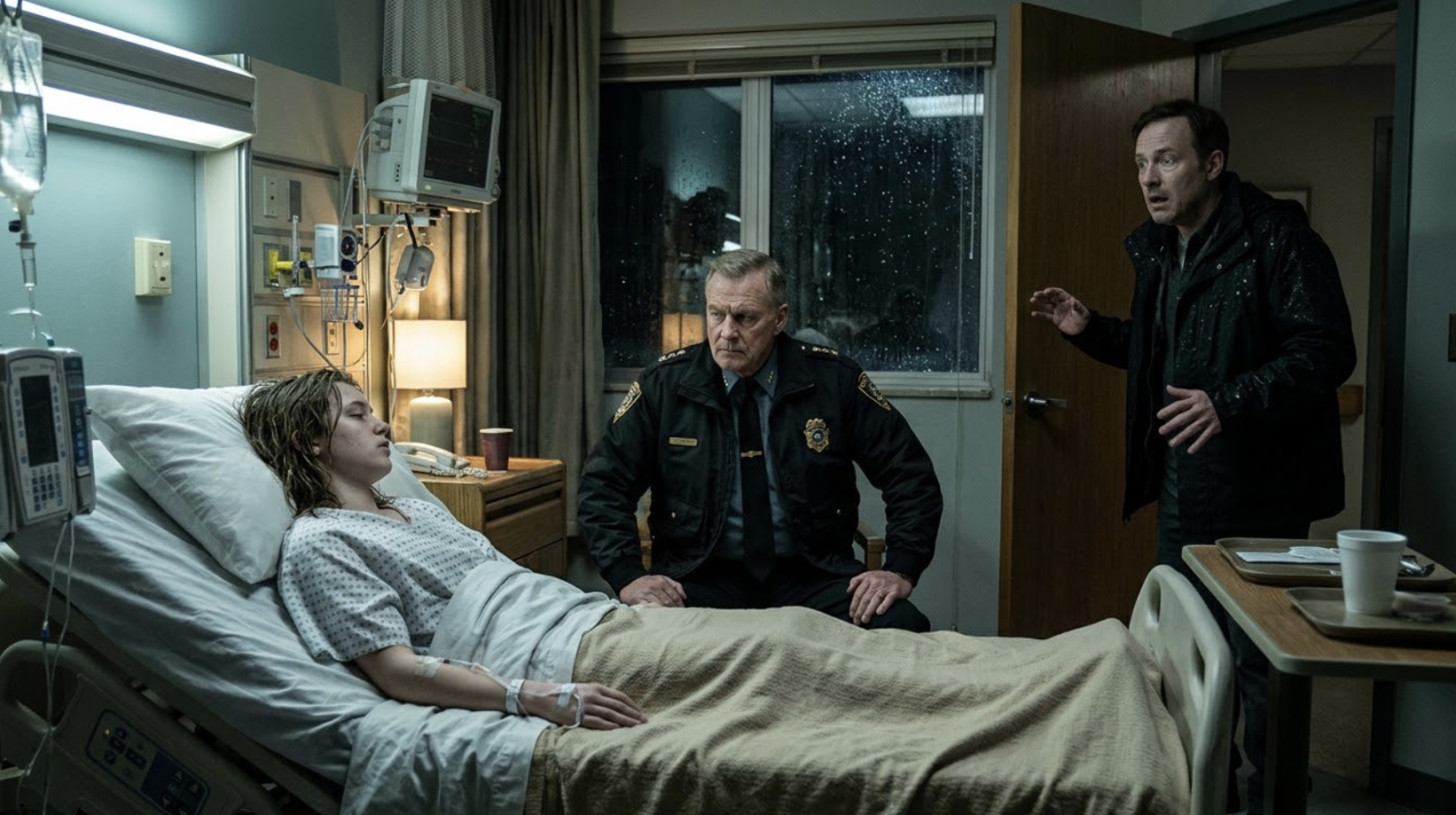
PART4
“Sir, step back.”
Dad stopped.
I looked at the document on the table.
Then I looked at my father.
“Dad…”
He wouldn’t meet my eyes.
“Did you take my money?”
The question hung in the air.
Nobody spoke.
And just as Dad finally opened his mouth to answer, Officer Brangan’s radio crackled.
A second officer had arrived at the farmhouse.
He had found something in the kitchen.
Something that might explain exactly where the missing $340 had gone.
And, according to the message coming through the radio, it wasn’t the only thing he had discovered.
I looked at my father.
For the first time in my life, he seemed to have absolutely nothing left to say.
The radio crackled again.
Officer Brangan stepped toward the hallway to listen more carefully. I couldn’t hear everything, but I caught a few words.
“Cash box…”
“Kitchen drawer…”
“Additional documents…”
Then he turned toward the room.
“Richard, I need you to come with me for a moment.”
My father didn’t move.
“What did they find?”
“The officer at your residence would like to speak with you.”
“About what?”
“Sir, I’d prefer to discuss that outside.”
Colleen looked increasingly uncomfortable.
“Richard, what’s happening?”
He ignored her.
Instead, he looked at Elena.
“This is your fault.”
Elena didn’t raise her voice.
“No, Richard. This started when you decided that a fifteen-year-old girl was easier to blame than to protect.”
Dad turned toward me.
“Myra, please. You need to understand that things aren’t always what they look like.”
I stared at him.
“Then why didn’t you explain them before you threw me outside?”
He looked down.
For a moment, I thought he might finally tell me the truth.
But Officer Brangan interrupted.
“Sir, we need to go.”
Dad reluctantly followed him into the hallway.
Colleen remained in the room.
She stood near the foot of my bed, looking at the medical equipment as though she suddenly didn’t know what to do with herself.
I didn’t want to speak to her.
But I had one question.
“Did you know about the money my grandparents left me?”
She looked at me.
“What?”
“The medical trust.”
Her expression changed.
“I don’t know anything about that.”
Elena watched her carefully.
“Are you sure?”
Colleen’s lips tightened.
“I said I don’t know.”
Then she picked up her handbag.
“I need to call someone.”
She walked into the hallway.
Elena sat beside me again.
I looked at her.
“Mom, what is a medical trust?”
She took my hand.
“Your grandparents loved you very much. When you were born, they started saving money for your future. After your diagnosis, they made sure additional funds were available for your medical needs.”
“How much?”
She hesitated.
“I don’t know the exact balance. I haven’t had access to the complete account records for years. But the original documents listed an initial contribution of $85,000, with additional deposits over time.”
My eyes widened.
“Eighty-five thousand dollars?”
“Yes.”
“Where is it now?”
“That’s what needs to be investigated.”
I stared at the ceiling.
My father had spent years complaining about how expensive my medical care was.
Sometimes he reminded me how much my prescriptions cost.
Sometimes he said my condition made everything harder for the family.
I remembered one afternoon when my blood glucose monitor stopped working. Dad had told me we couldn’t afford a replacement immediately.
I had gone three weeks using an older device while trying not to bother him.
I remembered asking for new glucose tablets.
He told me to stop wasting money on unnecessary things.
And all that time, apparently, there had been money specifically intended to help me.
I couldn’t understand it.
“Why didn’t you tell me?”
Elena’s eyes filled.
“I thought you knew. When I discovered that you hadn’t received any of my letters, I started investigating. But I couldn’t get complete information because I wasn’t the trustee.”
“Who was?”
She looked toward the door.
“Your father.”
I closed my eyes.
It was becoming harder to breathe normally.
Not because of my blood sugar.
Because every answer seemed to reveal another question.
About twenty minutes later, Officer Brangan returned.
He wasn’t alone.
A woman in a dark blue jacket accompanied him. She introduced herself as Detective Marissa Cole.
She was calm, professional, and carried a small notebook.
“Hello, Myra. I’m sorry to interrupt your recovery.”
I nodded.
She explained that she had been called to assist with the investigation after the officers discovered additional evidence at the farmhouse.
“Your sister Brin has spoken with us again,” she said.
I immediately sat up slightly.
“Is she okay?”
“She’s physically fine. She’s with a trusted adult while we sort out the situation.”
“What did she say?”
Detective Cole exchanged a glance with Officer Brangan.
“She admitted that she lied about seeing you take the money.”
My chest tightened.
I had suspected it.
But hearing it confirmed still hurt.
“Why?”
The detective continued.
“She told us she had taken the $340 herself.”
I stared at her.
“Brin took it?”
“Yes.”
I didn’t know what to say.
“Where was it?”
“She had hidden it inside an old winter boot in the laundry room.”
I looked toward Elena.
The missing money had never been in my backpack.
It had never been in my room.
It had been hidden inside our own house.
“Why did she blame me?”
Detective Cole opened her notebook.
“She said she was afraid of what would happen if your stepmother discovered the money was missing. According to her statement, she had taken it because she wanted to buy a tablet and some other things online.”
I shook my head.
“But why point at me?”
The detective paused.
“She said Colleen had previously accused you of stealing food and hiding things in your backpack. Brin believed that if she suggested you had taken the money, your father would believe her.”
I felt tears gathering.
“So she knew he would blame me?”
“According to what she told us, yes.”
I looked away.
Brin was my little sister.
We had shared a bedroom when we were younger.
I had helped her with homework.
I had covered for her when she broke a kitchen vase.
When she was afraid of thunderstorms, she used to climb into my bed.
I had never imagined she would do something like this.
“Did she say she was sorry?” I whispered.
Detective Cole nodded.
“She has been crying.”
That didn’t make me feel better.
I didn’t want her to cry.
I wanted her to have told the truth before I ended up beside a highway.
Then the detective continued.
“There is something else.”
I looked at her.
“Brin told us that Colleen had discovered the missing money earlier in the afternoon. She said Colleen threatened to tell your father that she had stolen it unless she explained where it had gone.”
My stomach tightened.
“Did Colleen know Brin had taken it?”
“Brin says she did.”
Elena slowly sat straighter.
“Then why did Colleen accuse Myra?”
Detective Cole answered carefully.
“That is one of the questions we’re investigating.”
I thought about the dinner table.
The metal cash box.
Colleen’s trembling voice.
The way she had stared at the empty container while Dad accused me.
Suddenly, I remembered something.
“Wait.”
Everyone looked at me.
“Colleen said she counted the money herself.”
Detective Cole nodded.
“Yes.”
“But she didn’t look surprised when Brin pointed at me. She just sat there.”
The detective wrote something down.
“That’s useful information.”
I swallowed.
“Could I have some water?”
Elena immediately reached for the cup.
The detective gave us a few minutes.
But before leaving, she said something that changed the direction of the entire conversation.
“We also found a folder in the kitchen drawer. It contains financial records connected to your grandparents’ trust.”
Elena became very still.
“Which records?”
“Bank statements, correspondence, and several withdrawal confirmations.”
I looked at her.
“What does that mean?”
Detective Cole answered.
“It means we have reason to believe money intended for your care may have been used for other purposes. We are preserving the documents and referring the financial questions for further investigation.”
I looked toward the hallway.
My father was still outside.
And for the first time, I began to understand why he had looked so frightened when Elena entered my hospital room.
He wasn’t just afraid of losing an argument.
He was afraid of what might finally come to light.
The next morning, I woke to sunlight coming through the hospital curtains.
My blood sugar had stabilized overnight, and the medical team was discussing my discharge plan.
Elena had fallen asleep in the chair beside my bed.
Her coat was folded over her knees, and one hand rested near mine.
I watched her for a while.
She looked tired.
But she hadn’t left.
Not once.
When she woke, she immediately checked whether I needed anything.
“Good morning, sweetheart.”
“Good morning.”
“How are you feeling?”
“Better.”
She smiled.
“That’s good.”
I hesitated.
“Mom?”
“Yes?”
“Will you still be here when I leave?”
Her expression softened.
“Of course.”
I looked down.
“Even if Dad gets angry?”
Elena took my hand.
“Especially if he gets angry. You don’t have to earn my love by agreeing with everyone.”
I started crying quietly.
She moved closer and hugged me.
For years, I had thought being loved meant being easy to take care of.
I thought I had to be quiet about my diabetes.
I thought I had to avoid asking for expensive things.
I thought I had to apologize whenever my medical needs interrupted someone’s plans.
Now someone was telling me I didn’t have to apologize for being a child who needed care.
It was a feeling I didn’t know how to describe.
At eleven that morning, Detective Cole returned with an update.
She explained that the investigation at the farmhouse had revealed several important details.
The first was that the $340 had been recovered.
Brin had admitted taking it, and the money was being returned.
The second involved the medical trust.
Investigators had identified several withdrawals from the account over the previous years.
Some were recorded as medical expenses.
Others were described as household costs.
A few were transfers into an account that appeared to be connected to Colleen.
The records required further examination, and Detective Cole made it clear that no final conclusions had been reached.
But Elena looked deeply troubled.
“How much?” she asked.
Detective Cole checked her notes.
“The statements show approximately $31,600 in withdrawals that have not yet been supported by clear documentation showing they were spent on Myra.”
I stared at her.
Thirty-one thousand six hundred dollars.
I had never seen that much money in my life.
“Does that mean Dad stole it?”
“Not necessarily. We need to establish what each transaction was for, who authorized it, and whether it complied with the trust agreement.”
Elena nodded.
“I understand.”
I looked at the detective.
“Can I ask something?”
“Of course.”
“Did that money belong to me?”
She answered carefully.
“It was held for your benefit under the terms of the trust. The exact rights and responsibilities depend on the legal documents.”
I looked at Elena.
She squeezed my hand.
“We’ll get the documents reviewed by an attorney, sweetheart. You don’t need to solve everything today.”
Then Detective Cole mentioned something else.
“Your father has agreed to provide additional information about the account.”
I almost laughed.
Of course he had.
He hadn’t wanted to explain anything when I was standing in the kitchen.
He hadn’t wanted to answer when I was walking into the rain.
But now that investigators had found documents, suddenly he was willing to talk.
I didn’t know whether to feel angry or relieved.
Perhaps both.
That afternoon, my father asked to speak with me.
I initially said no.
Then I changed my mind.
Not because I wanted to forgive him.
Because I wanted to hear what he had to say.
The hospital social worker remained in the room, and Elena sat beside me.
Dad entered slowly.
He looked older than he had the night before.
His eyes were red, and he had barely shaved.
He stood near the foot of the bed.
“Myra.”
I didn’t answer.
He cleared his throat.
“I’ve been thinking about what happened.”
I looked at him.
“Okay.”
“I made a mistake.”
I waited.
“I shouldn’t have sent you outside.”
That was the first honest sentence I had heard from him.
But it wasn’t enough.
He continued.
“I was angry about the money. Colleen told me you had been hiding things. Brin said she had seen you with the cash.”
“She said she had seen my snacks.”
He looked down.
“Yes.”
“And you believed her.”
“I did.”
“Without finding the money?”
He rubbed his forehead.
“I thought you were lying.”
I stared at him.
“Why?”
He didn’t answer.
I continued.
“Why was it so easy for you to believe I stole something?”
He finally looked at me.
“Because things have been difficult at home.”
I felt my chest tighten.
“Because of my diabetes?”
“No. That’s not what I meant.”
“But you always say my diabetes makes everything difficult.”
He looked toward Elena.
She remained silent.
I continued.
“I have to check my blood sugar. I have to take medicine. I have to eat on time. I didn’t choose any of that, Dad.”
He nodded.
“I know.”
“Then why do you make me feel like I’m doing something wrong?”
His eyes filled.
“I don’t know.”
For a moment, I saw the father I remembered.
The one who used to carry me on his shoulders at the county fair.
The one who taught me to ride a bicycle.
The one who stayed awake beside me when I was first diagnosed.
I wanted that man back.
But I couldn’t pretend the man standing in front of me hadn’t locked the door.
“I was scared last night,” I whispered.
Dad’s lips trembled.
“I know.”
“No, you don’t.”
I looked directly at him.
“I was scared because I couldn’t feel my hands. I was scared because I couldn’t remember how to type on my phone. I was scared because I thought I might fall asleep beside the road and nobody would find me.”
He covered his face.
“I am sorry, Myra.”
I swallowed.
“Why didn’t you come looking for me?”
He lowered his hands.
“I thought you had gone to the gas station.”
“How long did you wait?”
He hesitated.
“I don’t know.”
“Did you call me?”
He didn’t answer.
“Did you even check whether I was safe?”
His silence answered for him.
I turned toward the window.
Something inside me had finally stopped waiting for the answer I wanted.
Then I heard him say:
“I never wanted you to get hurt.”
I looked back.
“But you didn’t make sure I was safe.”
He began crying.
And for once, I didn’t rush to comfort him.
The following week, I stayed with Elena in her apartment while the child welfare agency reviewed the situation.
The arrangement was temporary at first, but everyone agreed that it was safer for me to remain there while the investigation continued.
Her apartment was small.
It had two bedrooms, a narrow kitchen, and a balcony with several flowerpots.
But it was warm.
There was a little table near the window where I could do my homework.
And there was always food in the refrigerator.
On my first evening there, Elena prepared chicken soup and baked potatoes.
She checked with me about my meal schedule and made sure I had everything I needed for my diabetes.
I sat at the kitchen table, watching her move around the room.
“Mom?”
She turned.
“Yes?”
“Why do you keep asking whether I’m hungry?”
She smiled sadly.
“Because I want to make sure you’re okay.”
I looked at my bowl.
“Nobody used to ask.”
She stopped stirring the soup.
Then she walked over and kissed the top of my head.
“Well, someone should have.”
That night, I slept for almost ten hours.
For the first time in a long time, I didn’t wake up worrying about whether I had annoyed someone.
Three weeks later, the investigation into the trust became more complicated.
An attorney appointed to review the records discovered that the original trust agreement had included specific restrictions.
The money could be used for Myra’s medical care, education, and certain living expenses directly benefiting her.
It could not simply be treated as ordinary household income.
The attorney requested additional bank statements and receipts.
Several expenses had proper documentation.
Others did not.
There were payments for household renovations, vehicle expenses, and purchases that appeared unrelated to my care.
Investigators also discovered that a number of transfers had been made into an account controlled by Colleen.
When she was asked about those transfers, she claimed Richard had told her the money was available for family expenses.
Richard disputed that explanation.
The two began blaming each other.
But I didn’t want to be involved in their arguments.
I was tired of adults turning my life into something they could use against each other.
The attorney eventually explained that the financial review would continue and that any money improperly withdrawn might have to be restored to the trust.
I didn’t understand every legal detail.
I only understood one thing.
The money my grandparents had set aside to help me had not been properly protected.
And that was another thing I would never have known if I had stayed silent.
Brin contacted me almost a month after the night of the storm.
She sent a message.
Myra, can we talk?
I stared at it for a long time.
I didn’t know whether I wanted to respond.
Finally, I wrote:
What do you want to say?
Her reply came quickly.
I’m sorry.
Then another message appeared.
I didn’t think Dad would actually make you leave.
I read that sentence several times.
I wanted to understand it.
I wanted to believe she hadn’t known how serious it would become.
But she had watched me walk outside.
She had heard the door lock.
She had known about my diabetes.
And she had said nothing.
I typed:
You knew I hadn’t taken the money.
She replied:
Yes.
Why did you lie?
There was a long pause.
Then she wrote:
Colleen told me she would be furious if I admitted taking it. She said Dad would never believe me anyway. I thought if I blamed you, Dad would just yell at you and make you give the money back.
I felt sick.
I typed:
You knew I had taken insulin.
This time, she didn’t respond immediately.
Then:
I know. I’m sorry.
I put my phone down.
I didn’t hate Brin.
But I wasn’t ready to forgive her.
I was still fifteen.
I needed time to understand what had happened.
When I told Elena about the messages, she didn’t tell me what to do.


One Comment on “PART4: My Parents Threw Me Out at 15 in a Freezing Storm Because My Sister Lied—3 Hours Later, Dad Arrived at the Hospital”
Comments are closed.