PART5
She sat across from me.
For several minutes, she said nothing.
Then she began.
“Your father and I made mistakes.”
I waited.
“We were under pressure. Things weren’t going well financially. We thought we could borrow against the money and return it before you needed it.”
I looked at her.
“Did you ever consider asking me?”
She shook her head.
“We thought you would say no.”
“Then you knew it wasn’t yours.”
She looked down.
“We were desperate.”
I leaned back.
“Mom, do you know what desperation looks like to me?”
She raised her eyes.
“It looks like choosing between groceries and a utility bill. It looks like working until midnight because rent is due. It looks like going to school tired because I spent the night worrying about money.”
My voice began to shake.
“I lived that way for years while you knew I had an inheritance. You watched me struggle.”
She began crying.
“I didn’t think you needed to know.”
“You didn’t think I deserved to know.”
She reached across the table.
I moved my hand away.
“Brooke, please.”
“No. I need you to listen.”
She stopped.
“You didn’t just hide money from me. You hid my choices. You allowed me to believe I was alone when I wasn’t. And when I finally discovered the truth, you tried to take my home.”
My mother wiped her face.
“What do you want us to do?”
I had thought about that question many times.
Part of me wanted an apology.
Part of me wanted them to admit everything in front of the family.
But I had finally realized that I couldn’t build my future around waiting for my parents to become different people.
“I want you to stop contacting my financial institutions. I want you to stop making decisions about my property. I want you to cooperate with the investigation. And I want you to stop telling people that I stole something from the family.”
She nodded slowly.
“And after that?”
I looked at her.
“After that, I need distance.”
Her face crumpled.
“You’re our daughter.”
“Yes,” I said. “And I wish you had remembered that before you tried to take my future.”
She began crying harder.
But I didn’t take her hand.
Not this time.
The weeks that followed were difficult.
The investigation continued.
My parents had to respond to questions about the documents and the attempted financial requests.
Their financial situation became increasingly public within the family.
Zachary eventually called me.
I hadn’t spoken to him properly in months.
“Brooke, what’s going on?”
I almost smiled.
“That’s a big question.”
“Mom says you’re trying to destroy them.”
I closed my laptop.
“Have you seen the documents?”
“No.”
“Then perhaps you should.”
I sent him the records Melissa had approved for sharing.
He called back twenty minutes later.
“Is this real?”
“Yes.”
He was quiet.
Then he asked, “They knew about your inheritance?”
“Yes.”
“And they tried to use it?”
“Yes.”
I heard him sigh.
“Brooke, I didn’t know.”
I believed him.
But I also remembered that he had received years of financial help while I was expected to manage everything alone.
“I know you didn’t know about the trust,” I said. “But you knew how they treated me.”
He didn’t deny it.
“I should have said something.”
“Yes. You should have.”
For once, I didn’t soften my answer to protect his feelings.
He apologized.
Not dramatically.
Not with excuses.
Just a quiet apology.
I accepted that he was sorry, but I told him that rebuilding a relationship would take time.
He understood.
Two months later, the legal investigation reached an important stage.
The financial institution confirmed that the $240,000 withdrawal had never been approved or completed.
The property transfer to Alyssa had also never become legally effective.
My parents were required to cooperate with the investigation into the unauthorized documents.
I was advised not to discuss every detail publicly while the matter remained under review.
Melissa also helped me complete additional protections around my inheritance and property.
Every account had updated access instructions.
Every important document was stored securely.
And nobody in my family had authority to make financial decisions for me.
The most important thing, however, was that I finally felt safe.
Not because I had a million dollars.
Not because I owned a beautiful house.
But because I no longer believed that I had to surrender my boundaries to keep people from abandoning me.
Alyssa called me one Saturday afternoon.
“Brooke?”
“Hi.”
“Can I come over?”
I hesitated.
“Why?”
“I want to talk. Just us.”
I agreed to meet her at a small coffee shop.
When she arrived, she looked nervous.
She sat down and placed a small box on the table.
“I brought something.”
I opened it.
Inside was an old photograph.
It showed Dorothy sitting in the garden, holding a little girl on her lap.
The little girl was me.
Alyssa was standing beside us, holding Dorothy’s hand.
I smiled sadly.
“I remember this day.”
“Grandma Dorothy used to tell me that you were her favorite person to garden with.”
I laughed softly.
“She always let me plant flowers in the wrong places.”
Alyssa smiled.
Then her expression changed.
“I’ve been thinking about everything.”
She took a breath.
“I benefited from the way Mom and Dad treated us. I didn’t ask why I got everything so easily. I thought that was just how life worked.”
She looked down.
“I was selfish.”
I didn’t interrupt.
“I can’t change what happened. But I want you to know that I don’t expect anything from you. Not money. Not the house. Nothing.”
She pushed the photograph toward me.
“I just don’t want us to become like Mom and Dad.”
I studied her face.
For years, I had thought that if I ever became financially secure, I would finally be able to make my family understand how badly they had hurt me.
But sitting across from Alyssa, I realized something.
I didn’t need her to suffer to prove that I had suffered.
“I can’t promise everything will go back to normal,” I told her.
“I know.”
“But we can start slowly.”
She nodded.
Then she smiled through her tears.
“Thank you.”
We talked for almost two hours.
We remembered Dorothy.
We talked about childhood memories.
We talked about the ways our parents had shaped us differently.
And for the first time, my sister listened without trying to defend them.
It wasn’t a perfect reconciliation.
But it was an honest beginning.
Six months after the morning my parents arrived with the moving truck, I made a decision.
I renovated the small room at the back of my house.
It had once been a storage space filled with boxes, old furniture, and things I had never found time to organize.
I cleared everything out.
I painted the walls a warm cream color, installed bookshelves, bought a comfortable desk, and placed a large window seat beside the garden.
It became my office.
On the wall, I framed Dorothy’s letter.
Not because I wanted to remember the money.
But because I wanted to remember the woman who had believed I deserved a life of my own.
I also decided to use part of my inheritance to create a small scholarship program for young women who were struggling to pay for college.
Nothing extravagant.
Just enough to help a few students each year with tuition, books, and living expenses.
Melissa helped me structure it properly.
When I told Alyssa about the idea, she offered to help organize the applications.
I agreed.
We named the program the Dorothy Grace Scholarship Fund.
The first student we selected was a nineteen-year-old girl named Hannah.
She came from a family where money was always tight.
During our first meeting, she told me she had almost dropped out of college because she couldn’t afford another semester.
I listened carefully.
Then I told her something I wished someone had told me when I was nineteen.
“You don’t have to earn the right to have a future. Sometimes you just need someone to give you a chance.”
She cried.
And I did too.
One year after everything happened, I received a letter from my mother.
It arrived on a Tuesday morning.
I recognized her handwriting immediately.
For several minutes, I left it on the kitchen counter.
Then I opened it.
Brooke,
I don’t expect you to forgive me because I wrote this letter.
Your father and I have spent a long time dealing with the consequences of what happened. I know you probably don’t want to hear that, but I need you to know that I understand now how deeply we hurt you.
I used to tell myself that I was helping your brother and sister because they needed more. I told myself you were strong enough to manage without help.
But I now understand that I used your strength as an excuse to neglect you.
I should have protected you. Instead, I made you feel like you had to protect yourself from us.
I’m sorry.
I don’t know if we will ever have the relationship we once had. Perhaps we shouldn’t. But I hope one day you will be able to think about your childhood without remembering only the pain.
Mom.
I read it twice.
Then I folded it carefully and placed it in a drawer.
I didn’t call her.
I wasn’t ready.
Maybe someday I would be.
Maybe I wouldn’t.
But I no longer believed forgiveness was something I owed someone simply because they were related to me.
I could wish my mother well without giving her access to my life.
I could love the memories I had of my family without accepting the way they had treated me.
And I could move forward without waiting for anyone’s permission.
On the anniversary of Dorothy’s birthday, Alyssa came over.
We spent the afternoon in the garden.
She brought flowers, and I prepared lunch.
For the first time in a long time, the house felt peaceful.
After lunch, we sat on the back porch.
Alyssa looked toward the framed photograph of Dorothy hanging near the garden door.
“Do you think Grandma knew this would happen?”
I considered the question.
“I don’t know.”
“Do you think she knew Mom and Dad would try to take everything?”
I shook my head.
“I think she knew I might need something they couldn’t give me.”
Alyssa looked at me.
“What?”
“Freedom.”
We sat quietly for a while.
Then I looked around.
The house was exactly where it had always been.
The same front door.
The same dining table.
The same windows where morning sunlight came through.
But everything felt different.
I was no longer afraid of someone arriving with a moving truck.
I was no longer checking my bank account with fear.
I was no longer apologizing for having something good.
And I was no longer the little girl who believed she had to accept unfair treatment just to remain part of a family.
That evening, after Alyssa left, I walked into my office and opened Dorothy’s letter one more time.
I read the final lines.
I trust you, Brooke.
I smiled.
For years, I had thought the million dollars was the greatest thing my great-grandmother had left me.
I was wrong.
She had left me something much more valuable.
The ability to choose my own life.
And perhaps that was why, when I looked out the window that night, I finally felt something I hadn’t felt in years.
Peace.
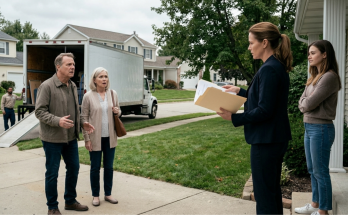
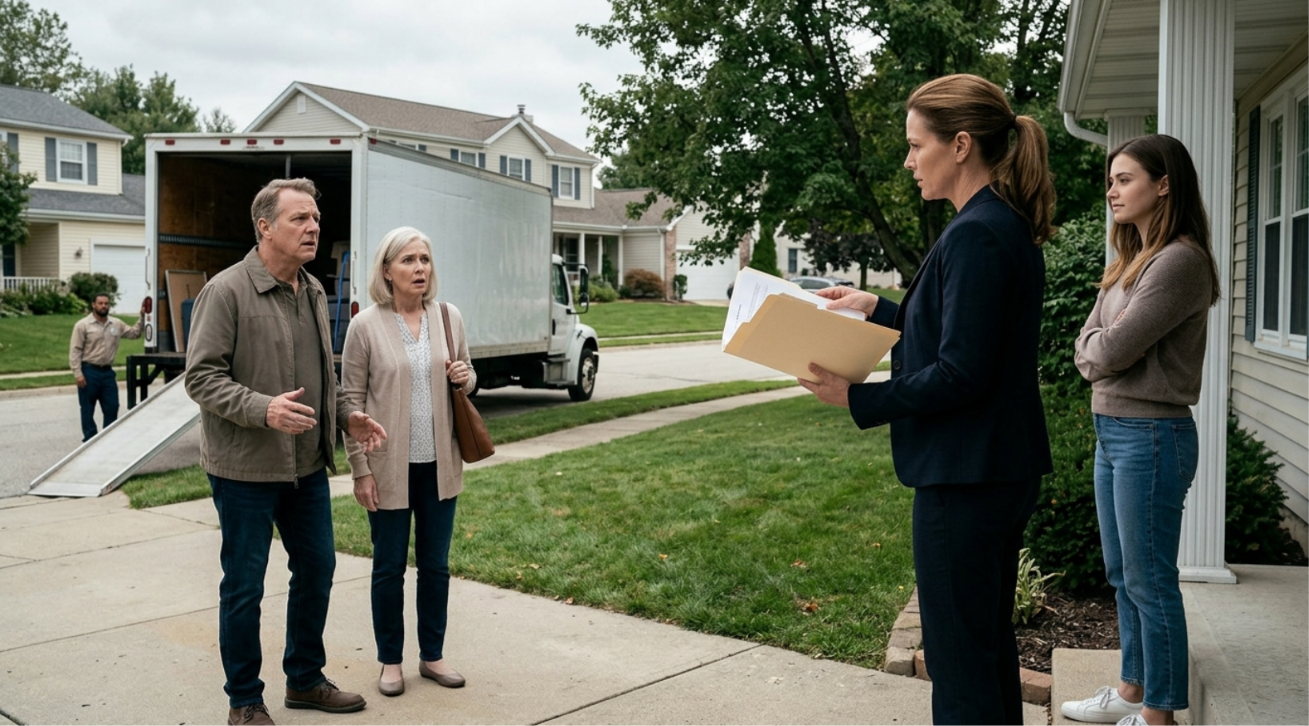
My parents had once stood in my kitchen and told me that my house wasn’t mine anymore.
They had arrived with a moving truck, convinced that I would pack my belongings, lower my head, and disappear quietly.
They expected me to surrender because that was what I had always done.
But they had forgotten one important thing.
I was no longer the daughter who needed their permission to live.
I was Brooke.
I owned my home.
I controlled my future.
And I finally understood that being someone’s daughter did not mean I had to sacrifice myself to keep them happy.
The house was still mine.
The inheritance was still mine.
But most importantly, my life was finally mine.
And that was something nobody could ever take away from me.