PART5
Grandma looked at her.
“Then don’t say anything today.”
Andrea looked toward William, then at me.
“Claire, you could have talked to me. You could have told me she was going to do this.”
I almost laughed.
“You left Grandma on my porch without her medication. You didn’t call to ask whether I could take care of her. You didn’t even tell me she was coming. And now you’re upset because I didn’t warn you about the decisions she made for herself?”
Andrea shook her head.
“You don’t understand.”
“No,” I said. “I think I understand a lot more than I did two days ago.”
Grandma gently touched my arm.
“That’s enough, Claire.”
I stopped.
She looked at Andrea one last time.
“I love you. I always will. But love doesn’t mean I have to agree with everything you do. It doesn’t mean I have to give you my home. It doesn’t mean you can make decisions for me because you believe you know what’s best.”
Andrea wiped her face.
“Are you going to forgive me?”
Grandma answered honestly.
“I don’t know yet.”
That answer seemed to hurt Andrea more than the documents.
Todd stood up.
“Come on, Andrea. Let’s go.”
Andrea remained seated for a few seconds.
Then she looked at Grandma.
“Can I call you tomorrow?”
“If you want to talk to me, you can call.”
“Will you answer?”
Grandma thought about it.
“If I’m ready, yes.”
Andrea nodded and left.
For the first time in my life, I watched my sister walk away without Grandma following her, without Grandma apologizing, and without Grandma trying to make everything right before the other person had even admitted they were wrong.
THREE WEEKS LATER
Grandma stayed with me for the first week.
Then she decided she wanted to go home.
Not because she was angry with me.
Not because she didn’t appreciate what I had done.
She simply missed her house.
She missed her garden.
She missed the kitchen where she had cooked for Grandpa for fifty-seven years.
She missed the little window above the sink where she could watch the birds.
William arranged for a home safety assessment, and Grandma agreed to a few practical changes.
We installed grab bars in the bathroom.
We added brighter lights in the hallway.
We arranged grocery delivery for heavy items.
We set up a medication reminder system that Grandma herself controlled.
She refused to let me turn her home into a hospital.
“I’m not moving into a medical facility,” she said when I suggested adding another handrail.
“It’s just a handrail.”
“I know. But if you add one more thing, I’m going to start charging admission to my house.”
I laughed.
She was still Grandma.
Still stubborn.
Still capable of making me feel like a twelve-year-old who had put too much salt in the soup.
On the day she returned to Oakridge, I helped her unpack.
She walked through the house slowly.
She stopped beside Grandpa’s chair.
She touched the armrest.
Then she stood in front of the fireplace and looked at the photographs.
“Your grandfather would have hated all this drama.”
I smiled.
“He would have hated Todd.”
She laughed.
“Oh, he would have had a few things to say about Todd.”
Then her smile faded.
“But he would have been proud that I finally said no.”
I hugged her.
And this time, she hugged me back without saying she was sorry for taking up my time.
ANDREA’S FIRST APOLOGY
Andrea didn’t call the next day.
She didn’t call the day after that.
For almost two weeks, there was silence.
Then, on a Sunday afternoon, Grandma’s phone rang.
Andrea.
Grandma answered.
“Hello.”
“Mom?”
“Yes.”
“I wanted to talk.”
“All right.”
There was a long pause.
Then Andrea said something I had never heard her say before.
“I’m sorry.”
Grandma didn’t immediately respond.
Andrea continued.
“I’m sorry I left you at Claire’s. I’m sorry I spoke to you like you were a problem. I’m sorry I made plans involving your house without asking you.”
Grandma sat down.
“Why did you do it, Andrea?”
Andrea began crying.
“Because I was scared. Todd was losing money. We had creditors calling. I was trying to save our house. I convinced myself that you would eventually agree to move in with us, and I thought selling Oakridge would solve everything.”
“And what if I didn’t agree?”
Andrea was quiet.
“I didn’t think about that.”
Grandma closed her eyes.
“That is the part I need you to understand.”
“I know.”
“No, Andrea. I don’t think you do yet.”
Andrea sniffed.
“Then tell me.”
Grandma took her time.
“You didn’t see me as a person with my own plans. You saw me as a solution to your problems. You decided where I would live. You decided what would happen to my home. You decided what I could afford to give you. And when I became inconvenient, you left me somewhere else.”
Andrea sobbed.
“I know. I know. I’m sorry.”
Grandma’s voice softened.
“I don’t want an apology that lasts one afternoon. I want you to understand why it happened so it never happens again.”
“I understand.”
“Do you?”
Andrea didn’t answer immediately.
Then she said:
“I think I do now.”
Grandma looked out the window at her garden.
“Good. Then we can start there.”
They talked for twenty minutes.
They didn’t discuss money.
They didn’t discuss the house.
They didn’t discuss the trust.
They talked about Grandma’s health, Andrea’s children, the weather, and an old recipe for apple pie.
When they hung up, Grandma didn’t look happy.
But she looked peaceful.
And that was enough.
THE TRUTH ABOUT THE $286,000
A month later, William confirmed the balance of the old property account.
The account had grown over the years through interest and a few deposits that Grandpa had arranged before his death.
The final balance was just over $291,000.
Grandma was surprised.
She asked William to explain every deposit.
She wanted to know where the money came from, whether any tax obligations existed, and whether the account had any restrictions.
After several meetings, she understood everything.
And then she made a decision.
She did not give the money to Andrea.
She did not give it to Todd.
She did not divide it among her children.
Instead, she used a portion to repair the Oakridge house, update the plumbing, replace the old roof, and make the home safer for her to live in.
She also set aside money for her own future care.
The remainder stayed invested under her control.
When Andrea heard about the repairs, she didn’t ask how much they cost.
For the first time, she simply said:
“Mom, I’m glad you’re taking care of yourself.”
Grandma replied:
“I should have started doing that sooner.”
CHRISTMAS AT OAKRIDGE
By December, Grandma decided to host Christmas.
Not because she wanted to prove anything.
Not because she wanted everyone to pretend the past hadn’t happened.
She simply wanted Christmas in her own home.
She invited the family.
Andrea came with Todd and the children.
My uncle came.
My aunt came.
I brought a casserole and a pie.
The house smelled of cinnamon, roasted turkey, and pine.
Grandma wore her red sweater.
The same one Grandpa had bought her years ago at a little store near the lake.
The children ran through the hallway.
Todd helped carry dishes.
Andrea stood in the kitchen, helping Grandma prepare the gravy.
For a while, it looked like the old Christmases.
But something was different.
Grandma wasn’t doing everything.
She wasn’t spending three days cooking.
She wasn’t paying everyone’s expenses.
She wasn’t quietly handing out envelopes of money when someone complained about bills.
She had asked everyone to bring one dish.
And everyone had.
After dinner, Grandma sat beside the fireplace.
Andrea came over and sat next to her.
“Mom?”
“Yes?”
“I’ve been thinking about what you said.”
Grandma looked at her.
Andrea swallowed.
“I think I used to believe that because you helped us so much, it was normal for you to keep helping. I didn’t think about how much it cost you. Not just money. Your time. Your energy. Your freedom.”
Grandma didn’t interrupt.
Andrea continued.
“I think I started treating your help like something I was entitled to.”
Her eyes filled.
“I’m sorry.”
Grandma reached for her hand.
“Thank you for saying that.”
Andrea looked toward the Christmas tree.
“I don’t expect you to trust me immediately.”
“Trust takes time.”
“I know.”
Grandma squeezed her hand.
“Then we’ll take our time.”
Todd stood across the room talking to my uncle.
He never apologized.
He never admitted what he had done.
But Grandma didn’t spend the evening trying to make him understand.
She had finally learned that not every person needed to agree with her for her to live peacefully.
THE LAST ENVELOPE
After everyone left, I helped Grandma clean the kitchen.
We wrapped leftovers.
Put dishes in the dishwasher.
Folded the tablecloth.
Grandma was tired, but she kept smiling.
When I was about to leave, she called me into the living room.
“I have something for you.”
She handed me a small envelope.
“Grandma, what is this?”
“Open it.”
Inside was a letter.
And a check.
I stared at the amount.
$10,000.
I immediately handed it back.
“Grandma, no. I can’t take this.”
She pushed it gently toward me.
“It’s not payment for today. It’s not payment for helping me. And it’s not because I need you to keep doing anything.”
“Then what is it?”
“It’s a gift.”
“I don’t need ten thousand dollars.”
“I know.”
“Grandma, you should keep your money.”
She smiled.
“Claire, I have kept my money. I have paid my bills. I have repaired my house. I have arranged my future. I have made sure I won’t depend on anyone to make decisions for me.”
She tapped the envelope.
“This is something I want to give. And I want you to accept it without feeling guilty.”
I looked at her.
“Why me?”
She took my hands.
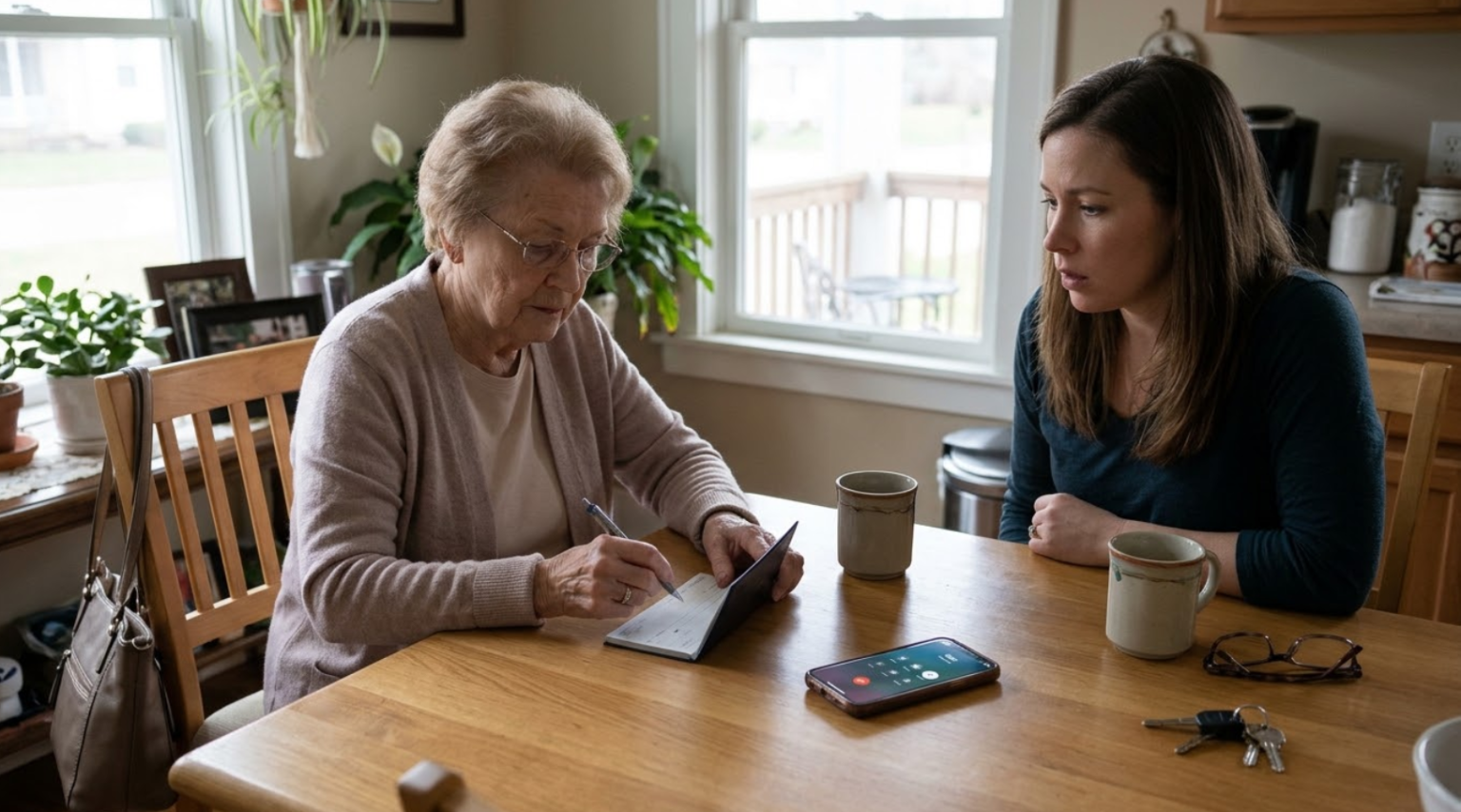
“Because when your sister left me on your porch, you didn’t ask how much trouble I would be. You asked whether I had my medication. You brought me inside. You made me tea. You drove me to the attorney because I asked you to.”
She paused.
“You didn’t try to take over my life. You helped me take it back.”
My eyes filled with tears.
“But Grandma, I didn’t do anything special.”
“That’s exactly what I mean.”
She smiled.
“You did what family is supposed to do. You didn’t treat me like a burden.”
I finally accepted the envelope.
But I hugged her before I could say anything.
And I cried against her shoulder.
THE HOUSE THAT WAS NEVER FOR SALE
The following spring, Grandma planted flowers along the Oakridge fence.
She planted yellow roses near the front porch.
She planted lavender beside the walkway.
She planted little white flowers around Grandpa’s old bench.
I visited every Saturday.
Sometimes I brought groceries.
Sometimes I brought lunch.
Sometimes we did nothing except sit outside and watch the birds.
Andrea started visiting too.
At first, she came once a month.
Then more often.
She never asked about the property account.
She never asked about Grandma’s will.
She never asked William about the trust.
One afternoon, she brought Grandma a framed photograph of Grandpa.
It was taken on their wedding anniversary.
Andrea had found it in an old box at her house.
Grandma held the picture for a long time.
Then she looked at Andrea.
“Thank you.”
Andrea sat beside her.
“I wish I had understood sooner.”
Grandma smiled sadly.
“Sometimes people understand only after they lose the privilege of doing things the old way.”
Andrea nodded.
She didn’t argue.
She didn’t make excuses.
She simply sat beside Grandma and held her hand.
It wasn’t a perfect reconciliation.
Todd remained distant.
The family never returned to the old arrangement where Grandma quietly solved every problem.
But the relationship between Grandma and Andrea slowly became something more honest.
And that was better than pretending.
ONE YEAR LATER
One year after the airport call, I visited Grandma on a sunny afternoon.
She was sitting on her porch swing.
The same porch where Andrea had left her.
The same porch where everything had changed.
I sat beside her.
“Do you ever regret changing your estate plan?”
She looked at me.
“Not once.”
“Do you regret what happened with Andrea?”
She thought about it.
“I regret that it happened. I regret that I didn’t recognize the problem sooner. But I don’t regret protecting myself.”
She watched a bird land on the fence.
“Claire, when I was younger, I thought being a good mother meant always saying yes. I thought if I gave enough, helped enough, forgave enough, then my family would never feel abandoned.”
She turned toward me.
“But I learned something.”
“What?”
“Sometimes saying yes to everyone else means saying no to yourself for the rest of your life.”
I sat quietly.
Grandma smiled.
“And I don’t have that much life left to spend saying no to myself.”
I laughed through my tears.
She reached for her iced tea.
Then she said something I would remember for the rest of my life.
“People can love you and still disappoint you. People can be family and still be wrong. And you can forgive them without giving them the keys to your house.”
She looked toward the Oakridge home.
Her home.
The home she had shared with Grandpa.
The home she had nearly lost because her family thought her generosity meant ownership.
“Your grandfather built that house with me,” she said. “We worked for it. We paid for it. We raised our children there. I have every right to finish my life in the place I love.”
I nodded.
“Yes, you do.”
She leaned back against the swing.
The wind moved gently through the roses.
For a moment, neither of us spoke.
Then Grandma laughed.
“Do you remember Andrea’s voice at the airport?”
I smiled.
“Unfortunately.”
Grandma shook her head.
“She said, ‘She’s your responsibility now.’”
I looked at her.
“And what do you think about that now?”
Grandma took a slow sip of tea.
“I think she was wrong.”
She turned toward me.
“I was never a burden. I was a mother, a grandmother, a wife, a woman who had spent her entire life caring for people. And when I finally needed a little care myself, I deserved kindness—not abandonment.”
She reached for my hand.
“And so did I.”
I squeezed her hand.
The porch swing moved gently.
The roses were blooming.
The house was quiet.
And for the first time in a long time, Grandma Evelyn didn’t feel like she had to prove her worth to anyone.
She was home.
She was safe.
She was free.
And the family arrangement that had existed for decades was finally over.
Not because she stopped loving her family.
But because she finally started loving herself enough to stop being afraid of losing them.


One Comment on “PART5: My Sister Left Grandma on My Porch and Called Her a Burden—But Grandma Had Already Changed Everything”
Comments are closed.