PART5
He had looked at the staircase, the dining room, and the framed photographs on the wall.
Then he said something I hadn’t understood until now.
“Things change, Mom. Sometimes other people have to make decisions for us.”
I had thought he was talking about the painters.
Now I wasn’t so sure.
Eleanor gathered the documents.
“I’ll contact the property registry and the relevant financial institutions. I’ll also arrange for an independent assessment of your wishes and capacity, so nobody can claim that you’re unable to make your own decisions simply because you disagree with them.”
“Will I have to stay here?”
“Not if you are legally free to leave and suitable arrangements can be made. We’ll review your admission status and speak with the appropriate authorities. I don’t want you making any sudden decisions before we understand the paperwork, but I won’t let you be ignored.”
I took her hand.
“Eleanor, I don’t want revenge.”
She gave me a small, sad smile.
“What do you want, Maggie?”
I thought of my garden.
The rosebush Frank had planted beside the kitchen window.
The little wooden bench where we used to drink coffee on Sunday mornings.
The kitchen where Scott had learned to bake pancakes, and where I had once believed that raising a child meant that, no matter what happened, he would always remember who loved him first.
“I want my home back,” I said.
“And I want my son to understand that being someone’s mother doesn’t mean I stop being a person.”
Eleanor nodded.
“Then that’s where we’ll begin.”
She packed the documents and stood.
At the door, she paused.
“One more thing, Maggie. I want you to prepare yourself. If Scott believed you had no resources, no support, and no way to challenge him, he may have made decisions he never expected anyone to examine.”
I looked down at Frank’s letter.
For the first time in days, I wasn’t waiting for Sunday.
I was waiting for the truth.
And somewhere across town, my son was about to discover that the mother he had abandoned had never been as powerless as he believed.
On Friday afternoon, Eleanor called me with news that made my hands go cold.
“Margaret, I’ve found the buyer.”
I sat upright in my bed.
“And?”
“The sale has been recorded, but there are serious irregularities in the documents. The buyer says Scott represented himself as your authorized agent. We’re working to establish exactly what happened and whether the transfer can be challenged.”
I closed my eyes.
Forty-four years of memories had become a line in a property record.
“Who bought my house?”
Eleanor hesitated.
“A company connected to Heather’s brother.”
For several seconds, I couldn’t speak.
Heather had carried my suitcase into Willow Creek. She had smiled at the receptionist. She had watched Scott kiss my forehead and promise to return on Sunday.
She had known.
“Did she help him?”
“I won’t accuse her without evidence,” Eleanor replied. “But we have enough reason to investigate the entire transaction.”
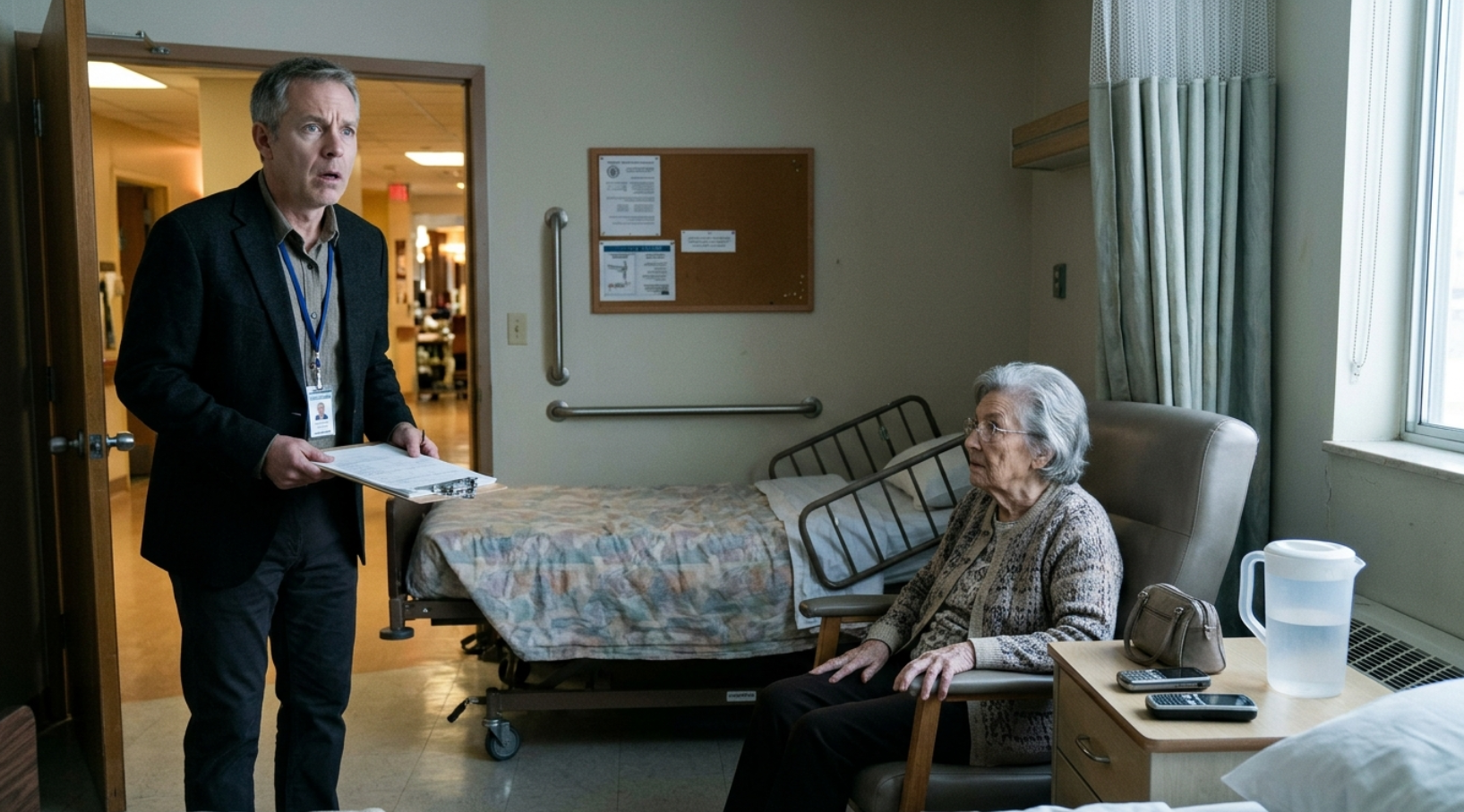
That evening, Dr. Reyes visited my room.
“Mrs. Dunmore, I want you to know that our review has uncovered several concerns. The admission paperwork describes you as someone who requires permanent placement, but there is no adequate assessment supporting that conclusion. We are also reviewing whether the person who signed you in had the necessary authority.”
“Can I leave?”
“We’re arranging an independent assessment and reviewing the legal documentation. I won’t promise you a particular outcome before those steps are complete, but your wishes matter. We will not simply accept your son’s instructions without question.”
For the first time, I slept peacefully.
Not because my problems had disappeared, but because I was no longer facing them alone.
On Saturday morning, Eleanor returned with a plan.
She had contacted the relevant property authorities, notified the appropriate people that the sale was disputed, and begun the process of challenging the documents. She had also arranged for my personal affairs to be reviewed independently.
The financial trust Frank had established was still active.
Its assets were protected under its own terms, and Scott had no automatic right to control them simply because he was my son.
Most importantly, the independent assessment confirmed what I had been saying all along.
I was capable of making my own decisions.
I knew my name, my address, the date, the value of my assets, and exactly where I wanted to live.
I was seventy-eight years old.
I was not confused.
I was not helpless.
And I was not going to let anyone convince me otherwise.
By Monday, Eleanor had arranged for me to leave Willow Creek once the necessary release and care arrangements were finalized.
But before I left, Dr. Reyes asked whether I would join her in the entrance hall.
She stood beneath Frank’s bronze plaque.
“I’ve been thinking about what your husband intended when he helped establish this place,” she said. “He wanted people to have dignity, regardless of their circumstances. I think we have some work to do to make sure we live up to that.”
I looked at the words engraved in bronze.
“Frank always believed that a person’s age should never determine their worth.”
“Then I hope you’ll allow us to learn from what happened to you.”
I squeezed her hand.
“Make sure the next person who arrives with a small suitcase is asked whether they truly want to stay.”
Dr. Reyes nodded solemnly.
“I promise we’ll take that seriously.”
Then I returned to my room, packed my three nightgowns, my reading glasses, and Frank’s photograph.
The same suitcase I had brought on the first day.
Only this time, I was leaving because I had chosen to.
And I was going home.
Or at least, I was going to fight for it.
The Truth Comes to Light
Two weeks later, Eleanor called me into her office.
She had obtained additional records relating to the sale of my house, and the picture was becoming clearer.
Scott had submitted a power of attorney that he claimed gave him authority to act for me. The document had not been properly verified, and its validity was now being formally challenged.
There were also emails showing that Heather’s brother’s company had been discussing the purchase before I was admitted to Willow Creek.
The messages suggested that the family had planned the transaction in advance.
One email from Scott read:
Once she’s settled in, she won’t have a reason to come back. We can take care of the house before she changes her mind.
I read those words twice.
Then a third time.
Once she’s settled in.
As though I were a piece of furniture being moved into storage.
Eleanor gently took the papers from me.
“Margaret, you don’t have to read any more today.”
“No,” I said. “I need to know.”
There were more messages.
Heather had worried that I might contact Eleanor.
Scott had assured her that I wouldn’t.
Mom trusts me, he had written. She won’t make trouble.
I placed the papers on the desk.
For years, I had believed that Scott’s occasional selfishness was simply a flaw I could overlook because he was my son.
I had defended him when he forgot birthdays.
I had forgiven him when he borrowed money and repaid it late.
I had made excuses when he failed to visit Frank during his final months.
I had told myself that every family had problems, and that a mother’s job was to love her child through them.
But I finally understood something painful.
My love had never been the problem.
My refusal to recognize his behavior had allowed it to continue.
“What happens now?” I asked.
Eleanor answered carefully.



One Comment on “PART5: My Son Abandoned Me in a Nursing Home—Then the Director Read My Name and Discovered Who I Really Was”
Comments are closed.