PART6
He looked at me.
“For the way I spoke to you.”
“Anything else?”
“For not standing up for you.”
“Anything else?”
His expression grew uncomfortable.
“I don’t know what else you want me to say.”
“I don’t want you to say anything you don’t mean.”
The room fell silent.
I could have told him that he had disappointed me.
I could have reminded him of every school play I attended after working twelve hours in the fields, every winter morning I drove him to college, every time I lent him money without asking when I would get it back.
But love was not a ledger.
I had not raised my son so I could collect interest on every sacrifice.
I had raised him hoping he would become a man who could recognize another person’s dignity, even when defending that dignity was inconvenient.
I leaned forward.
“Shane, when you were nine years old, you came home crying because a boy at school told you your boots smelled like manure. Do you remember that?”
He nodded reluctantly.
“You were embarrassed. You didn’t want to go back the next day. I told you that the smell came from working for a living, and there was nothing shameful about it.”
“I remember.”
“I told you that people might judge you by your clothes, your house, your job, or the money in your pocket. But those things didn’t tell you whether someone was good.”
I paused.
“You understood that when you were nine. Somewhere along the way, you forgot it when you were forty.”
Shane’s eyes reddened.
Danica crossed her arms.
“This is ridiculous. You’re turning a birthday dinner into a lecture about morality.”
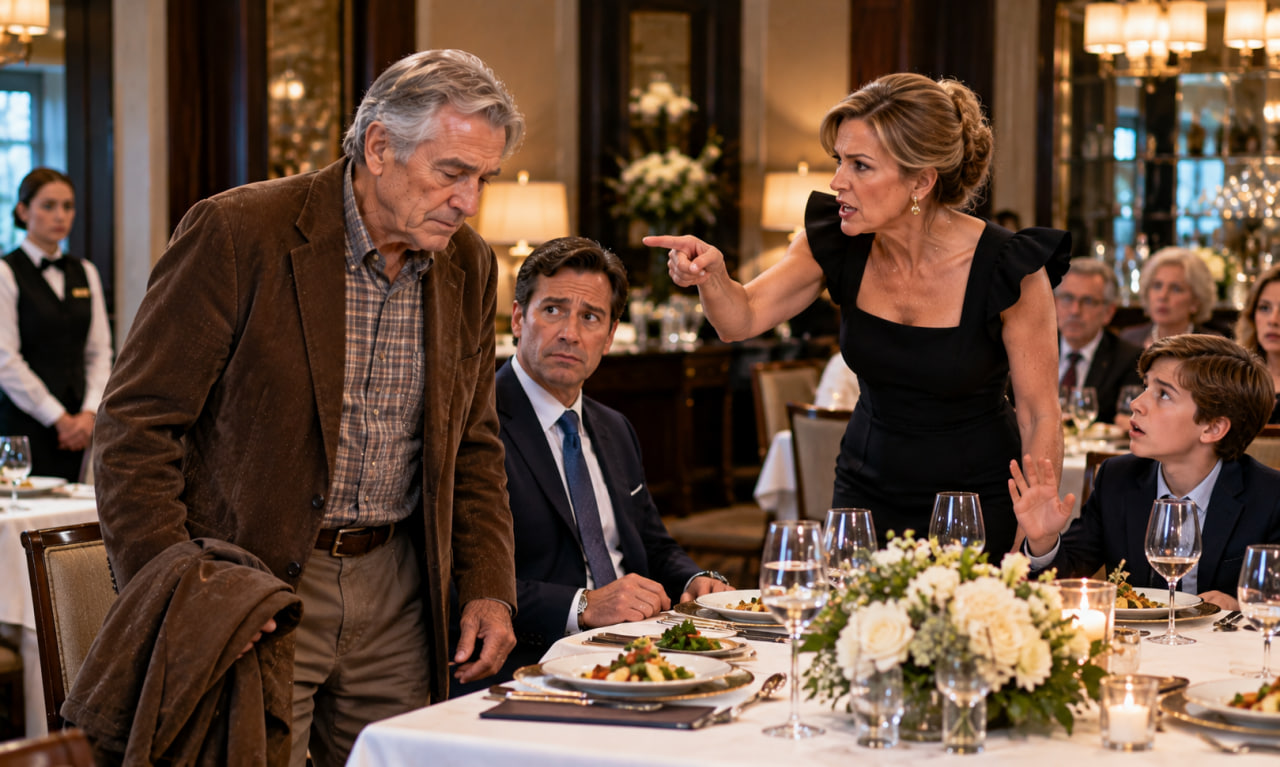
“No,” I said. “I’m trying to understand why a family that claims to love one another could sit at a table and allow one person to be humiliated for the crime of wearing an old jacket.”
Shane stared at the photograph.
Then he whispered something I hadn’t expected.
“I saw Bo stand up.”
I looked at him.
“What?”
“When Mom told you to leave, Bo stood up. I saw him push his chair back. He was going to say something.”
His voice broke slightly.
“I told him to sit down.”
I remembered the scrape of the chair against the floor.
I remembered Bo’s frightened face.
I hadn’t known Shane had noticed.
“Why did you tell him to sit down?”
Shane covered his mouth with one hand.
“Because I was ashamed.”
“Of what?”
He looked at me.
“Of you.”
The words landed harder than the first insult had.
He continued before I could respond.
“I was ashamed of the jacket. Of the truck. Of the way you talked about the farm. I know how terrible that sounds, but I kept thinking about my boss and the other guests, and I wanted everything to look perfect.”
He swallowed.
“I wanted them to think I’d made it.”
I studied my son.
There it was.
Not the whole explanation, perhaps, but the beginning of an honest one.
Shane had spent years climbing toward a life in which people admired his success. He had measured his progress through job titles, watches, expensive dinners, and the approval of people who barely knew him.
And somewhere along the way, he had begun to see his own father as a reminder of everything he feared becoming.
A man who worked hard.
A man who wore the same jacket for decades.
A man who didn’t need a room full of strangers to confirm his worth.
I felt a deep sadness for him.
Not because he had embarrassed me.
Because he had become so frightened of appearing ordinary that he had failed to recognize the extraordinary love that had carried him through his life.
I looked at the watch on his wrist.
“Your mother would have liked that watch.”
He glanced down.
“Really?”
“She liked beautiful things. But she always wanted to know the story behind them.”
He removed the watch and placed it on the table.
“I don’t know what story I want mine to tell,” he said.
For the first time that morning, I had no answer ready.
Then Danica interrupted.
“This is all very touching, but we still need to resolve the actual issue. If your father owns the hotel, then surely he understands that a director has to maintain standards.”
Shane turned toward her.
“Danica, stop.”
She stared at him.
“What?”
“Just stop for a minute.”
“You’re taking his side?”
He looked at her in disbelief.
“I’m asking you to stop talking long enough to think about what happened.”
She went pale.
It was the first time I’d heard Shane challenge her in public.
It was also the first time that morning he seemed to understand that a decision was his to make, rather than something he had to do to keep someone else happy.
But Danica wasn’t finished.
“You have no idea what I’ve sacrificed for your career,” she said. “I organized that dinner. I managed the guest list. I spent weeks making sure everything was perfect. And now your father has turned the entire thing into a personal attack.”
Shane looked at the floor.
Then he looked at me.
“Dad, can we talk privately?”
I considered the request.
“Of course.”
I turned to Melissa.
“Please continue the review without me for a few minutes. I don’t want my family relationship to influence your findings.”
Then I stood, took the cracked frame, and followed Shane into the small sitting room next door.
For the first time since the previous evening, we were alone.
And what he said next changed the conversation completely.
Shane closed the door behind us.
For a moment, neither of us spoke.
The sitting room overlooked the hotel’s courtyard, where a gardener was trimming the hedges. Guests were walking through the lobby below, carrying suitcases and talking about their plans for the day.
The Ambrose was operating as usual.
Somewhere in the kitchen, someone was preparing lunch.
A young employee was probably learning how to carry three plates at once.
Life continued, even when a family found itself at the edge of something it could not easily repair.
Shane sat on the sofa.
I remained standing.
“Dad,” he said, “there’s something I haven’t told you.”
I waited.
“Things haven’t been going well at work.”
I pulled a chair closer.
“How badly?”



One Comment on “PART6: My Daughter-in-Law Had Security Throw Me Out of My Son’s 40th Birthday—The Next Morning, She Found Me in the Manager’s Office”