PART6
He came over on Saturdays and helped me repair a loose cabinet door. He brought Penny to bake cookies. He started asking about my investments, but when I told him I preferred not to discuss specific holdings, he respected that boundary.
Stacy remained distant.
She sent polite messages and attended one family lunch, but I could tell she was still uncomfortable with the new reality.
I didn’t demand that she become my friend.
I didn’t need her to admire me.
I needed her to understand that respect wasn’t something she could switch on and off depending on my financial circumstances.
That lesson would take time.
And then, in March, I received an unexpected phone call.
It was Stacy.
Her voice was quieter than usual.
“Theodora, could I speak with you privately?”
“Of course.”
She hesitated.
“I owe you an apology.”
I said nothing, allowing her to continue.
“I was wrong about Christmas. I wanted everything arranged my way, and I treated you as though you were an inconvenience. I told myself I was simplifying the holiday, but that wasn’t the whole truth.”
“What was the rest of the truth?”
She exhaled.
“I had started thinking of you as someone who would always be there. Someone who would always forgive us. I didn’t think about what it felt like to be you.”
I sat very still.
“I also became embarrassed after the financial news,” she continued. “I realized how much I didn’t know about you. Instead of being happy that you’d succeeded, I immediately started worrying about what it meant for us.”
“That must have been an uncomfortable realization.”
“It was.”
She paused.
“I don’t expect you to forgive me immediately. I just wanted to say that I’m sorry. Not because of the money. Because of what I did.”
For the first time, her apology sounded as though it belonged to her rather than to the circumstances.
“Thank you for telling me,” I replied. “I appreciate it.”
“Do you think we could start again?”
“We can try. But trust takes longer to rebuild than it takes to break.”
“I understand.”
We spoke for another ten minutes.
It wasn’t a magical reconciliation. We didn’t suddenly become close.
But something had shifted.
Stacy had finally acknowledged what happened without blaming the stress of the holidays, and I had no intention of pretending that an apology erased every hurt.
Still, it was a beginning.
By the following Christmas, the foundation had funded its first group of rural healthcare projects. I visited one of the clinics with the team, met the staff, and watched a mobile medical unit arrive in a community where residents had previously traveled hours for routine appointments.
I returned home that evening exhausted but deeply grateful.
For years, I had measured success by returns, risk, and the performance of a portfolio.
Now I had another way to measure it.
A grandmother who could get her blood pressure checked without taking an entire day off work.
An older man who could consult a specialist without asking his children for money.
A family that didn’t have to postpone care because the nearest clinic was too far away.
Those were returns I could feel.
And they were worth more to me than any headline.
The following December, Todd called me three weeks before Christmas.
“Mom, we’re hosting dinner this year,” he said.
I smiled slightly.
“That sounds nice.”
“We’d really like you to come.”
I waited.
“And before you ask,” he continued, “Stacy and I have already discussed it. You’re welcome because you’re family, not because of anything in the news. Penny has been talking about baking lasagna with you for weeks.”
I looked toward my freezer.
The lasagna I had made the previous Christmas was still there, carefully wrapped and labeled.
I had never thrown it away.
Perhaps some part of me had been waiting until I could look at it without remembering the pain of that night.
“Thank you for inviting me,” I told him. “I’d be happy to come.”
On Christmas Eve, I prepared a fresh lasagna.
Not because I needed to prove anything.
Not because I hoped the family would finally appreciate my cooking.
I made it because I enjoyed cooking, because Penny loved helping, and because I wanted to bring something to a table where I had been genuinely invited.
When I arrived at Todd’s house, Penny ran down the hallway.
“Grandma! You came!”
She hugged me so tightly that I nearly dropped the dish.
Stacy appeared behind her.
For a second, we looked at each other.
Then she stepped forward.
“I’m glad you’re here, Theodora.”
“Thank you.”
She reached for the lasagna.
“Let me take that for you.”
It was such a small gesture.
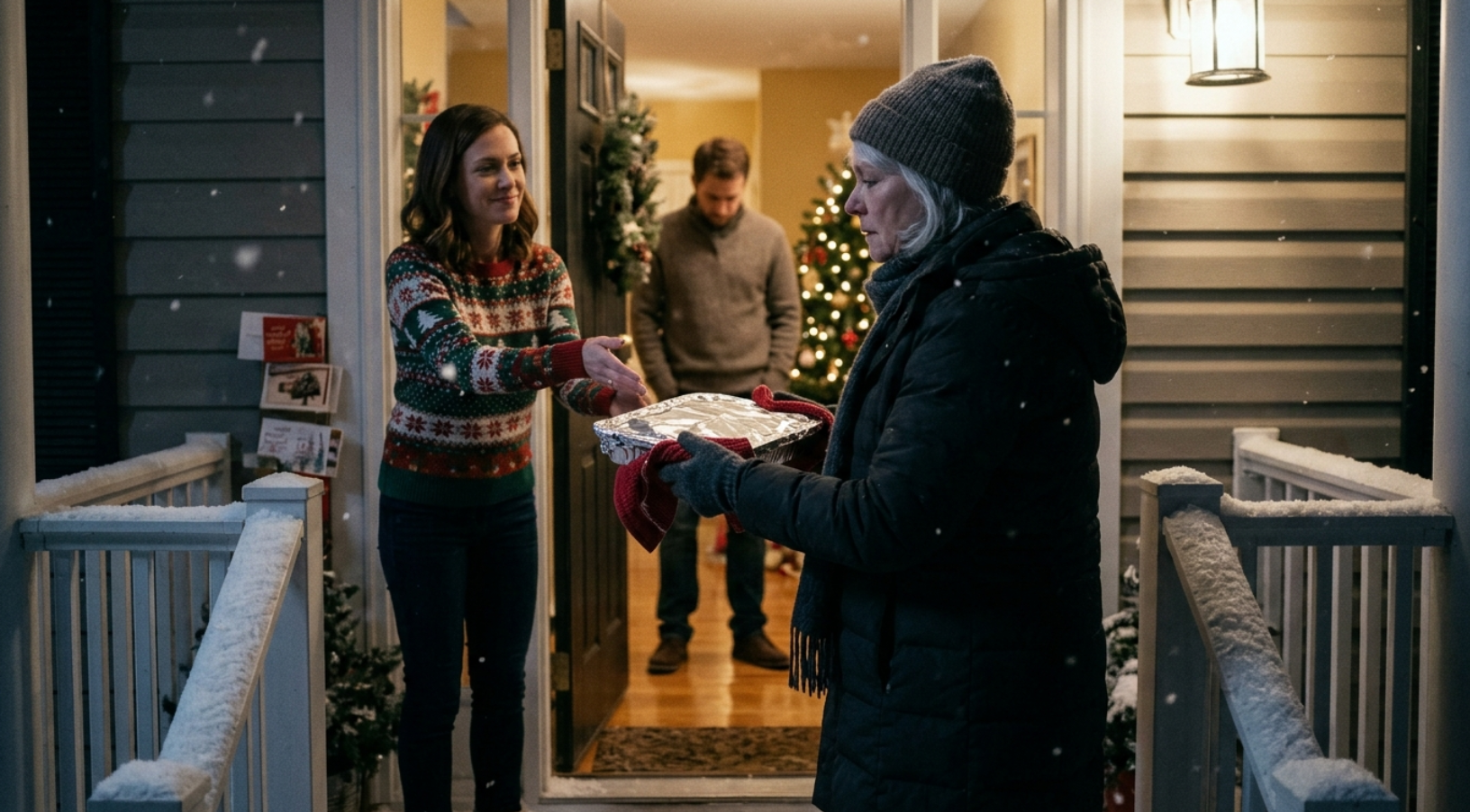
But I remembered the previous Christmas, when she had returned my dish without even letting me cross the threshold.
This time, she carried it into the kitchen.
The house was full of conversation, music, and the smell of roasted vegetables. Todd had arranged a seat for me beside Penny, and the family ate together without anyone making me feel that I was taking up space.
After dinner, Penny brought out a stack of drawings.
She had drawn the foundation’s mobile medical unit after seeing a photograph I had shown her.
“This is the clinic,” she explained, pointing to a box with wheels. “And these are the people who get to see the doctor.”
“That is wonderful, sweetheart.”
She smiled proudly.
Then she showed me another drawing.
It was a Christmas tree surrounded by four people: Todd, Stacy, Penny, and me.
Above them, she had written:
MY FAMILY IS BETTER WHEN WE ARE KIND.
I hugged her and kissed the top of her head.
Across the room, Todd watched us.
Later that evening, he found me standing beside the window, looking at the snow beginning to fall.
“Mom?”
“Yes?”
“I’ve been thinking about last year.”
“So have I.”
“I keep remembering how you must have felt driving home alone. I knew you’d been hurt, but I don’t think I really understood how much until I imagined someone treating Penny that way when she’s older.”
He swallowed.
“I should have stood up for you.”
“Yes,” I said softly. “You should have.”
“I can’t change what I did.”
“No. But you can decide what kind of man you want to be from now on.”
He nodded.
Then he reached into his pocket and handed me a small envelope.
Inside was a photograph of the three of us—Todd, Penny, and me—taken that afternoon.
On the back, he had written:
Mom, thank you for giving me the chance to do better. I know I don’t deserve to forget what happened, but I hope I can keep showing you that I’ve learned from it. I love you.
I read the message twice.
Then I tucked the photograph into my handbag.
“I love you too, Todd.”
He hugged me.
This time, there was nothing awkward about it.
Stacy joined us a few minutes later. She apologized once more, quietly, without excuses or requests.
I accepted her apology.
Forgiveness, I had learned, did not mean pretending the past had never happened. It meant allowing people the opportunity to prove that the future could be different.
I didn’t give Todd a large sum of money that Christmas.
I didn’t announce a special inheritance.
I didn’t promise Stacy that they would eventually receive a particular share of my fortune.
My estate plans remained private, carefully prepared with independent legal advice, and designed around my own wishes. The foundation had its own governance and financial safeguards.
My son and his family would have to build their lives through their own choices, just as I had built mine.
And I would continue helping them in the ways I considered appropriate—not out of guilt, not out of fear of losing them, and never as the price of being loved.
That night, when I drove home, I carried an empty lasagna dish in the passenger seat.
I smiled when I noticed it.
The previous year, I had driven home with an untouched meal and a broken heart.
This year, I was driving home with leftovers, a photograph, and the knowledge that my place in the family was no longer something I had to beg for.
I was sixty-four years old.
I had spent forty-one years learning how money worked.
It had taken me much longer to understand something far more important.
Money can reveal people’s priorities, but it cannot create genuine love.
My wealth had given me choices. It had allowed me to support communities, protect my independence, and build something that would continue helping people long after I was gone.
But it hadn’t made me more worthy of a place at my son’s table.
I had always deserved that respect.
Even when my bank account was smaller.
Even when I was simply a tired mother carrying a homemade lasagna through the cold.
And if I could offer one lesson from everything that happened, it would be this:
Never measure someone’s value by what they can give you.
The person you overlook today may be carrying a lifetime of sacrifice you never bothered to notice.
And sometimes, the greatest change in a family doesn’t begin when someone becomes rich.
It begins when someone finally learns to treat the people they love with kindness.
A few months later, I stood in front of the first rural medical clinic funded by my foundation. As I watched an elderly woman thank the nurses for helping her receive treatment she had postponed for years, I realized that my greatest achievement had never been the $186 million.
It was what I could do with it.
Todd stood beside me, holding Penny’s hand. Stacy had come too. Our relationship wasn’t perfect, and the pain of that Christmas never completely disappeared, but we were learning to build something more honest.
Before we left, Todd turned to me.
“Mom, I wish I had stood up for you that night.”
I squeezed his hand.
“Then make sure you stand up for what’s right the next time.”
He nodded, his eyes full of tears.
That Christmas, I didn’t bring lasagna because I was afraid of being forgotten. I brought it because I was loved, respected, and genuinely welcome.
And when Stacy opened the door, she stepped aside, smiled warmly, and said, “Come in, Mom. We’ve been waiting for you.”
I walked inside with my granddaughter’s hand in mine.
For the first time in years, I felt completely at home.
I had spent two years building a fortune, but my greatest victory was discovering that I no longer needed anyone’s approval to know my worth.
At 63, I learned that it is never too late to start a new chapter—and never too late to teach the people you love how you deserve to be treated.


One Comment on “PART6: My Daughter-in-Law Turned Me Away on Christmas—Then My $186 Million Fortune Made Headlines, and My Son Finally Realized What He Had Lost”
Comments are closed.