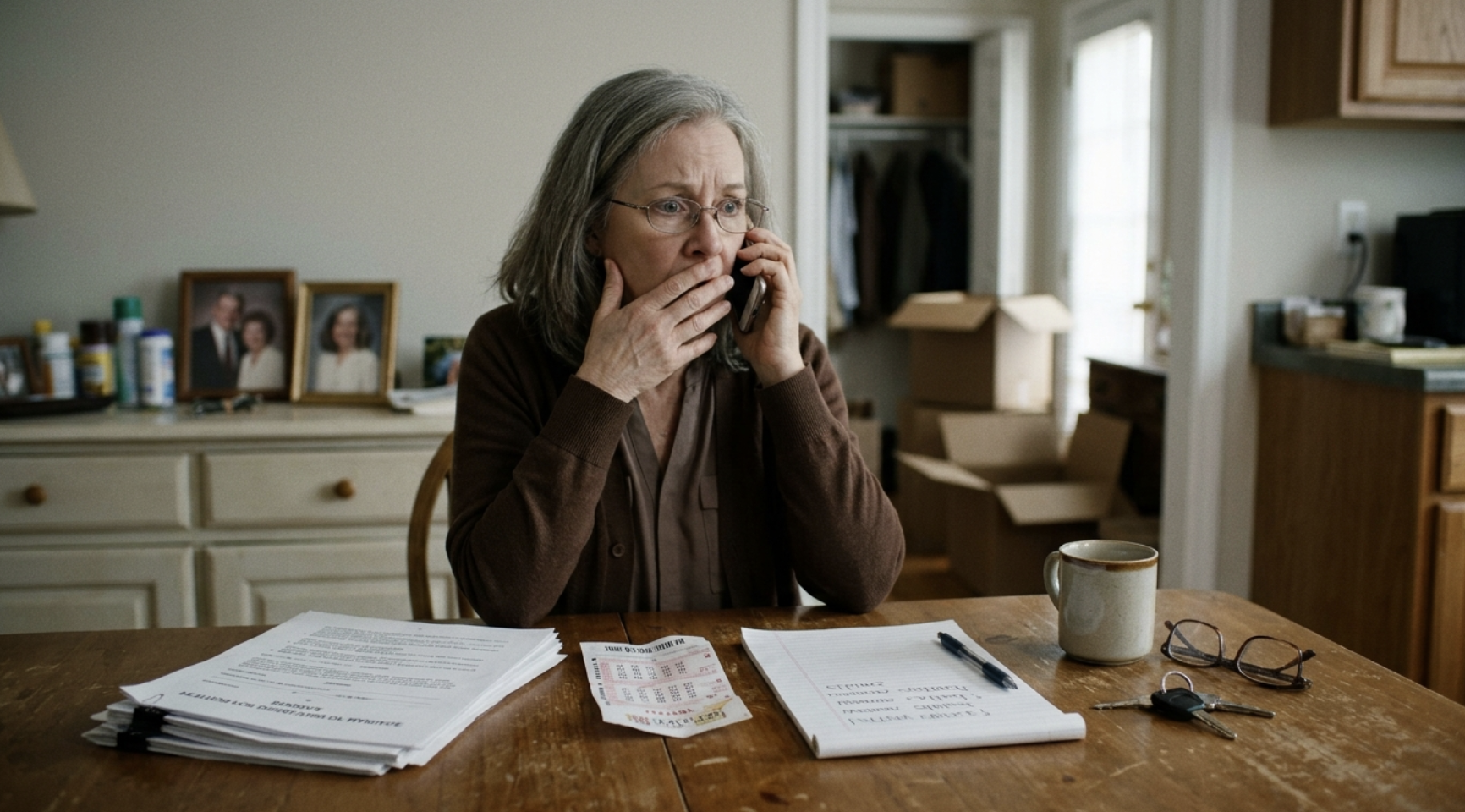
PART6
Linda told me the investigation was ongoing and that no final decision had been made about the prize.
I thanked her and left.
On my way home, I stopped at the bank and requested copies of several old statements.
The teller printed them and placed them in a folder.
I sat in my car and looked through the pages.
At first, the transfers seemed random.
Two hundred dollars here.
Five hundred there.
A thousand every few months.
But when I arranged them by date, a pattern emerged.
The amounts had increased during the last two years.
And several of the larger transfers occurred shortly after Gary had insisted that we were struggling financially.
I remembered those conversations.
The new roof would have to wait.
The bathroom repairs were too expensive.
We couldn’t afford to help Emily with her student loan payments.
I remembered taking extra shifts at a local bookkeeping office and selling homemade pies to neighbors during the holidays.
I remembered telling myself that marriage meant making sacrifices.
What I hadn’t understood was that I had been sacrificing for a household whose finances were not what Gary had told me they were.
That evening, I searched the filing cabinet again.
Behind a stack of old insurance papers, I found a sealed envelope with Gary’s handwriting on the front.
It was addressed to someone named Richard.
I didn’t recognize the name.
The envelope had never been mailed.
Inside was a letter dated three months earlier.
Richard,
I think I’m finally ready to make a clean break. Patty has no idea how much I’ve put away, and she doesn’t need to know until everything is settled. The house will be easier to deal with once I file. If I can get the timing right, I’ll be able to start over without carrying the old life with me.
I read it twice.
Then a third time.
There was no mention of the lottery.
The letter had been written months before the winning numbers were drawn.
Gary had already been planning to leave me.
The lottery hadn’t created his decision.
It had simply given him a reason to believe he could leave with more.
I took photographs of the letter and called Mr. Harris.
He asked me to preserve the original and bring it to his office.
“Don’t write on it or alter it,” he said. “We’ll document where you found it.”
I placed it in a clean folder.
Then I sat on the edge of the bed we had shared for thirty-four years.
I thought about our first apartment, where the kitchen was so small that only one person could stand at the counter.
I thought about our children learning to ride bicycles in the driveway.
I thought about the years I had worked overtime to help pay for college, the evenings I had waited for Gary to come home, and the vacations we had postponed because there was always something more important to pay for.
Had he been planning to leave me during all those years?
Had he been sitting across from me at dinner, asking me to save money on groceries, while quietly imagining a future in which I no longer existed?
I would never know the answer to every question.
But I finally understood that I didn’t need every answer to make a decision.
I could grieve the marriage I thought I had.
I could remember the good moments without pretending the bad ones hadn’t happened.
And I could refuse to let the last chapter of my life be written by a man who believed my loyalty made me weak.
The next morning, I signed the papers Mr. Harris had prepared in response to the divorce filing.
For thirty-four years, I had signed school forms, mortgage documents, birthday cards, and Christmas checks with the same name.
Patricia Dunn.
That morning, I signed it on a document that represented something different.
Not the end of my life.
The beginning of my own.
The Day the Truth Came Out
Three weeks later, the lottery office contacted Mr. Harris.
The investigation had progressed, and they wanted a formal meeting with both parties and their attorneys.
I arrived early.
Gary came in ten minutes later wearing a new suit.
He looked healthier than he had at our first meeting. His hair was neatly combed, and he carried a leather folder under his arm.
He glanced at me and gave a small, confident smile.
For a moment, I wondered whether he had convinced himself that the entire situation would somehow disappear if he acted as though he were the reasonable one.
Linda entered with another official and several documents.
“We’ve reviewed the information provided by both parties,” she began. “The claim remains subject to the applicable rules and final legal determinations. However, the evidence supports several important findings.”
Gary leaned forward.
Linda continued.
“The ticket was sold at the location identified by Mrs. Dunn. Her records demonstrate a long-standing pattern of purchasing the same numbers. The ticket bears her signature and the date she says she purchased it. The documentation she provided is consistent with that account.”
Gary interrupted.
“Those records don’t prove she bought this particular ticket.”
“That’s one reason the review was necessary,” Linda replied. “We have also considered the information concerning your possession of the ticket and the statements made during the initial claim.”
She paused.
“Your explanation has changed several times.”
Gary’s jaw tightened.
Linda turned to me.
“Mrs. Dunn, we are continuing to work through the ownership and legal issues. The prize cannot be released until those issues are resolved.”
I nodded.
Then Linda placed a document on the table.
“Mr. Dunn, we also need clarification about your statement that you purchased the ticket yourself. The information provided to us does not substantiate that claim.”
Gary stared at the paper.
His attorney leaned over to speak quietly with him.
I watched his expression change from confidence to confusion, then to anger.
“This is ridiculous,” he said. “We’re married. It doesn’t matter who bought the ticket.”
His attorney whispered something else.
Gary stood abruptly.
“I want a minute.”
Linda agreed to a brief recess.
In the hallway, Gary caught up with me.
“You’ve made your point,” he said. “Now stop.”
I turned toward him.
“What point is that?”
“You’ve embarrassed me. You’ve dragged lawyers into this. You’ve made me look like a criminal.”
“I didn’t take the ticket, Gary.”
“You know what I mean!”
“Yes,” I said quietly. “I think I do.”
He glanced around to see whether anyone was listening.
Then he lowered his voice.
“Look, we can settle this between us. I’ll withdraw the divorce. We’ll claim the money together. I’ll make sure you get your share.”
I stared at him.
“Your share?”
“Our share. Whatever. You know what I mean.”
I could have shouted.
I could have reminded him of every lie, every accusation, every humiliating remark he had made.
Instead, I asked him one question.
“If the ticket had been worth two dollars instead of two million, would you have come back?”
His face hardened.
“You’re impossible.”
He walked away.
I watched him disappear into the conference room.
And I knew that whatever happened to the prize, I would never return to the marriage he was offering me.
Not because I wanted revenge.
Because I had finally stopped confusing being needed with being loved.
A Different Kind of Victory
The legal process took months.
There were meetings, financial disclosures, arguments over the transfers, and long conversations with Mr. Harris about the difference between what I believed was fair and what the law would actually permit.
The lottery office eventually completed its review of the ticket, but the prize could not simply be handed over without considering the remaining legal issues. My attorney made sure the claim and the divorce proceedings were handled properly.
Gary’s lawyer argued that the prize should be treated as marital property.
Mr. Harris argued that the evidence of my purchase and ownership needed to be considered under the relevant state law.


One Comment on “PART6: My Husband Filed for Divorce After We Won $2.4 Million—But He Never Checked the Back of the Lottery Ticket”
Comments are closed.