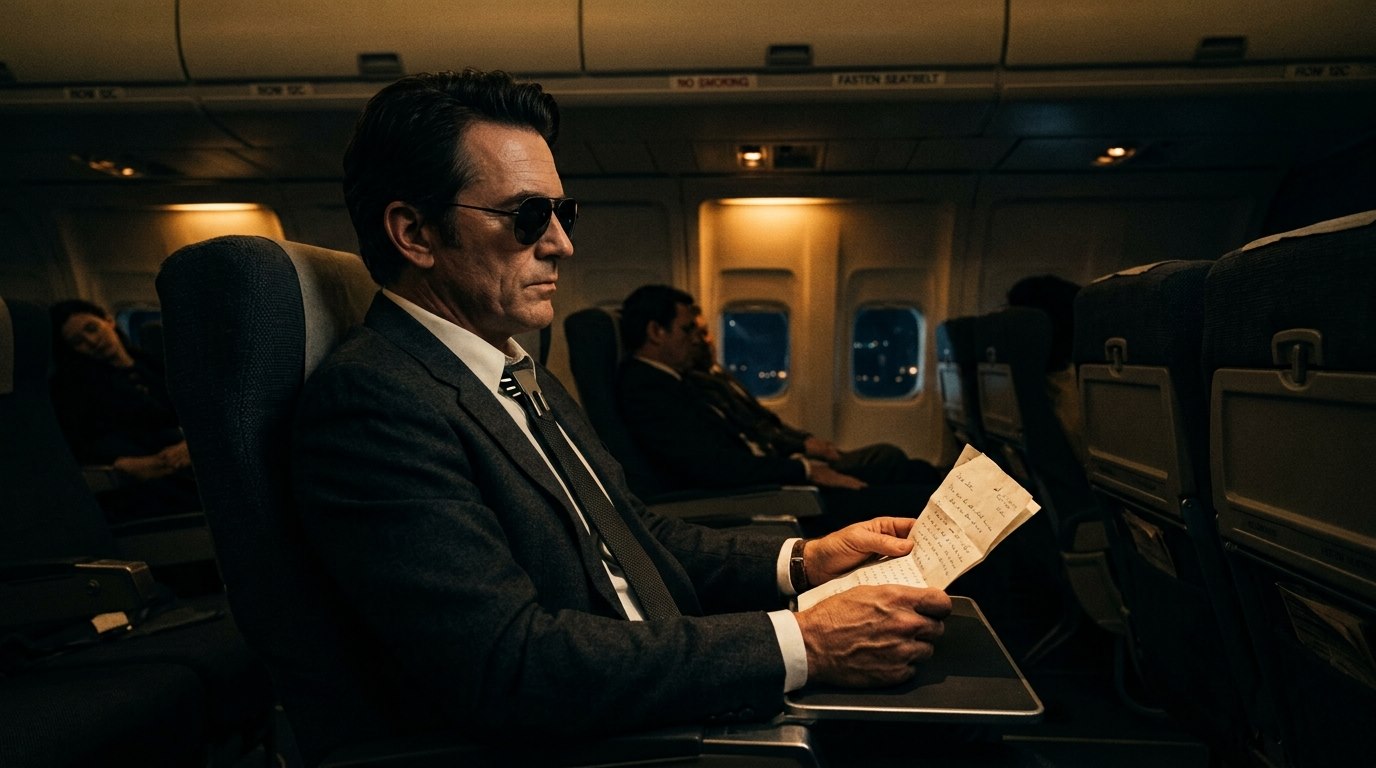
On the rainy afternoon of November 24, 1971, a man carrying a black attaché case bought a one-way ticket from Portland, Oregon, to Seattle, Washington. He gave the name Dan Cooper. He was dressed like a corporate executive: a dark suit, ironed white shirt, and a black clip-on tie.
Shortly after takeoff, he handed a folded note to flight attendant Florence Schaffner. Thinking he was just another lonely businessman giving her his phone number, she dropped it into her purse. Cooper leaned toward her and whispered, “Miss, you’d better look at that note. I have a bomb.”
Inside his briefcase were red cylinders attached to wires and a battery. His demands were precise: $200,000 in negotiable American currency (twenty-dollar bills), four parachutes, and a fuel truck waiting in Seattle. The FBI complied. After releasing the 36 passengers in Seattle, Cooper ordered the pilots to fly toward Reno, Nevada, at a low altitude of 10,000 feet with the landing gear deployed.
Somewhere over the dense, freezing wilderness of southwestern Washington, while a violent winter storm raged outside, Cooper lowered the plane’s rear stairwell. At 8:13 PM, the aircraft’s tail suddenly bounced upward—the exact moment Cooper leaped into the freezing void with $200,000 strapped to his body. Despite an immediate, massive search by the FBI and the US Army, not a single trace of the man was ever found in the dense pine forests below.
For decades, the official FBI theory was that Cooper couldn’t have survived the jump. The pitch-black night, sub-zero wind chill, and rugged terrain would have been fatal to an experienced skydiver, let alone a man wearing loafers and a trench coat.
However, in 1980, a young boy named Brian Ingram was digging a campfire pit on a sandy beach along the Columbia River when he uncovered three decaying bundles of $20 bills. The serial numbers matched Cooper’s ransom money. Yet, the bills were arranged in a way that suggested they had deposited by natural river currents years after the jump—meaning Cooper likely survived the landing and hid the stash.
The most shocking breakthrough came from the one physical item Cooper left behind on the plane: his cheap, J.C. Penney clip-on tie. Using modern Scanning Electron Microscopy, independent citizen sleuths and forensic scientists recently analyzed the tie and discovered over 100,000 microscopic particles embedded in the fabric.
Among these particles were pure titanium, bismuth, and aluminum alloys—materials that were extremely rare in 1971 and only handled in specialized aerospace laboratories and military defense contractors, such as Boeing’s Supersonic Transport (SST) project. This physical evidence suggests D.B. Cooper was not a common criminal or a rough outdoorsman, but a highly skilled chemical or aerospace engineer who likely worked in the very industry he targeted. To this day, the case remains the only unsolved skyjacking in commercial aviation history.