2 LaGuardia Air Traffic Controllers Left Early Before Deadly Air Canada Crash, FAA Weighs Discipline
NEW YORK — August 29, 2026 — Two air traffic controllers at New York’s LaGuardia Airport allegedly left work about an hour early on the night of a deadly runway collision involving an Air Canada Express jet, prompting the Federal Aviation Administration to pursue disciplinary action that could include firing the pair.
The revelation adds a significant new element to the investigation into the March 22, 2026 crash, which killed both pilots and sent 39 people to hospitals.
Two Controllers Reportedly Left About an Hour Early
According to the Associated Press, a government official familiar with the investigation said two controllers departed LaGuardia’s tower roughly an hour before their scheduled shifts ended.
Their departure left two controllers in the tower during an unusually busy period that included frequent arrivals and an emergency involving another aircraft on the ground.
The controllers who departed had been scheduled to remain at the airport beyond the time of the crash and therefore could have been available as additional backup, according to the official cited by AP.
The FAA is pursuing disciplinary action against the two employees, potentially including termination.
Transportation Secretary Sean Duffy characterized leaving before completing a paid shift as unacceptable and said the government would take action when employees fail to fulfill their responsibilities.
What Happened in the LaGuardia Crash?
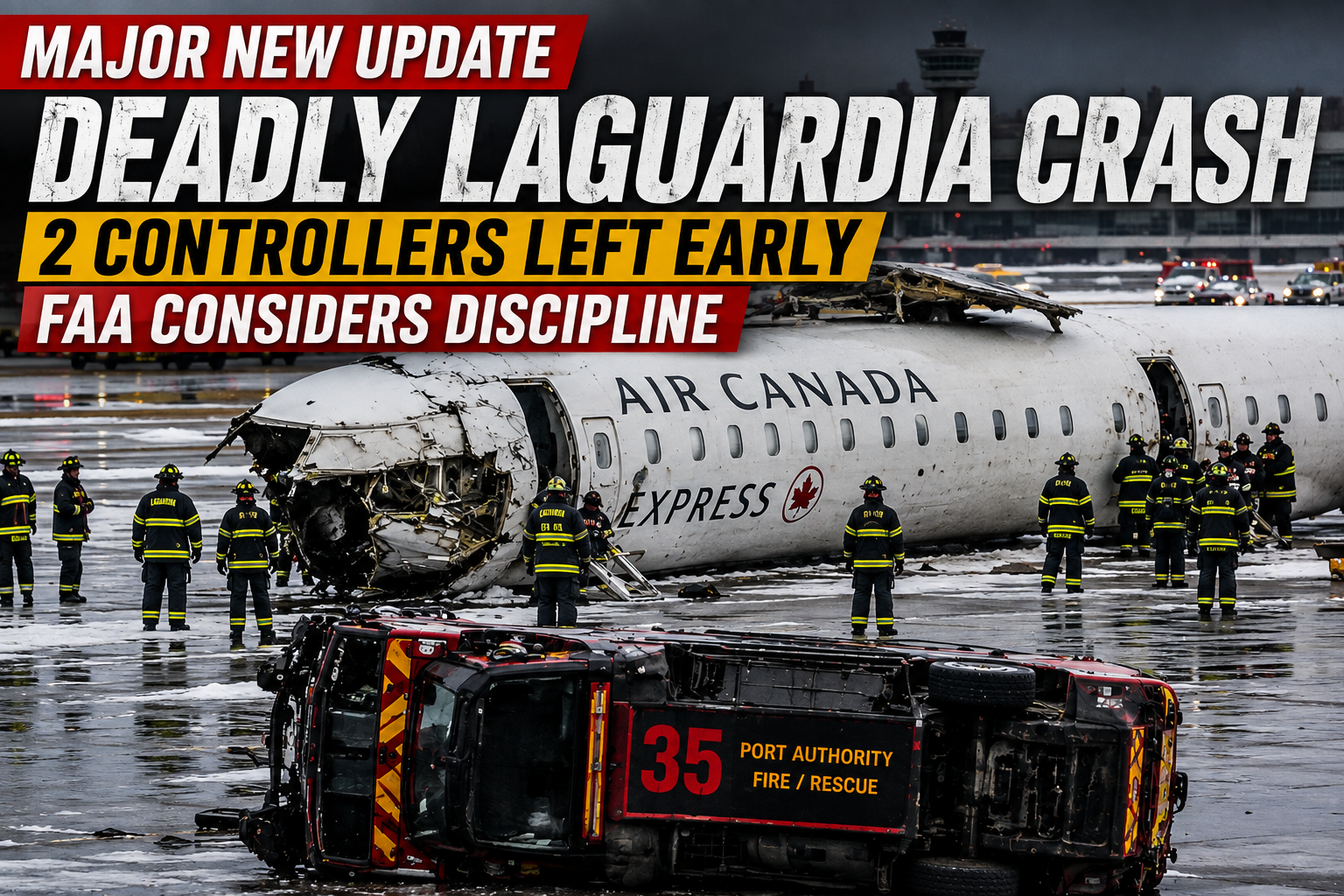
At approximately 11:37 p.m. on March 22, an Air Canada Express CRJ-900 operated by Jazz Aviation was landing on Runway 4 at LaGuardia Airport after a flight from Montreal.
The aircraft collided with Rescue 35, an airport Aircraft Rescue and Firefighting vehicle that was crossing the runway.
The jet was carrying 72 passengers and two flight attendants, in addition to the pilots. Two firefighters were aboard the rescue vehicle.
The aircraft’s captain and first officer were killed.
Thirty-nine people were transported to hospitals, with the NTSB reporting six serious injuries and 33 minor injuries.
Fire Truck Cleared to Cross Runway Seconds Before Landing
Earlier findings from investigators revealed another critical part of the sequence.
One of the two controllers working at the time cleared the airport fire truck to cross Runway 4 only 12 seconds before the Air Canada aircraft touched down, according to information previously released by federal investigators.
The controller subsequently issued urgent instructions for the vehicle to stop, but the collision could not be prevented.
Investigators have also found that Rescue 35 lacked a transponder needed for the airport’s surface surveillance system to reliably identify its position. As a result, the system did not predict the conflict or generate an audio or visual collision alert.
Why Was the Airport So Busy?
LaGuardia was experiencing an unusually heavy workload that night.
Weather-related delays had pushed additional arrivals and departures into the late-night period. AP reported that the number of flights after 10 p.m. was more than double what had originally been scheduled.
At the same time, emergency crews were responding to a separate situation involving an outbound United Airlines aircraft after a strong odor reportedly made flight attendants feel ill.
That emergency was why the fire-rescue vehicles were moving across the airport when the fatal collision occurred.
Did the Controllers Leaving Early Cause the Crash?
Investigators have not reached that conclusion.
This distinction is important.
The NTSB’s investigation remains ongoing, and the agency has identified multiple areas requiring examination. The official cause will not be established until investigators complete their work and issue a final report.
NTSB Chair Jennifer Homendy previously cautioned against prematurely blaming controllers, emphasizing that major aviation accidents typically involve multiple breakdowns rather than a single failure.
Therefore, the early departures should currently be described as a new staffing and disciplinary issue under scrutiny, not as the established cause of the crash.
FAA Has Already Moved to Improve Airport Safety
The crash has also prompted broader safety changes.
The FAA announced an initiative to equip approximately 1,900 agency vehicles at airports across the United States with vehicle movement area transponders, which allow airport surveillance systems and controllers to better identify vehicles operating near runways.
The FAA said it accelerated the initiative following the March 22 LaGuardia accident.
The NTSB investigation into the collision remains active.