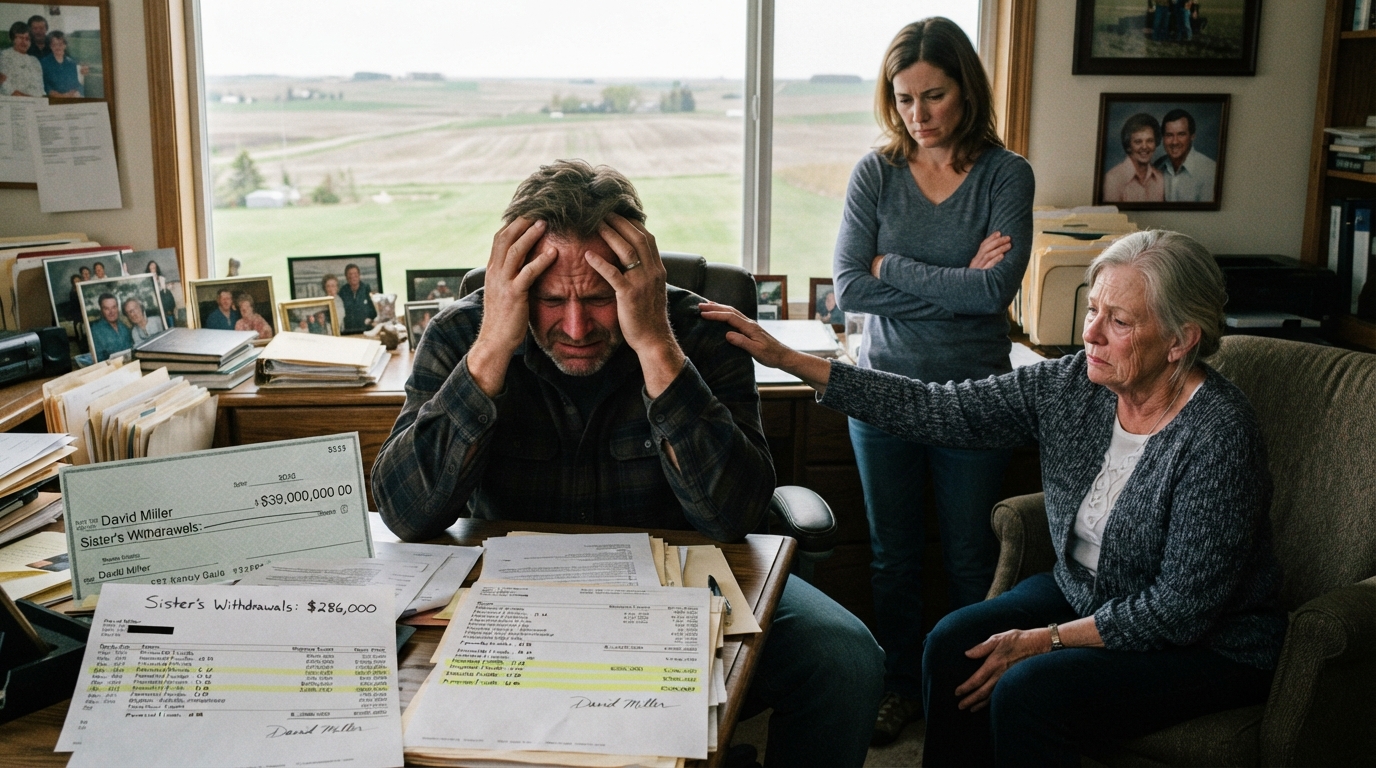
FINAL PART
I called Ranata and agreed to meet her at our parents’ house that afternoon. I told her I would listen, but I would not accept another explanation without evidence.
When I arrived, she was already sitting at the kitchen table with a thick envelope in front of her.
“I know you think I stole from you,” she began, avoiding my eyes. “But it wasn’t that simple.”
“Then tell me the truth.”
She opened the envelope and pulled out several receipts. Some were for family expenses, but none showed payments to my farm. Finally, she placed a letter on the table.
It was from our father, written six years earlier.
In it, Dad had asked Ranata to help him organize some family financial matters and manage payments while he recovered from surgery. The letter explained why he had trusted her with access to certain records.
I looked at him.
“Why didn’t you tell me about this?”
Dad lowered his eyes.
“Because I thought it was a private arrangement between your sister and me. I never imagined she would tell you were receiving money.”
Ranata wiped her cheeks.
“Some of the money went toward expenses for Mom and Dad. Some went toward my own debts. I kept telling myself I would replace it before anyone noticed.”
“Then why did you keep saying it was for me?”
She looked at me, and for the first time, her voice lost its defensiveness.
“Because once I started lying, I was afraid to stop. Every time they asked about the money, I invented another emergency. I thought I could fix everything before the truth came out.”
Desmond sat silently beside her.
Dad’s expression was devastated.
“You let us believe your sister was suffering while you took money we had saved for our retirement.”
“I know,” Ranata whispered.
“And you let Fay believe we thought she was a failure.”
That sentence finally broke her.
She covered her face and began to cry.
I felt no satisfaction watching her. I had wanted the truth, but the truth was uglier and sadder than I had imagined.
Then I asked the question that had been troubling me since I received her message.
“What did you mean when you said Mom and Dad had kept something from me about the farm?”
Dad exchanged a glance with Mom.
Mom reached for his hand.
“Fay, years ago, we wanted to help you buy your eighty acres. Your father and I had some savings, and we discussed offering you a loan. But Ranata told us you didn’t want our involvement.”
Dad nodded sadly.
“We decided to respect what we thought was your choice. We never realized she had told you something different—or that she was using that story to explain the money we later gave her.”
I sat back.
For years, I had wondered why my parents had never offered to help me when I was struggling to get the farm started. I had assumed they didn’t believe in my decision.
Now I understood that another lie had stood between us.
But I also understood that they could have called me.
They could have asked.
They could have checked.
“I wish you had spoken to me directly,” I said quietly.
Mom squeezed my hand.
“So do we.”
That afternoon, I made my decision.
I would not give Ranata money to rescue her from the consequences of her actions. I would not use my $39 million to make the problem disappear. And I would not allow the family to settle everything through promises and tears.
My parents would obtain a complete accounting of the transfers, and the family would seek independent legal advice about the money and any appropriate repayment.
Ranata would have to take responsibility for what the evidence established.
She didn’t argue this time.
“I don’t expect you to forgive me today,” she said.
“Good,” I replied. “Because forgiveness isn’t something you can demand from me. It has to come after honesty.”
She nodded, crying quietly.
The following months were difficult. My parents worked with their advisers to determine the full amount that had been misused and what could reasonably be recovered. Ranata had to face the financial and personal consequences of her choices, and her marriage went through a painful period of uncertainty.
I kept my distance while the matter was being addressed.
Eventually, Ranata began making a documented repayment arrangement with our parents. It did not erase what had happened, but it was a start.
I also began rebuilding my own life.
I invested the proceeds from the farm sale carefully with professional advice. I bought a comfortable home, replaced my oldest equipment, and took a vacation I had postponed for years.
But I kept one thing from my old life.
My battered pickup.
It still ran, and I still liked driving it.
Six months after that terrible afternoon, Mom invited me to dinner. When I arrived, she hugged me tightly before I could even step inside.
“I have something for you,” she said.
She handed me a small photo album filled with pictures of the farm: the old barn, the first fence I repaired, the fields after a summer rain, and the sunrise I had photographed on my first morning there.
On the final page, she had written:
We are proud of the life you built, Fay. We are sorry we didn’t take the time to understand it.
I cried when I read those words.
Not because of the money.
Because, after years of being misunderstood, I finally felt seen.
Ranata and I did not suddenly become close again. We began with occasional conversations, cautious apologies, and small efforts to rebuild trust. I learned that loving someone did not require pretending they had never hurt me.
And I learned that a family could only heal when the truth was allowed to remain the truth, even when it was painful.
A year after selling the farm, I drove past the property one last time.
The fields were still there, stretching toward the horizon. The new owners had begun their work, and the old barn stood quietly beneath the afternoon sky.
I pulled over and sat in my truck for a few minutes.
For fifteen years, I had believed that farm was the greatest thing I had built.
But I realized that what mattered most was never the land or the $39 million.
It was the independence, patience, and strength I had developed while building a life nobody else understood.
My family had mistaken my quiet life for a failed one.
They had mistaken my silence for weakness.
And my sister had mistaken my lack of interest in appearances for a lack of success.
They had all been wrong.
I drove away without looking back.
Because the greatest reward wasn’t proving my family wrong. It was finally understanding that I had never needed their approval to know my own worth.
The farm had made me wealthy, but the truth had given me something money never could: the freedom to decide who deserved a place in my life.


One Comment on “FINAL PART: I Sold My Farm for $39 Million, Then Discovered My Sister Had Been Taking $286,000 From Our Parents in My Name”
Comments are closed.