PART8
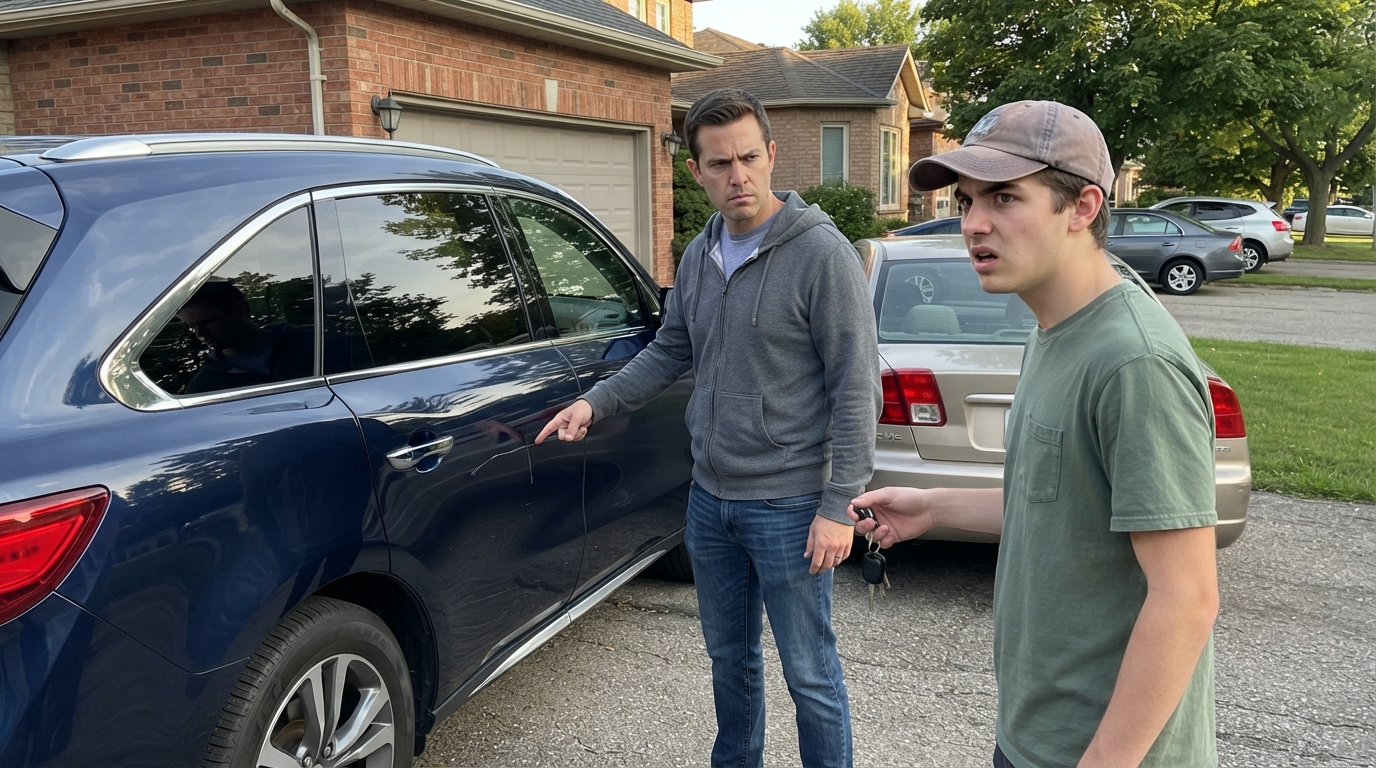
He looked exhausted. His shirt was wrinkled, and there were dark circles beneath his eyes. For the first time, he seemed less interested in shouting than in making me listen.
I remained at the doorway.
“You have five minutes.”
He glanced down at the folder.
“I’ve been driving that car for two years. Everybody knows it’s mine.”
“Everyone knows you’ve been driving it.”
“What’s the difference?”
“The title.”
He rolled his eyes.
“You know what I mean.”
“Yes. I know what you mean. You believe that because you’ve had access to something for a long time, it belongs to you.”
He looked at me sharply.
“That’s not fair.”
“Isn’t it?”
He opened the folder and pulled out a stack of receipts.
“Look. I paid for gas. I bought tires once. I paid for an oil change.”
I examined the receipts without taking them from him.
“Those expenses don’t change the name on the title.”
“You make it sound like I never contributed anything.”
“I didn’t say that.”
“You’re acting like you did everything.”
“I paid for the car. I paid for the insurance. I paid for the major repairs. I allowed you to use it because I wanted you to succeed.”
He looked away.
For a moment, I thought he might finally acknowledge what I had done for him.
Instead, he said, “You always bring up money.”
I felt the old frustration rise, but I kept my voice steady.
“Because money is what you asked me for, Mitch. Fifteen thousand dollars. When I refused, you damaged my SUV.”
He rubbed his forehead.
“I already said I was angry.”
“You haven’t apologized.”
“I said I was angry!”
“That explains how you felt. It doesn’t make what you did acceptable.”
He stared at me.
Then he lowered his voice.
“What do you want me to do? Get on my knees?”
“No.”
“Then what?”
“Take responsibility.”
He looked at the floor.
I continued.
“Tell the truth about what happened. Stop claiming I owe you the sedan. Work with the insurance process. Address the damage you caused. And stop telling our parents that I’m destroying the family because I won’t give you what you want.”
His eyes lifted.
“I can’t afford eight thousand dollars.”
“I didn’t ask you to produce eight thousand dollars today.”
“Then what are you asking?”
“For you to stop acting as though the consequences of your decisions are my fault.”
He was silent.
For several seconds, neither of us spoke.
Then he said something I hadn’t expected.
“You know Dad says you were always his favorite.”
I blinked.
“What?”
“He says you were the one who could do no wrong. You got good grades. You got a good job. You bought your own car. Everybody was proud of you.”
I stared at him.
“Mitch, that’s not true.”
“Of course you’d say that.”
“I spent years helping you.”
“And you never let me forget it.”
The words struck harder than I expected.
I had never thought of my help as a way to make him feel inferior. I had helped because I wanted him to have opportunities I could see slipping away.
But perhaps he had experienced my help differently.
Perhaps every payment reminded him that he hadn’t achieved what he wanted.
Perhaps every time our parents praised me for being responsible, he felt the comparison.
I couldn’t know for certain.
And even if that was how he felt, it still didn’t excuse what he had done.
“Mitch,” I said carefully, “if you’ve felt that way, I wish you’d talked to me about it. I would have listened.”
He gave a bitter laugh.
“You wouldn’t understand.”
“Maybe not. But I would have tried.”
He looked at me for a long moment.
Then he said, “I need that car.”
“I understand.”
“No, you don’t. If I lose my job, I won’t be able to pay rent. If I can’t pay rent, I’ll have nowhere to go.”
I felt a familiar pull inside me.
The old instinct.
The urge to fix the problem before it became worse.
I could almost hear the solution forming in my mind. I could help him rent a vehicle. I could pay for a few weeks of transportation. I could ask my aunt whether she knew someone who needed delivery help.
I could do all of those things.
But before I could even consider them, Mitch added, “So just give it back. You don’t need it as much as I do.”
The urge disappeared.
I looked at him.
“That’s exactly the problem.”
He frowned.
“What?”
“You believe that because your need is greater, my ownership matters less.”
He said nothing.
“I hope you find a way to keep your job. I really do. But I can’t keep solving your problems by sacrificing my own security.”
His face hardened again.
“So that’s it?”
“For now, yes.”
He shoved the folder against his chest.
“You’re going to regret this.”
“Maybe.”
I stepped back.
“But I’m not changing my answer because you’re angry.”
Then I closed the door.
I stood behind it, listening to his footsteps retreat down the hallway.
My hands were shaking.
My heart was pounding.
But I didn’t open the door again.
For once, I allowed a difficult conversation to end without trying to make the other person feel better about the boundary I had set.
And that was progress.
That weekend, I took my SUV to the repair shop for a more detailed assessment.
The technician walked me along the driver’s side, pointing out the areas where the paint had been cut deeply enough to require extensive refinishing.
He explained that the final cost could change once the work began, depending on what they found beneath the damaged surface.
I signed the necessary paperwork and arranged transportation while the repairs were pending.
When I returned home, I found an envelope tucked beneath my apartment door.
My name was written across the front in my mother’s handwriting.
Inside was a single sheet of paper.
Cassie,
Your father and I want you to come to dinner on Sunday. Mitch will be there. We think it’s time for everyone to sit down and talk.
We don’t want this to destroy our family.
Love, Mom.
I read it twice.
Part of me wanted to refuse immediately.
I could already imagine the conversation. Dad would explain why Mitch had acted out. Mom would ask everyone to calm down. Mitch would complain about his lost vehicle. Eventually, someone would suggest that I return the sedan and forgive the damage because that was the easiest way to restore peace.
But another part of me wondered whether there might still be a way forward.
Not a return to the old arrangement.
A new one.
One where I could love my family without being expected to finance every crisis.
I called my aunt.
She listened while I explained the invitation.
“What do you want to happen at this dinner?” she asked.
“I want them to understand that I’m not going to keep doing this.”
“Then go only if you can say that without needing them to agree.”
I thought about it.
“Why does that matter?”
“Because they may never agree, Cassie. You can explain yourself perfectly and still have someone decide that you’re wrong. Your boundary doesn’t become real only when they approve it.”
I looked at the leather key fob lying on my kitchen counter.
Yours.
She was right.
I didn’t need my father’s permission to protect my savings.
I didn’t need my mother’s approval to expect respect.
And I didn’t need Mitch to admit that he had been wrong before I could decide what I was willing to accept.
“I’ll go,” I said.
“Then go because you want to speak, not because you’re hoping they’ll give you permission to leave.”
I smiled faintly.
“You’re very good at this.”
“I’ve had practice.”
We laughed, and for the first time in days, the sound came easily.
I confirmed the dinner with Mom.
Then I spent the rest of the evening doing something I hadn’t done in a long time.
I made plans for myself.
I booked a short weekend trip for the following month. Nothing extravagant. Just two nights in a quiet coastal town, with a hotel room overlooking the water and no responsibilities beyond choosing where to eat.
I had postponed that trip twice because Mitch needed help.
I had canceled another vacation the year before because Dad’s truck needed repairs.
This time, I made the reservation and put it on my calendar.
The money was mine.
The time was mine.
And I was allowed to enjoy both.
I didn’t know what would happen at Sunday’s dinner.
I only knew that I would no longer walk into my parents’ house believing I had to earn the right to be treated fairly.
For the first time, I was prepared to let them be disappointed.
Because their disappointment was not proof that I had done something wrong.
And the next time Mitch looked at me and expected me to solve his problems, he would have to confront a truth he had spent years avoiding:
I could love my brother without being the person who rescued him.


One Comment on “PART8: My Brother Scratched My $40,000 SUV After I Refused to Give Him $15,000—So I Took Back the Car He’d Been Driving for Two Years”
Comments are closed.