PART5
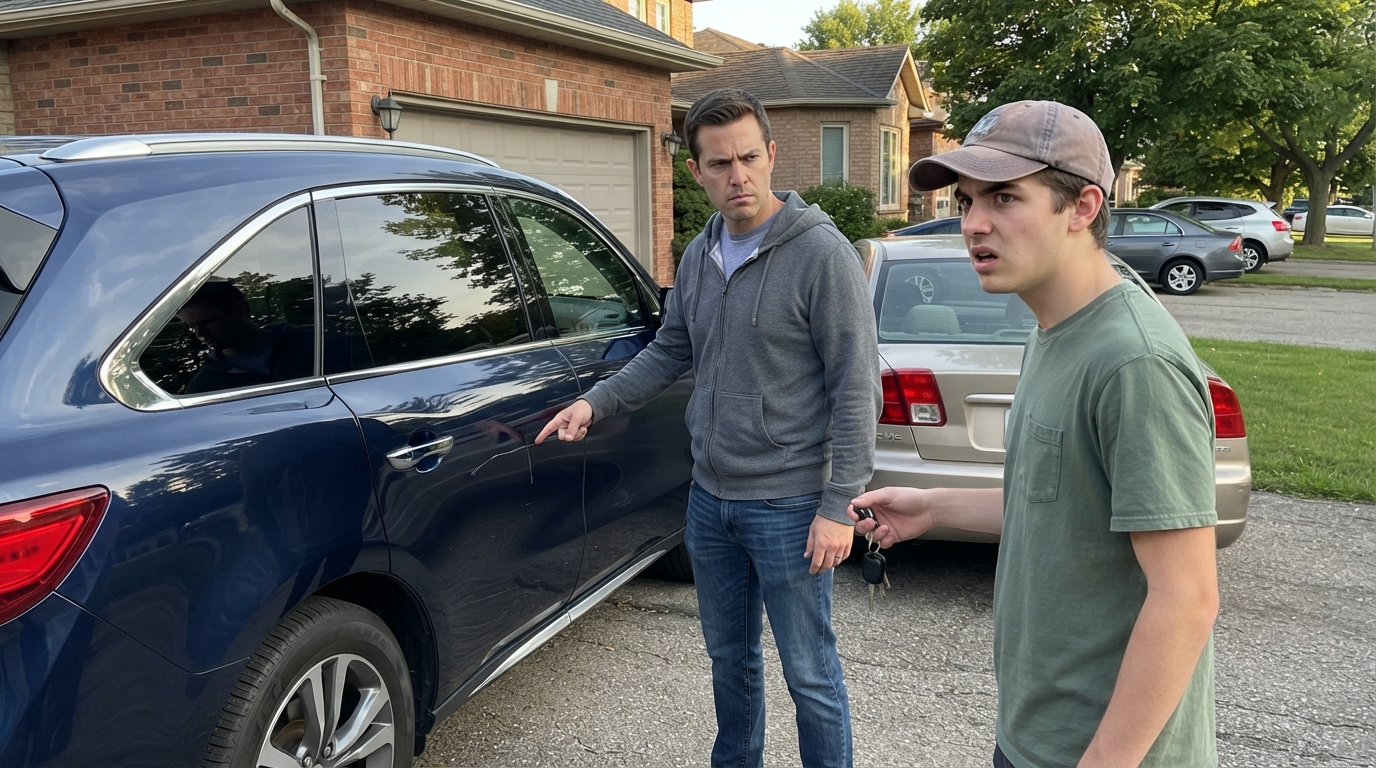
There was a message from my insurance adjuster confirming that the vandalism claim had been opened. The adjuster requested photographs, the police report number, and an estimate from an approved repair facility.
I forwarded the requested documents.
Then I saw another message.
It was from Penn.
Penn: Cass, I just wanted you to know that I still have the original footage saved. If the police need it directly, let me know. I’m sorry this happened to you.
I thanked him.
Then I put my phone away.
I didn’t need to tell everyone in the neighborhood what had happened. I didn’t need to post the footage online. I didn’t need to turn my family into entertainment.
I wanted accountability, not an audience.
That distinction would become important in the days ahead.
Because my family wasn’t finished trying to make me the villain.
Not even close.
At 4:37 p.m., I received a text from Mitch.
It was longer than his previous messages.
Mitch: I need to talk to you. This has gone too far. Dad says you’re planning to take me to court. I don’t know what you want from me, but I can’t pay thousands of dollars for your car. I was angry, okay? I made a mistake. You have to let this go.
I read it twice.
There was no offer to pay for the damage.
No promise to cooperate with the insurance investigation.
No acknowledgment that he had intentionally damaged my property.
Just an explanation of why the consequences were inconvenient for him.
I typed a response.
Then deleted it.
I typed another.
Deleted that one, too.
Finally, I wrote:
Cassandra: I am not discussing this through text. My attorney will contact you regarding the property damage and any other matters that need to be addressed. Please do not use my personal accounts or contact me repeatedly about the vehicle.
I sent it.
His response came almost immediately.
Mitch: Wow. You’re actually getting a lawyer involved against your own brother?
I didn’t reply.
Mitch: You are going to destroy this family over a scratch.
I looked at the message for a long time.
Eight thousand two hundred dollars was not a small scratch.
But even if the damage had cost only eighty-two dollars, the principle would have been the same.
The problem wasn’t simply the paint.
It was the fact that my brother had deliberately damaged something I owned because I refused to give him money.
And my father had looked at that damage and told me to grow up.
I blocked Mitch’s number temporarily and returned to my work.
For the first time, I understood that I could love someone without remaining available for every argument they wanted to have.
Two days later, I met with Attorney Ramsay.
His office was on the third floor of a brick building downtown. The waiting room smelled faintly of coffee and old paper. I sat across from him at a wide desk while he reviewed the documents I had brought.
He was in his early fifties, with silver hair and the patient manner of someone who had spent years listening to people explain why their situations were different from everyone else’s.
He began with the SUV.
“The video is helpful,” he said. “The insurance company will make its own assessment, and the police will determine how to proceed with the report. Preserve everything, including the original file and any messages in which your brother discusses the incident.”
I nodded.
“Now, the sedan.”
He examined the purchase agreement, title, registration, insurance records, and receipts for maintenance.
“Your name is on the ownership documents?”
“Yes.”
“Your brother’s?”
“No.”
“Did you sign any agreement transferring ownership to him?”
“No. We agreed he could use the vehicle while he worked toward refinancing it.”
“Do you have messages confirming that arrangement?”
“I have several.”
He read through them.
One message from two years earlier stood out.
Mitch: Thanks for helping me get back on my feet. I’ll get the financing sorted in six months, and then the car will officially be mine.
My response had been simple.
Cassandra: All right. Let’s revisit it in six months. Until then, I’ll keep the insurance current.
Ramsay placed the phone on his desk.
“That helps clarify the arrangement. We should review the applicable state law and any notice requirements before taking further action, but the documents support your position that you remained the owner.”
“Can he force me to give the car back?”
“Not simply because he has been using it. However, we’ll handle any challenge through the proper process.”
He leaned back.
“There’s another issue. You mentioned that you’ve paid his insurance for two years. Why?”
I felt embarrassed, although I wasn’t sure why.
“He couldn’t afford the premiums when I first bought the car. I thought it was temporary.”
“And the payments continued?”
“Yes.”
“Did he contribute anything?”
“Occasionally, he paid for gas. He covered one oil change, but I paid for the major maintenance.”
Ramsay made a note.
“Keep those records. We need to distinguish expenses you voluntarily agreed to cover from amounts he actually promised to repay. Not every payment automatically becomes a recoverable debt, but the documentation is still important.”
I nodded.
Then he asked the question I had been avoiding.
“How much money have you lent your brother over the years?”
I looked down at my hands.
“I don’t know exactly.”
“An estimate?”
I thought about his rent deposit.
His utility bills.
The transmission repair on his previous vehicle.
The money he had borrowed when he changed jobs.
The emergency expenses that somehow appeared every few months.
“Maybe twelve thousand dollars. Possibly more.”
“Was that money a gift or a loan?”
“Some of it was supposed to be repaid.”
“Do you have written records?”
“Some.”
He nodded.
“Then we’ll organize those separately. I don’t want you assuming that every dollar can be recovered. But I do want you to understand what you’ve been carrying.”
I stared at the papers on his desk.
For years, I had viewed each payment as a separate event.
A temporary favor.
A one-time emergency.
A little help until things improved.
I had never added them together.
Ramsay turned his monitor slightly toward me.
“Let’s start with the documented expenses and work from there.”
For the next hour, we reviewed bank transfers, receipts, insurance payments, and messages.
When we finished, I walked out with a folder containing copies of everything and a clear list of the next steps.
But the most important thing Ramsay told me wasn’t about the law.
It was something he said while walking me to the door.
“Cassandra, you can be fair without making yourself financially vulnerable. Those are not contradictory goals.”


One Comment on “PART5: My Brother Scratched My $40,000 SUV After I Refused to Give Him $15,000—So I Took Back the Car He’d Been Driving for Two Years”
Comments are closed.