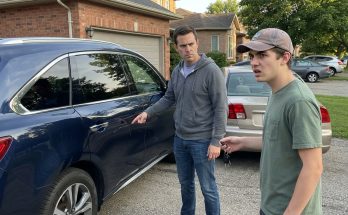
My Brother Scratched My $40,000 SUV After I Refused to Give Him $15,000—So I Took Back the Car He’d Been Driving for Two Years
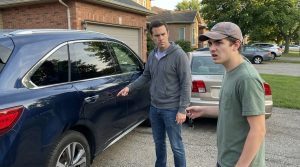
PART 3
“That video doesn’t prove anything,” he said. I almost laughed.
Not because anything about the situation was funny, but because I had spent so many years watching my brother escape responsibility that his first reaction was exactly what I had expected.
He had been caught. And somehow, he still believed he was the victim.
“Really?” I asked. He straightened his shoulders.
“Yeah. It proves I walked near your car. It doesn’t prove I did anything.”
“Mitch, you were holding a key against the paint for ninety seconds.”
“You can’t tell what I was doing from that angle.”
“Then explain it.”
He opened his mouth.
Nothing came out.
Dad stepped between us.
“All right. That’s enough.”
I looked at him.
He pointed toward the flatbed.
“Get that car down.”
I turned toward the driver.
“Everything is secured, correct?”
The driver nodded. “All set.”
“Thank you.”
Dad’s face darkened.
“Did you hear me?”
“Yes.”
“Then do what I said.”
I slipped my phone into my coat pocket.
“No.”
One word.
It was astonishing how much that single word seemed to offend him.
For most of my life, saying no to my father had felt like standing in front of a moving train. I would explain myself, offer alternatives, apologize for inconveniencing him, and eventually give in just to make the noise stop.
When Mitch needed money for rent, I was expected to find it.
When Mom’s washing machine broke, I was expected to help replace it.
When Dad’s truck needed repairs, I was the first person he called.
I had become the family member everyone praised for being responsible, which was another way of saying I was the person they expected to rescue everyone else.
And because I usually did, they had started treating my help as something they were entitled to receive.
That morning, I finally understood the difference between being generous and being controlled.
Dad had mistaken my patience for permission.
He was about to discover that the two things were not the same.
“That is your brother’s car,” he repeated.
“No. It’s my car.”
“You bought it for him.”
“I purchased it so he could get to work. We agreed he could use it until he qualified for his own financing.”
“He has a job because of that car!”
“And I paid for the car, the insurance, and the maintenance.”
Mitch suddenly found his voice.
“You said I could have it!”
I turned to him.
“When?”
“You told me it was mine.”
“No, I told you that you could use it.”
“You never said you were going to take it back!”
“I didn’t think I needed to explain that stealing my savings, damaging my property, and refusing to repay your debts might change our arrangement.”
His face flushed.
“You are unbelievable.”
I nodded slowly.
“That’s interesting. I was thinking the same thing about you.”
He stepped toward me.
“You can’t just leave me without a car. I have deliveries today.”
“Then you should call your employer and explain that you no longer have access to a vehicle.”
“You know I can’t afford another one!”
“I know.”
“You know I need that job!”
“I know that, too.”
“Then why are you doing this?”
I stared at him.
There it was again.
The question that had defined our relationship for years.
Why wasn’t I making his life easier?
Why wasn’t I absorbing the consequences of his decisions?
Why wasn’t I putting his immediate comfort above my own financial security?
I looked toward the flatbed.
“Because I need to stop paying for the privilege of being treated badly.”
Mitch’s mouth tightened.
Dad shook his head in disgust.
“You’ve changed, Cassandra.”
For the first time that morning, I smiled.
“No, Dad. I’ve finally stopped pretending.”
The tow truck driver gave me a copy of the recovery paperwork.
I signed it, confirmed the vehicle identification number, and thanked him for waiting while my family attempted to turn a lawful recovery into a neighborhood courtroom.
Before he climbed back into his cab, he glanced at Mitch.
“You’re welcome to arrange transportation with the owner,” he said matter-of-factly. “But the paperwork is in order.”
Then he climbed into the truck.
The flatbed pulled away.
Mitch watched his silver sedan disappear down the street.
His expression shifted from disbelief to anger, then to something I rarely saw on his face.
Fear.
He was suddenly standing in front of our parents’ house without the vehicle he had relied on for two years.
He had a job to get to.
Bills to pay.
A life that had been functioning, however precariously, because someone else had been quietly covering the gaps.
And that someone was no longer volunteering.
“You just ruined everything,” he said.
I picked up my coffee.
“No, Mitch. I stopped hiding the damage.”
He looked as if he wanted to hit something.
Dad noticed it, too.
“Don’t you dare start,” Dad warned him.
For a moment, I wondered whether he was finally going to hold Mitch accountable.
Then he turned to me.
“Are you satisfied now?”
I felt something inside me go very still.
“With what?”
“Humiliating your brother in front of the neighborhood.”
I glanced across the street.
Penn was standing on his porch, quietly drinking his coffee. He raised one hand in a small greeting.
I returned it.
Then I looked back at Dad.
“Mitch humiliated himself when he deliberately damaged my vehicle. I didn’t make him do that.”
“You could have handled this privately.”
“I did handle it privately. I told him no at dinner. He decided to answer by destroying something I worked four years to buy.”
Dad’s jaw tightened.
“He’s your brother.”
“And I’m your daughter.”
The words hung between us.
For a moment, I thought Mom might finally speak.
She had come to the doorway wearing her blue robe, her coffee mug still in her hand. Her eyes moved from the empty driveway to Mitch’s face, then to me.
I waited.
I don’t know what I wanted her to say.
Perhaps I wanted her to admit that what Mitch had done was wrong.
Perhaps I wanted her to remember all the times she had watched me quietly shoulder responsibilities that weren’t mine.
Perhaps, after years of being the dependable daughter, I simply wanted my mother to look at me and recognize that I was hurting, too.
Instead, she lowered her eyes.
“Cassie,” she said softly, “couldn’t you have given him a little more time?”
I stared at her.
“Time for what?”
“To calm down.”
“He had time. He went outside, found a key, checked whether anyone was watching, and scratched my SUV.”
“He was upset.”
“So was I.”
She sighed.
“You know how your brother gets.”
Yes.
I knew exactly how my brother got.
He got angry when he didn’t receive what he wanted.
He got dramatic when someone questioned him.
He got helpless when a bill arrived.
And somehow, after every explosion, my parents swept the pieces into someone else’s hands.
Usually mine.