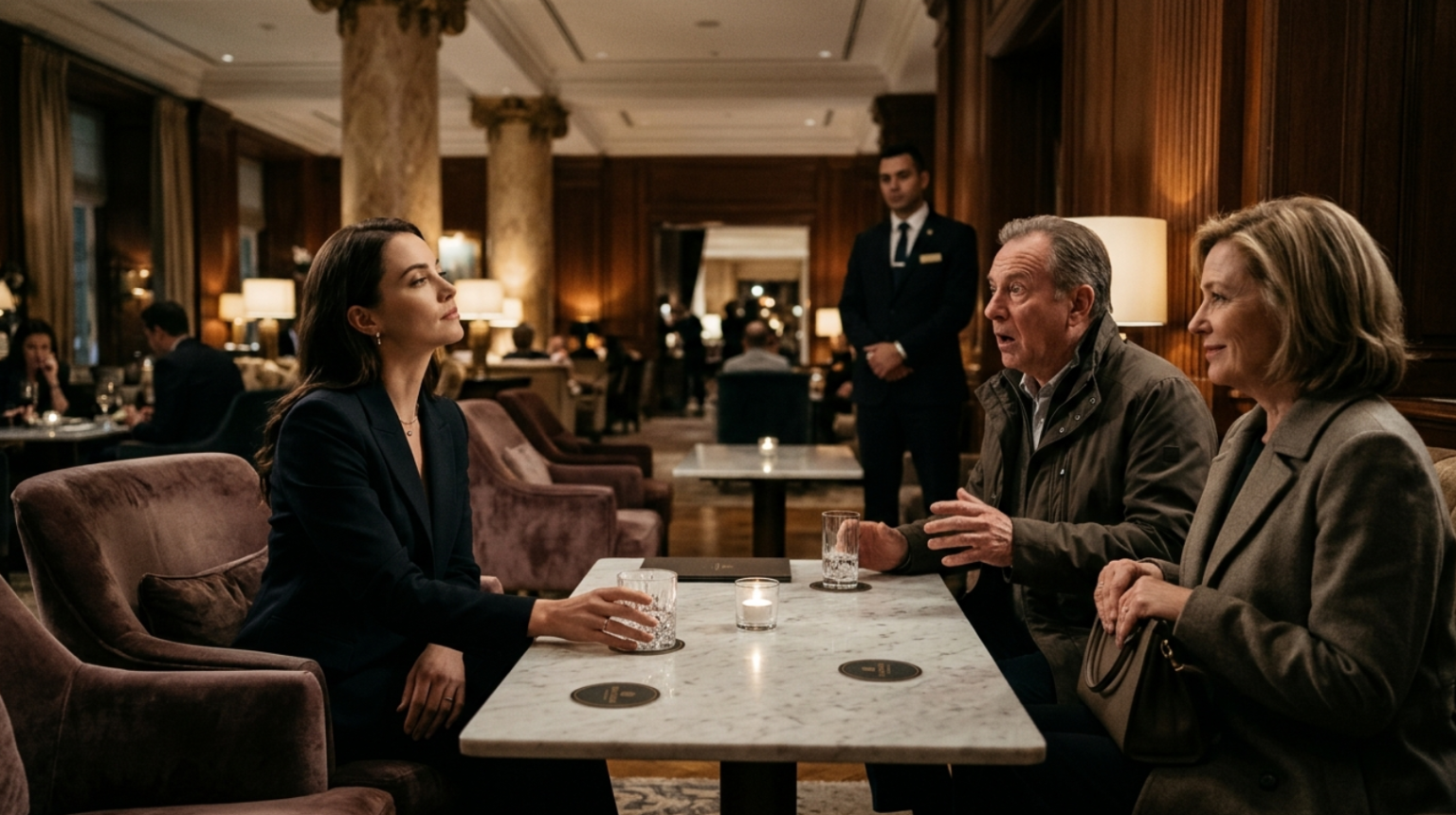
FINAL PART
He stared at the ground.
“Because I couldn’t accept that you had succeeded without me.”
I hadn’t expected that answer.
He continued.
“When you left, I thought you would come back. I thought you would apologize. I thought you would realize that you needed us.”
He gave a sad laugh.
“But you didn’t.”
“No.”
“You built a life.”
“Yes.”
“And I couldn’t stand it.”
I looked at him for a long moment.
“Do you know what hurt the most?”
He shook his head.
“It wasn’t losing the inheritance. It wasn’t being thrown out. It wasn’t even the seven years.”
I took a breath.
“It was realizing that my own father could watch me leave with one suitcase and still go to sleep that night without wondering where I would spend it.”
His eyes filled with tears.
“I know.”
“No, Dad. You know now. You didn’t know then.”
He nodded.
I continued.
“I spent years believing I had done something terrible. I thought maybe I wasn’t a good daughter. Maybe I was selfish. Maybe I deserved what happened.”
I looked down at the photograph.
“Grandma was the only person who made me feel that I was worth something.”
My father began crying.
“I am sorry.”
I believed he was sorry.
But being sorry and repairing something were not the same.
I put the photograph inside my purse.
“I hope you learn from this.”
He nodded.
“Can we start again?”
I looked at the courtyard.
Then back at him.
“We can start by telling the truth. But we cannot pretend the past never happened.”
He accepted that.
For once, he didn’t argue.
He didn’t demand.
He didn’t tell me what a daughter should do.
He simply nodded.
And that was the first time in my life that my father had allowed me to decide what happened next.
The months that followed were difficult for everyone.
The investigation established that Northbridge had circulated misleading property documents and that several people had knowingly made representations they could not support.
The forged guarantee was one of the central pieces of evidence.
My attorney helped me formally dispute it and protect the hotel and trust property.
The financial claims were handled through the appropriate legal proceedings.
Edward Voss and the people responsible for the false representations faced serious consequences.
Martha’s involvement was also examined.
She eventually admitted that she had helped organize the investor meetings and distribute documents.
She tried to explain that she had believed Richard had authority.
But the emails showed that she had known the property transfer was not complete.
I never celebrated her difficulties.
I simply stopped allowing her into my life.
My father had to confront the debts and obligations he had created.
He lost much of what remained of his financial security.
The construction business he had once hoped to rebuild never returned.
My mother moved into a smaller apartment and began working part-time at a local community organization.
Gabriel made the biggest change.
He found a job in a logistics company.
It wasn’t glamorous.
He wasn’t making much money.
But for the first time, he was supporting himself.
He also cooperated with the investigation and provided records that helped establish the timeline of the investment arrangements.
I didn’t give him the $1.1 million.
I didn’t pay his rent.
I didn’t buy him a car.
But I did something else.
I sent him information about an accounting course and encouraged him to complete it.
He did.
Six months later, he sent me a photograph of his certificate.
His message was simple.
“I earned this myself. I wanted you to know.”
I smiled when I read it.
Then I replied:
“I’m proud of you. Keep going.”
We didn’t suddenly become close.
Trust takes longer than a few apologies.
But we began speaking occasionally.
Sometimes about work.
Sometimes about ordinary things.
And sometimes about Grandma.
My mother and I also began having occasional conversations.
The first few were uncomfortable.
She tried several times to explain why she had remained silent for so many years.
I listened.
But I didn’t excuse it.
One day, she asked whether she could visit the hotel.
I told her she could come as a guest, provided she respected my staff and my boundaries.
She arrived on a quiet Sunday afternoon.
She walked through the lobby slowly.
Then she looked at me.
“You built all of this?”
“Yes.”
She touched the edge of the reception desk.
“Your grandmother would have been so proud.”
I smiled.
“I know.”
My mother looked down.
“I wish I had been here.”
I didn’t answer.
Because there was no sentence that could give me back seven birthdays, seven Christmases, and seven years of being a daughter without parents.
She eventually left.
And I allowed myself to feel sad without feeling responsible for making her feel better.
That was something I had never learned as a child.
One year after my family’s first visit to the hotel, I returned to the historic property.
This time, I wasn’t alone.
Daniel came with me.
Laura joined us.
Gabriel arrived a little later.
We had spent months reviewing the property and its future.
I had decided not to sell it.
Instead, I wanted to restore the buildings and turn part of the property into a business center for small entrepreneurs.
There would be affordable office spaces, meeting rooms, and a training center for people who wanted to start businesses but couldn’t afford expensive commercial leases.
The remaining spaces would be rented to established businesses at market rates.
It was a practical investment.
But it was also personal.
When I had left home at twenty-three, I had possessed almost nothing.
I knew what it felt like to have an idea but no resources.
I knew what it felt like to be dismissed because someone thought you weren’t important enough.
I wanted to create a place where people could begin without needing permission from someone who believed they were too small to matter.
During the opening ceremony, I stood in front of the courtyard.
There were local business owners, employees, neighbors, and several people who had helped restore the property.
I looked toward the old fountain.
Then I began speaking.
“My grandmother once told me that a person can inherit a building, money, or land. But none of those things guarantee that they will build a meaningful life.”
I paused.
“She taught me that the most valuable inheritance is the courage to stand on your own feet.”
People listened quietly.
“Seven years ago, I left my family’s house with one suitcase and $4,800. I didn’t know whether I would succeed. I didn’t know whether I would fail. But I knew I couldn’t spend my life begging people to recognize my worth.”
I looked at the photograph of Olivia displayed near the entrance.
“Today, this property is more than a financial asset. It is a promise I made to someone who believed in me when almost nobody else did.”
I smiled.
“And I intend to keep that promise.”
The applause began.
I looked around.
Daniel was smiling.
Laura was wiping her eyes.
Gabriel stood near the back.
And for the first time, I felt that the past no longer had the power to decide my future.
After the ceremony, Gabriel approached me.
“Grandma would have loved this.”
I nodded.
“She would.”
He looked toward the restored offices.
“Do you remember how she used to bring us here?”
“Every Saturday.”
“She always bought you hot chocolate.”
I laughed.
“Because you always stole mine.”
He smiled.
For a moment, we were children again.
Then he became serious.
“Chloe, I know things will never go back to how they were.”
“They shouldn’t.”
He nodded.
“I just want you to know I’m grateful you didn’t give up on me completely.”
I looked at him.
“I didn’t save you, Gabriel. You decided to change your life.”
He smiled.
“Maybe Grandma was right about you.”
I raised an eyebrow.
“What did she say?”
“She said you had a stubborn heart.”
I laughed.
“She wasn’t wrong.”
He looked toward the photograph.
“She also said that one day you’d build something that would outlast all of us.”
I felt tears gather in my eyes.
I turned toward the courtyard.
Maybe she had known.
Maybe she had seen something in me that I hadn’t yet learned to see in myself.
That evening, after everyone had left, I stayed behind.
I walked to the small office that had once belonged to my grandmother.
It had been restored, but I had kept her old wooden desk.
On top of it was the leather folder.
Beside it was the photograph my father had returned.
I opened the drawer.
Inside was a small envelope I had found during the restoration.
It contained one final note.
I recognized my grandmother’s handwriting immediately.
“Chloe,
If you are reading this, then you have probably discovered that life did not turn out the way you expected.
Perhaps someone disappointed you.
Perhaps someone you loved hurt you.
Perhaps you spent years wondering why the people who should have protected you were the ones who made you feel small.
I want you to remember something.
Their inability to love you properly was never proof that you were difficult to love.
Never confuse being needed with being loved.
And never give away your peace simply because someone shares your blood.
Build a life that makes you proud.
Give generously when your heart tells you to.
But never allow anyone to mistake your kindness for an obligation.
I love you more than words can express.
Grandma Olivia.”
I read the letter slowly.
Then I folded it and placed it beside her photograph.
For the first time in many years, I cried without feeling broken.
I cried because I missed her.
Because I wished she could have seen the hotel.
Because I wished she could have stood beside me in the courtyard.
And because I finally understood something she had tried to teach me when I was a little girl.
Family was not supposed to be a place where you had to earn the right to be treated with dignity.
Love was not supposed to come with a price tag.
And forgiveness did not require me to reopen every door I had worked so hard to close.
My father eventually sent me a letter.
He didn’t ask for money.
He didn’t ask me to help with his debts.
He simply wrote that he regretted the way he had treated me and hoped that one day we could have a better relationship.
I kept the letter.
I didn’t rush to answer it.
Maybe one day we would rebuild something.
Maybe we wouldn’t.
Either way, I had finally stopped measuring my worth by whether my parents approved of me.
The hotel continued to grow.
The historic property became a successful business center.
Gabriel built a career of his own.
My mother slowly learned that being part of my life meant respecting my boundaries.
And my father?
He learned that the daughter he had once thrown out of his house had become a woman he could no longer control.
But the most important thing was that I no longer needed him to know it.
A year and a half after that first night, I stood behind the bar at the Arístegui Hotel.
The same place where my family had walked in demanding $1.1 million.
The same place where my father had threatened to call the owner.
I looked around the lobby.
The stone floors.
The copper lamps.
The courtyard full of bougainvillea.
The dark wood reception desk.
Everything was exactly where it belonged.
My phone vibrated.
It was a message from Gabriel.
“Happy November 17, Chloe. I know today used to be a difficult day for you. I hope it’s a good one now. Grandma would be proud.”
I smiled.
For years, I had checked my phone every November 17th, hoping someone in my family would remember.
This time, I didn’t have to wait.
I walked outside, bought myself a small cake, and placed a single candle on top.
Then I made a wish.
Not for revenge.
Not for an apology.
Not for the family I had spent years trying to earn.
I wished for the courage to keep building a life filled with people who chose to stay.
I blew out the candle.
And as I looked at the hotel lights reflecting against the Chicago night, I finally understood the greatest lesson my grandmother had left me.
Sometimes, the best revenge isn’t making the people who hurt you regret losing you.
It’s building a life so peaceful, meaningful, and full that you no longer need them to regret anything.
My father had once told me that if I walked out of his house, I should never ask him for anything again.
I kept my promise.
I never asked him for a dollar.
And in the end, the little girl he thought would never survive without him built something he could never take away.
I didn’t lose my family when I walked out that door seven years ago.
I lost the illusion that they were the only people who could ever make me feel loved.
And that was the day my real life began.


One Comment on “FINAL PART: My Family Abandoned Me for Seven Years, Then Demanded $1.1 Million From Me—But When My Father Threatened to Call the Hotel Owner”
Comments are closed.