PART9
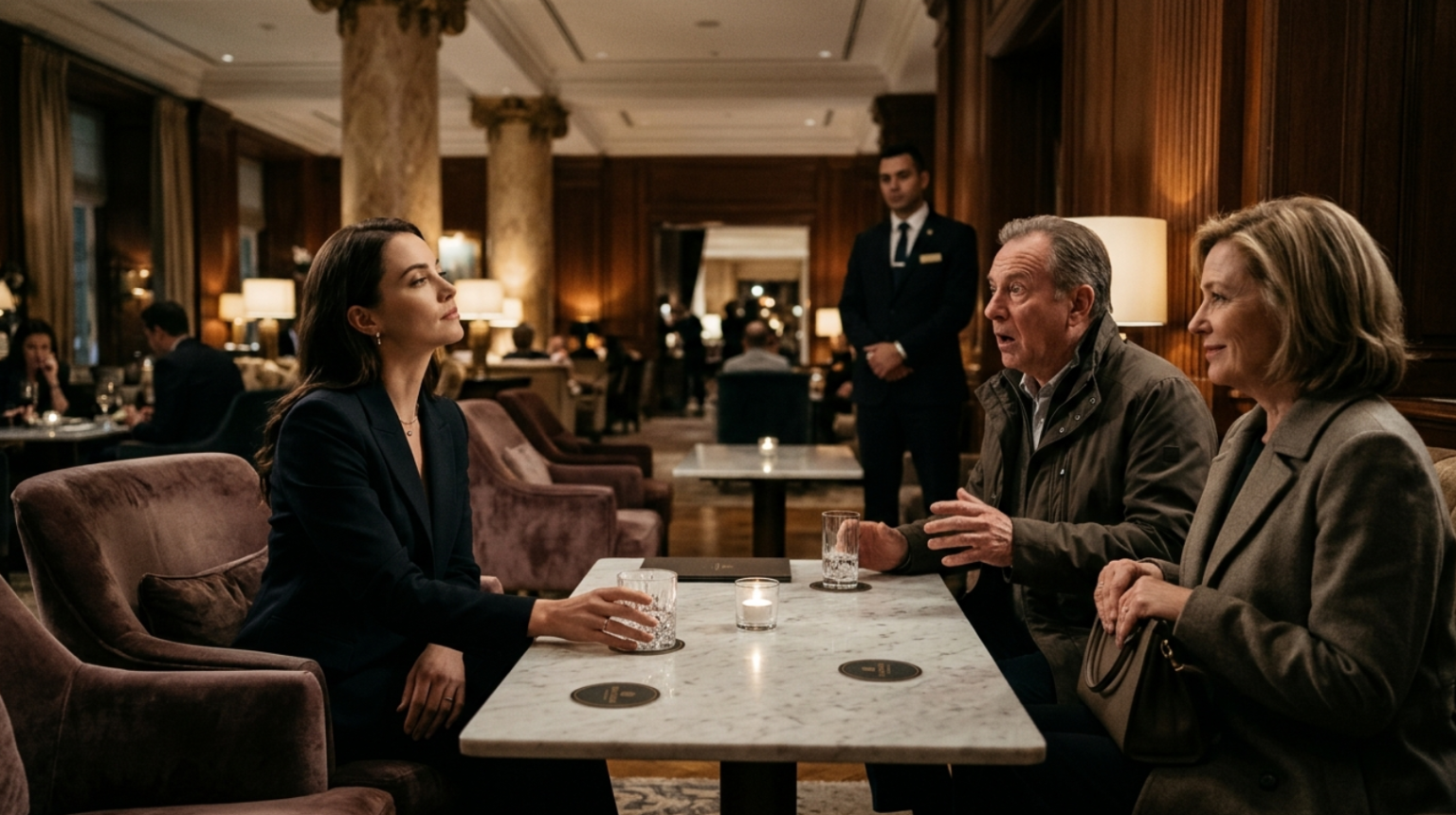
“Yes. But don’t mistake that for forgiveness.”
He nodded.
Then, unexpectedly, he began to cry.
Not loudly.
He simply covered his eyes with his hands.
I had seen my father angry.
I had seen him arrogant.
I had seen him threaten people.
But I had never seen him cry.
For a moment, I felt the little girl inside me wanting to comfort him.
Then I remembered that I had once been that little girl, sitting on a suitcase outside his house.
And nobody had comforted me.
I remained where I was.
The investigation continued over the following weeks.
Edward Voss was questioned about the investment arrangements.
Northbridge’s corporate records were examined.
The investors were contacted.
And the documents containing my forged signature were preserved as evidence.
Martha was also required to explain her involvement.
She initially denied knowing anything about the false guarantee.
But the records told a different story.
Several emails showed that she had coordinated meetings between Richard and Edward.
She had also circulated copies of my old business documents.
One message was particularly disturbing.
It had been sent to my father four months earlier.
“Once Chloe sees the amount of money involved, she’ll understand she has no choice. She’s too invested in protecting her hotel to let this become public.”
I read the message twice.
They hadn’t simply believed I would help.
They had planned to use my fear of losing my business against me.
There was another email.
This one came from Richard.
“She will pay. She always wanted to prove she could do everything herself. But when she realizes what this could do to her reputation, she’ll come around.”
I closed the document.
Daniel watched me.
“Are you okay?”
I nodded.
But I wasn’t.
Not because I wanted my father to love me.
I had finally stopped expecting that.
It hurt because the people who had known me since childhood had spent months planning how to use my success against me.
They knew what I had worked for.
They knew how much the hotel meant to me.
And they had decided that was the perfect weakness to exploit.
Two weeks later, I received another call from Gabriel.
This time, he sounded different.
“Chloe, I need to apologize.”
I was reviewing a financial report.
“For what?”
“For everything.”
I stopped typing.
He continued.
“I knew Dad was getting involved with investors. I knew he was promising something big. I should have asked more questions.”
I said nothing.
“I also knew he had been talking badly about you for years. I never corrected him.”
I looked out the window.
“Why?”
“Because it was easier.”
That answer hurt more than an excuse would have.
He continued.
“I was afraid of upsetting him. I wanted him to keep paying my expenses. I didn’t want to be the next person he turned against.”
I took a slow breath.
“Gabriel, you were nineteen when Dad threw me out.”
“I know.”
“You could have come downstairs.”
He became quiet.
“You could have said goodbye. You could have called me once. You could have asked whether I had somewhere to sleep.”
His voice cracked.
“I know.”
“But you didn’t.”
“I was a coward.”
I looked down at the financial report.
For years, I had imagined what I would say if Gabriel ever apologized.
I had thought I would be angry.
I had thought I would list every disappointment.
Instead, I simply said:
“Yes. You were.”
He began crying.
“I’m sorry, Chloe.”
I let the silence remain.
Then I said:
“I don’t know if I can trust you again.”
“I understand.”
“But I don’t want you to destroy your life because of Dad’s decisions. Tell the truth. Cooperate with the investigation. Find a job. Learn to stand on your own.”
“I will.”
“And Gabriel?”
“Yes?”
“Don’t ever sign something you haven’t read again.”
He gave a small, broken laugh.
“I won’t.”
We ended the call.
It wasn’t reconciliation.
Not yet.
But it was the first honest conversation we had shared in seven years.
Meanwhile, the legal process revealed something else about the November agreement.
My grandmother had known that Richard was facing serious financial trouble long before he lost his construction materials business.
He had borrowed money from several people.
Some debts were legitimate.
Others involved promises he couldn’t fulfill.
In November, he had attempted to negotiate a settlement using the historic property as security.
My grandmother refused.
She instead transferred the property into the trust, ensuring it could never be used to cover his personal debts.
She also placed a sealed copy of the original agreement with her attorney.
That document showed that Richard had acknowledged, in writing, that he had no ownership interest in the property.
He had signed it himself.
This was important because he had later told investors that he had inherited the right to control it.
The original agreement proved otherwise.
When Laura showed it to me, I sat quietly for a long time.
My grandmother had protected me before I even knew I needed protection.
And now I understood why she had written those words.
Don’t look at what they’re asking for. Look at what they’re hiding.
They hadn’t returned because they missed me.
They had returned because the one person who could legally protect the property was the daughter they had abandoned.
Three months later, the legal proceedings had progressed significantly.
Northbridge’s proposed development was suspended.
The unauthorized ownership claims were formally challenged.
The investigators were examining the financial transfers and the forged documents.
The investors were pursuing their own legal remedies.
My father, mother, aunt, and brother all had to answer questions about what they knew and when they knew it.
I didn’t interfere with that process.
I didn’t ask anyone to protect my family.
And I didn’t ask anyone to punish them on my behalf.
I simply wanted the truth established.
One afternoon, Laura called.
“Chloe, we have an update.”
“What is it?”
“The trust property is secure. The ownership records have been confirmed, and the unauthorized agreements do not create a valid interest in the land.”
I closed my eyes.
“Thank you.”
“There is something else. The original estate documents also confirm that you are entitled to the income generated by the property.”
I smiled faintly.
“How much?”
“That depends on the final accounting, but the property has been producing rental income for several years.”
I looked at the documents on my desk.
My grandmother’s property had been generating money while I believed it was simply an old family building.
And now the income records would have to be reviewed.
I didn’t know exactly how much would be recovered.
But I knew one thing.
My grandmother had left me more than an inheritance.
She had left me a choice.
A choice to build something without becoming the kind of person who had hurt me.
That evening, I received an invitation from the trust attorney.
There was a small gathering planned at the historic property.
It would be the first time I had visited since I was a child.
I went alone.
When I arrived, the courtyard was just as I remembered it.
The old brick walls.
The wooden benches.
The little fountain near the entrance.
The bougainvillea climbing along the side of the building.
I stood in the middle of the courtyard and remembered my grandmother holding my hand.
She used to tell me that buildings were not made valuable by their walls.
They were made valuable by the lives that happened inside them.
I smiled.
Then I heard a voice behind me.
“Chloe?”
I turned.
My father was standing near the entrance.
He looked older.
Much older than he had three months earlier.
He was holding a small envelope.
I didn’t move.
“What are you doing here?”
“I asked the attorney if I could come.”
“Why?”
He looked around.
“To see the property.”
I nodded.
“Then you’ve seen it.”
He looked down.
“I also wanted to give you something.”
He held out the envelope.
I didn’t take it immediately.
“What is it?”
“Your grandmother’s old photograph.”
I looked at the envelope.
He opened it.
Inside was a photograph of Olivia sitting in the courtyard, smiling.
I remembered that day.
I had been about twelve years old.
My grandmother had asked me to stand beside her, but I had refused because I was embarrassed by my school uniform.
She had laughed and taken the photograph anyway.
My father handed it to me.
“I found it in her old study.”
I took it carefully.
“Thank you.”
He stood there for a moment.
Then he said:
“I know you don’t want to hear this.”
I looked at him.
“But I need to say it.”
I waited.
“I was wrong.”
The words were simple.
But I had waited seven years to hear them.
He continued.
“I was wrong to throw you out. I was wrong to let your mother believe you deserved it. I was wrong to let Gabriel think you had abandoned us.”
His voice shook.
“And I was wrong to use your name without permission.”
I looked at him.
“Why did you do it?”


One Comment on “PART9: My Family Abandoned Me for Seven Years, Then Demanded $1.1 Million From Me—But When My Father Threatened to Call the Hotel Owner”
Comments are closed.