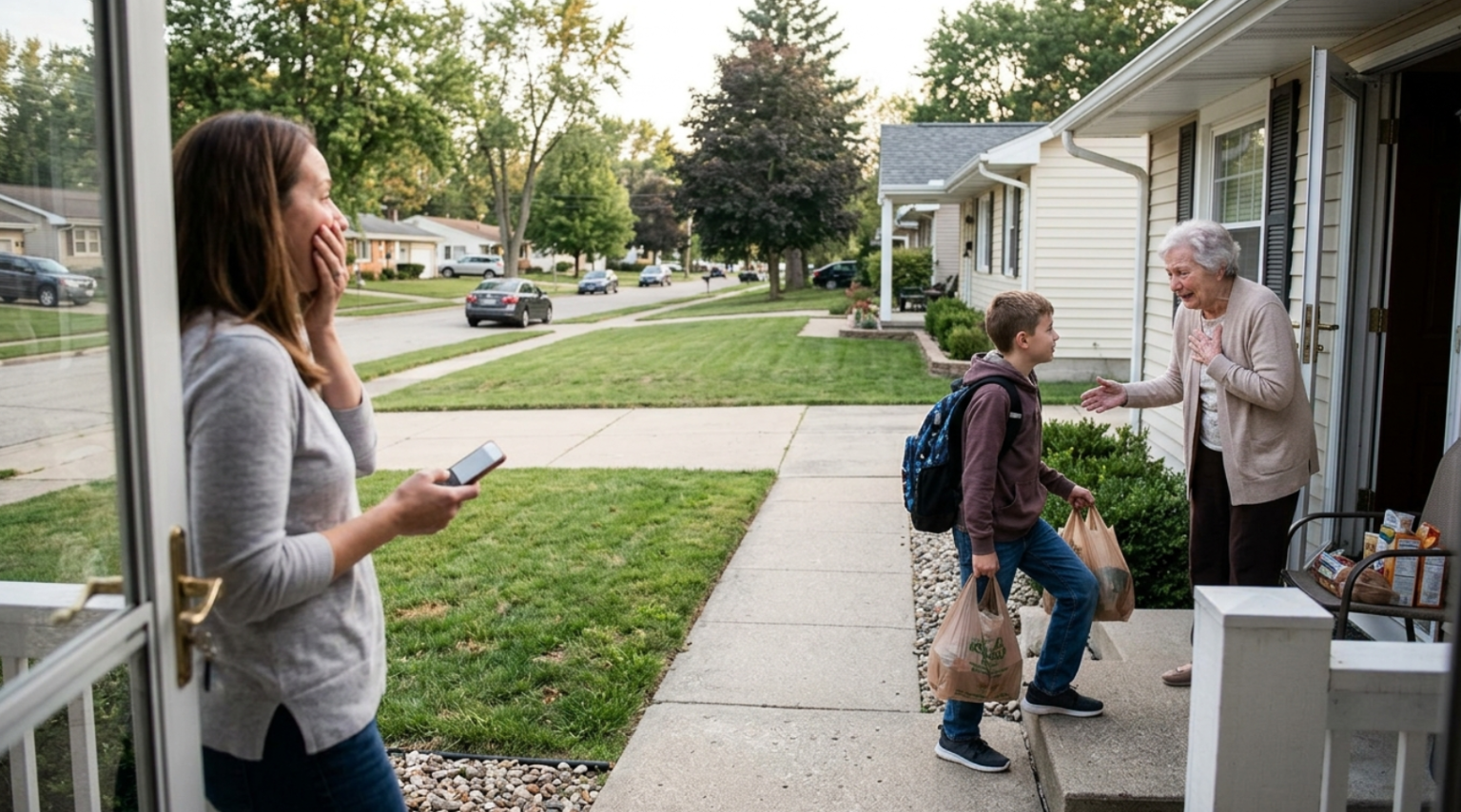
I let my 11-year-old son walk home from school alone for the first time. Twenty minutes later, my neighbor called………..
PART 2 — THE STRANGER WHO KNEW MY SON’S NAME
“He couldn’t what?” I asked, my voice shaking as I looked from Joel to the elderly man sitting against Ivy’s garden wall.
Joel tightened his grip on his backpack straps.
“He couldn’t stand up, Mom. Every time he tried, his legs started shaking. I thought he was going to fall into the street.”
The old man lowered his eyes, embarrassed by the attention surrounding him.
I knelt beside him.
“Sir, are you hurt? Do you need an ambulance?”
He opened his mouth, but no words came out.
Instead, he looked at Joel.
And something about the way he looked at my son made me stop.
It wasn’t the grateful expression I expected.
It was something deeper.
Almost like recognition.
“Mom,” Joel whispered, “I tried to call you, but he asked me not to leave him alone.”
I turned toward him.
“Why didn’t you use your phone?”
“I did.”
He pulled it from his pocket.
The screen showed three missed outgoing calls.
All to me.
My stomach tightened.
I checked my own phone.
Nothing.
Not a single missed call.
Then I remembered.
I had switched my phone to Do Not Disturb during a work meeting that afternoon.
And I’d forgotten to turn it off.
I stared at the screen, suddenly feeling ashamed.
For twenty minutes, I’d been worrying about whether my son was responsible enough to walk home alone.
Meanwhile, he’d been trying to reach me because someone needed help.
“What about the groceries?” I asked.
Joel glanced at the paper bag.
“I used my lunch money.”
I frowned.
“What lunch money?”
“The twenty dollars Grandma gave me last Sunday.”
I blinked.
Joel had been saving that money for a remote-control car he’d wanted for months.
He’d even taped a picture of it above his desk.
“You spent all of it?”
He nodded.
“The man said he hadn’t eaten since yesterday. I went to the little store on the corner. Mr. Patel helped me carry everything back.”
I looked at the delivery driver standing nearby.
He nodded quietly.
“Your boy asked me to watch the gentleman while he ran inside the shop. I was making a delivery, but I stayed.”
I looked back at Joel.
“Sweetheart, you should never go into a store or approach strangers without telling me.”
“I know, Mom.”
His voice cracked.
“But he looked like Grandpa did when he got sick.”
The words hit me unexpectedly.
My father had passed away two years earlier.
Joel had been especially close to him.
I still remembered how my son used to sit beside his hospital bed, reading comic books aloud because Grandpa said hearing his voice made the pain easier.
I reached out and brushed Joel’s hair away from his forehead.
“You wanted to help him.”
Joel nodded.
“But that’s not all.”
I looked up.
Ivy was standing behind us.
Her face was wet with tears.
“What do you mean?”
She pressed a trembling hand over her mouth.
“Tell your mother what you did after you bought the food, Joel.”
My son looked uncomfortable.
“It wasn’t anything.”
“Joel,” Ivy said gently.
“Tell her.”
He shifted his weight.
“The man couldn’t open one of the bottles because his hands were shaking. So I helped him drink some water.”
I nodded.
“And?”
“He said he was cold.”
I glanced at the afternoon sunshine.
It was warm outside.
But the elderly man’s thin shirt and trembling hands told a different story.
“So I gave him my sweater.”
Only then did I notice.
Joel’s favorite blue sweater was folded behind the man’s back, cushioning him against the brick wall.
I swallowed.
“That was kind of you, sweetheart.”
Joel looked down.
“And then he started crying.”
The old man suddenly covered his face.
His shoulders began trembling.
I moved closer.
“Sir? Are you all right?”
For several seconds, he said nothing.
Then he whispered something I barely heard.
“Thirty-seven years.”
I leaned closer.
“I’m sorry?”
He lifted his face.
Tears streamed down his deeply lined cheeks.
“Thirty-seven years,” he repeated. “That’s how long it’s been since someone did something like that for me.”
Nobody spoke.
Even the delivery driver looked away.
I felt a painful tightness in my throat.
“What’s your name?” I asked.
The elderly man hesitated.
“Arthur.”
“Arthur, I’m Melissa. Joel’s mother.”
He nodded slowly.
“Melissa.”
He repeated my name as though testing it against a memory.
Then he looked at Joel again.
“Your boy has a good heart.”
“Thank you.”
Arthur’s eyes filled once more.
“He reminds me of someone.”
I offered a small smile.
“Your grandson?”
He shook his head.
“My son.”
The silence that followed was uncomfortable.
I glanced at Ivy.
She looked just as confused as I felt.
“Where is your son?” I asked carefully.
Arthur stared at the photograph in his hands.
“I don’t know anymore.”
Joel stepped closer.
“That’s the picture he showed me, Mom.”
I looked at the old, creased photograph.
It showed a young man standing in front of a house, holding a little boy on his shoulders.
The man was smiling.
The child had both arms stretched wide, as though pretending to fly.
Something about the photograph made my chest ache.
“Is that your family?” I asked.
Arthur nodded.
“My boy was six when we took that picture.”
He brushed his thumb across the child’s face.
“He used to tell me he wanted to grow up and help people.”
His voice cracked.
“And then I made a mistake.”
I waited.
But Arthur didn’t continue.
Instead, he folded the photograph and tried to push himself upright.
His legs immediately buckled.
“Careful!” I cried.
Joel and I caught him before he fell.
Arthur winced.
“I’m fine.”
“You’re not fine,” I said firmly. “You can barely stand.”
“I don’t want to trouble anyone.”
“You’re not troubling us.”
I looked at Ivy.
“Could you bring a chair?”
She hurried toward her house.
Arthur shook his head.
“You’ve already done too much.”
Before I could answer, Joel spoke.
“Mom, can he come to our house?”
I turned sharply.
“Joel.”
“Just until he feels better.”
I hesitated.
Inviting a stranger into our home wasn’t something I could agree to without thinking.
Especially with my eleven-year-old son standing beside me.
But leaving an elderly man who could barely walk on the sidewalk wasn’t an option either.
“We’re going to get you proper help,” I told Arthur. “Let’s find out whether you need medical attention first.”
Arthur opened his mouth to protest.
Then his eyes rolled backward.
And he collapsed against me.
“Mom!” Joel screamed.
I barely managed to hold him.
“Call an ambulance!” I shouted.
Ivy rushed toward us with her phone already in her hand.
Joel stood frozen.
His face had gone completely white.
“Is he dying?”
I looked at my son.
“No, sweetheart. We’re going to help him.”
But I didn’t know if that was true.
Arthur’s breathing was shallow.
His skin had turned frighteningly pale.
And his hand, still clutching the battered photograph, had gone limp.
Then, just as I reached for his wrist, he opened his eyes.
He grabbed my arm with surprising strength.
“Please,” he whispered.
I leaned closer.
“What is it?”
He looked past me.
Straight at Joel.
And the words that came next made every person standing on that sidewalk fall silent.
“Don’t let them take my boy again.”
I froze.
“What boy, Arthur?”
His fingers tightened around my sleeve.
“The little one.”
My heart began pounding.
“Arthur, who are you talking about?”
He pointed a trembling finger toward Joel.
And whispered a name.
“Daniel.”
I stared at him.
Because Daniel wasn’t my son’s name.
It was my father’s.
And somehow, this stranger lying on the sidewalk had just spoken the name of a man who’d been dead for two years.
Before I could ask how he knew it, the ambulance turned onto our street.
Arthur saw the flashing lights.
His expression changed from confusion to absolute terror.
“No,” he whispered.
He tried to pull away.
“Please. Not again.”
I held his shoulders gently.
“Arthur, they’re here to help you.”
But he wasn’t looking at the ambulance anymore.
He was staring at the photograph.
And as the paramedics approached, he grabbed my hand one last time.
“Melissa,” he said urgently, “ask your mother what happened at the old house on Willow Street.”
My blood ran cold.
Because Willow Street was where my father had grown up.
And nobody outside my family was supposed to know what had happened there.
END OF PART 2 — TO BE CONTINUED…