PART 12 — THE BOY WHO STOPPED FOR A STRANGER (FINAL PART)
I stood frozen in the kitchen, staring at my eleven-year-old son.
“Joel,” I whispered, “what do you mean Grandpa told you where the other baby went?”
He looked down at his bare feet.
For a moment, he seemed unsure whether he should speak.
Then he reached for my hand.
“Mom, are you mad at Grandpa?”
The question broke my heart.
I knelt in front of him.
“No, sweetheart. I’m confused. And I’m sad. But I’m not angry with you.”
Joel swallowed.
“Grandpa told me something before he went to the hospital the last time.”
My chest tightened.
“When?”
“A few days before he died.”
I remembered those days.
Dad had been weak.
He could barely walk from his bedroom to the kitchen.
But whenever Joel visited, he seemed to find enough strength to smile.
They would sit together by the window.
Dad would tell him stories.
Joel would ask a hundred questions.
And sometimes, when I entered the room, they would stop talking.
I’d always assumed they were planning another surprise for me.
Now I wondered.
“What did he tell you?”
Joel hesitated.
“He said there was a baby who went home with the wrong family.”
My heart began pounding.
“Did he say who?”
Joel nodded.
“He said it happened a long time ago. And that the people who made the mistake were too scared to tell the truth.”
I stared at him.
“Did he tell you where the baby went?”
Joel reached into the front pocket of his pajamas.
And pulled out a small piece of blue paper.
It was folded into a tiny square.
“Grandpa gave me this.”
I took it with trembling hands.
“Why didn’t you show me before?”
Joel’s eyes filled.
“Because he told me to wait until somebody found the picture.”
My throat tightened.
Dad had known.
He’d known the secret might eventually be uncovered.
And somehow, he’d trusted Joel with the final clue.
I carefully unfolded the paper.
Inside was an address.
A small house in Millbrook.
Beneath it was a name.
MARGARET HALE.
The nurse.
The woman who had supposedly been present when the babies were born.
I looked at Joel.
“Did Grandpa tell you what was there?”
He nodded.
“He said the lady knew the truth.”
My eyes filled with tears.
“Anything else?”
Joel looked down.
“He said if you ever got really sad, I should tell you something.”
I swallowed.
“What?”
My son looked directly into my eyes.
“Grandpa said, ‘Your mom was my daughter from the first day I held her. Nothing anyone discovers will ever change that.’”
I covered my mouth.
For the first time all day, I began crying without trying to stop.
Because despite every lie, every document, every confusing story, I knew one thing.
Daniel Bennett had loved me.
Not perfectly.
Not without mistakes.
But completely.
I pulled Joel into my arms.
He hugged me tightly.
“Mom, are you okay?”
I kissed his forehead.
“I will be.”
That night, I slept beside my son.
Not because he was afraid.
Because I was.
I needed to hear him breathing.
I needed to know he was safe.
And after everything that had happened, I couldn’t bear another moment wondering where he was.
The following morning, I called Officer Grant.
I told him about Margaret Hale.
About the address.
About the note Joel had been keeping.
He listened carefully.
Then said something I hadn’t expected.
“Melissa, we found Margaret Hale yesterday evening.”
My heart stopped.
“What?”
“She came forward after hearing about the investigation.”
I sat upright.
“Is she alive?”
“Yes.”
“Can I speak with her?”
“She has agreed to meet with investigators. We can arrange a conversation if she consents.”
I closed my eyes.
Finally.
Someone who had been there.
Someone who could help separate memories from lies.
“Please.”
Two days later, I sat in a quiet room at the police station.
Officer Grant was beside me.
Across the table sat an elderly woman with silver hair and gentle blue eyes.
Margaret Hale.
She was eighty-three years old.
Her hands trembled slightly as she placed a worn handbag on the table.
When she looked at me, tears filled her eyes.
“Oh, my goodness.”
I swallowed.
“What?”
She pressed a hand against her mouth.
“You look so much like her.”
My heart hammered.
“Who?”
Margaret’s voice broke.
“The woman who brought you into the world.”
I gripped the edge of the table.
“Elizabeth?”
Margaret slowly shook her head.
“No, sweetheart.”
My stomach dropped.
“Evelyn?”
She closed her eyes.
“Yes.”
For several seconds, I couldn’t move.
Evelyn.
The woman who raised me.
The woman who had spent forty years telling me she wasn’t my biological mother.
The woman who had somehow convinced herself that the truth was too dangerous to reveal.
“Then why did she say Elizabeth was my mother?”
Margaret took a shaky breath.
“Because Elizabeth was the name written on the other baby’s identification bracelet.”
I stared at her.
“The other baby?”
She nodded.
“Two girls were born that night.”
My heart pounded.
“Twins?”
Margaret hesitated.
“No.”
I stopped breathing.
“What?”
“They were not twins.”
She opened her handbag.
And removed a faded hospital record.
The paper was yellowed.
The ink had faded in places.
But the names were still visible.
EVELYN MARSH — FEMALE INFANT.
ELIZABETH REED — FEMALE INFANT.
I stared at it.
“Two mothers?”
Margaret nodded.
“Two women gave birth within an hour of each other.”
I felt cold.
“And the babies?”
She lowered her eyes.
“They were accidentally placed in the wrong bassinets during a chaotic shift.”
My heart hammered.
“Then someone discovered the mistake?”
Margaret nodded slowly.
“Yes.”
“When?”
“The following morning.”
I stared at her.
“And?”
She began crying.
“By then, one of the babies had already been taken from the hospital.”
My stomach dropped.
“Which one?”
Margaret’s voice broke.
“The baby born to Elizabeth Reed.”
I swallowed.
“And the baby born to Evelyn?”
She looked directly at me.
“Was still there.”
I couldn’t breathe.
“But you said Evelyn was my biological mother.”
Margaret nodded.
“Yes.”
“Then what happened?”
She took a trembling breath.
“Daniel arrived that morning with Evelyn. They were told their daughter had been transferred for additional care. But when I checked the nursery records, I discovered someone had signed her out using false authorization.”
I felt sick.
“Who?”
Margaret opened another folder.
“Eleanor Bennett.”
My grandmother.
I closed my eyes.
Again.
Her name.
Her signature.
Her decisions.
Margaret continued.
“Eleanor had connections to a private placement organization. She believed the baby would be better off with another family.”
My hands shook.
“She gave away Evelyn’s child?”
Margaret nodded.
“Without permission.”
I felt tears spilling down my face.
“And Elizabeth’s baby?”
Margaret swallowed.
“Was still in the nursery, mistakenly identified as Evelyn’s.”
The room went silent.
I stared at the papers.
Trying to make sense of the impossible.
“So Daniel and Evelyn took home Elizabeth’s baby?”
Margaret nodded.
“Yes.”
“And that baby was me?”
She hesitated.
“According to the documents, yes. But we would need genetic testing to establish it conclusively.”
I looked at Officer Grant.
He nodded.
“We’ve arranged for the records to be independently reviewed.”
I stared back at Margaret.
“Then why did Evelyn think Elizabeth was her daughter?”
Margaret’s eyes filled with tears.
“Because years later, when the records were discovered, Eleanor created another false story to conceal what she’d done.”
My stomach tightened.
“What story?”
“She told Evelyn that Elizabeth was the child she’d given birth to years earlier and that you were Elizabeth’s daughter.”
I stared at her.
“But the dates…”
Margaret nodded.
“They were altered. Eleanor used multiple names and documents to hide the placements.”
I pressed my hands against my face.
For forty years, my family had been trapped inside a web of false records.
And somewhere, there was another child.
Evelyn’s biological daughter.
The baby Eleanor had taken.
“Where did she go?” I whispered.
Margaret lowered her head.
“Millbrook.”
My heart stopped.
The same town.
The same name that had appeared again and again.
“Was she raised as Elizabeth?”
Margaret nodded.
“Yes.”
I stared at her.
“So the woman who came to my house…”
“May be Evelyn’s biological daughter.”
I couldn’t speak.
The woman who claimed to be my mother might actually be the daughter Evelyn had lost.
My sister through the woman who raised me.
My family had been separated and rearranged by lies so thoroughly that nobody knew where they truly belonged.
I stared at Margaret.
“And Joseph?”
She looked confused.
“Joseph?”
“My supposed twin brother.”
Margaret took a slow breath.
“There was no male twin recorded in that delivery.”
I closed my eyes.
The photographs.
The false birth records.
The story of two newborns.
Someone had constructed an elaborate lie around Joseph’s identity.
“But Joseph is real.”
Margaret nodded.
“Yes. He was one of the children involved in the placement records from that period.”
I swallowed.
“Then who is he?”
She opened another folder.
“Joseph was born several weeks earlier to a different mother. He was later placed in the same household as Elizabeth’s daughter.”
I stared at her.
“So he isn’t my biological brother?”
“Not according to these records.”
My heart ached.
For days, I’d imagined meeting a twin brother.
Someone who shared my birthday.
My childhood that never happened.
The same missing pieces of my life.
Now I learned that even this connection might have been another lie.
But then I thought about Joseph.
A little boy who’d been moved between homes.
A child who grew up believing he’d been unwanted.
A man who’d spent forty years trying to understand where he belonged.
I swallowed.
“Does he know?”
Margaret shook her head.
“I don’t know.”
I looked at Officer Grant.
“I want to tell him.”
He nodded.
“When the records are verified, we’ll help arrange it.”
I wiped my cheeks.
“Thank you.”
But there was still one question.
One question that had followed me since that first afternoon.
“Margaret,” I whispered, “why did Eleanor do this?”
The elderly woman stared at her hands.
Then she said something I would never forget.
“Because she believed children belonged to whoever could give them the best life.”
My throat tightened.
“She didn’t believe parents mattered?”
Margaret’s eyes filled.
“She convinced herself she was helping.”
I stared at the documents.
Twenty-three children.
Twenty-three families.
Generations of secrets.
All because someone believed she had the right to decide who deserved a child.
I looked up.
“Did anyone ever stop her?”
Margaret nodded.
“Eventually. Arthur’s investigation exposed part of the operation. But many of the records disappeared, and some people involved were never held accountable.”
I swallowed.
“Then that’s what I want now.”
Officer Grant looked at me.
“What?”
“The truth.”
I wiped my face.
“All of it.”
Over the following weeks, investigators worked through the ledger, the photographs, and the surviving placement records.
Several families came forward.
Some had spent decades searching for children they’d lost.
Others discovered that the people who raised them had never known their records were false.
The investigation was painful.
Complicated.
And far from finished.
But for the first time, the truth was being examined instead of buried.
The police confirmed that Richard Collins had been involved in efforts to conceal records and that Peter Collins had helped pressure people connected to the old placements.
Their cases moved into the legal system.
The younger officer who had helped move Joel and Ivy to Willow Street was investigated separately.
Arthur gave a formal statement.
He admitted taking money decades earlier.
He described the threats, the forged paperwork, and the decisions he’d made.
I didn’t forgive him immediately.
I wasn’t sure I ever could.
But I was grateful he finally told the truth.
And when he asked whether he could apologize to Joseph, I passed the request along.
The decision belonged to Joseph.
Not me.
Not Arthur.
Joseph deserved to choose what came next in his own life.
Three weeks later, the independent records review confirmed that Margaret’s account was consistent with the surviving hospital documents.
Genetic testing was also arranged with everyone who consented.
The results took time.
And when they arrived, I asked to receive mine privately.
I sat in my living room.
Evelyn beside me.
Joel playing quietly upstairs.
The envelope rested on my lap.
For a moment, I couldn’t open it.
Evelyn reached for my hand.
“Melissa, whatever it says…”
I looked at her.
She was crying.
“I know.”
But she shook her head.
“No. I need to say this.”
I waited.
“I was wrong to hide the truth from you.”
Tears filled my eyes.
“I know.”
“I was afraid you’d stop loving me.”
My heart broke.
“Mom.”
She covered her face.
“I convinced myself I was protecting you. But really, I was protecting myself from losing you.”
I took her hand.
“You should have trusted me.”
She nodded.
“Yes.”
We sat in silence.
Then I opened the envelope.
The laboratory report confirmed that Evelyn was not my biological mother.
It also found no biological parent-child relationship between me and Michael.
And the additional testing confirmed something none of us had expected.
The woman calling herself Elizabeth was not my biological mother either.
She was Evelyn’s daughter.
The child Eleanor had taken.
I looked at Evelyn.
Her hands began shaking.
“My daughter?”
I nodded.
“Yes.”
She began sobbing.
For forty years, she’d believed the daughter she lost had disappeared forever.
And now that daughter had returned.
Not as my mother.
But as her own child.
We held each other while we cried.
Then I looked at the final section of the report.
My biological mother had been identified through independently verified family records as a woman named Anna Reed.
Anna had died fifteen years earlier.
But before she died, she’d written a letter.
A letter investigators found among the surviving records.
A letter addressed to the baby she’d lost.
Me.
I held it in my hands for a long time before I opened it.
The handwriting was delicate.
The paper was worn.
And the first words shattered me.
“My darling daughter, I don’t know what name they’ve given you.”
I pressed a hand over my mouth.
“But I want you to know that I never stopped looking.”
Tears streamed down my cheeks.
“I held you for less than an hour. But I have loved you every day since.”
I couldn’t see the page.
I wiped my eyes and continued.
“If you ever find this letter, please don’t spend your life hating the people who raised you. They may have loved you. And you deserve every bit of that love.”
My chest tightened.
“But please remember that you were wanted before anyone took you away.”
I began sobbing.
For forty years, I had wondered whether I was enough.
Whether I had been abandoned.
Whether someone had decided I wasn’t worth keeping.
And now, at last, I had an answer.
I had been wanted.
I had been loved.
I had been searched for.
My biological mother had never forgotten me.
I folded the letter carefully.
Then held Evelyn’s hand.
“I wish I could have met her.”
Evelyn nodded through her tears.
“So do I.”
Over the next several months, our lives slowly began to settle.
Not back to what they’d been.
That was impossible.
But into something new.
Something more honest.
Elizabeth and Evelyn began rebuilding their relationship.
It wasn’t easy.
There were years of grief between them.
Years of questions.
Years of missed birthdays.
But they kept trying.
Joseph met with me after investigators helped establish more of his history.
He wasn’t my twin.
But when we sat together for the first time, I felt an immediate connection.
Not because we shared blood.
Because we understood what it meant to have part of your life stolen by someone else’s choices.
He was nervous.
So was I.
We sat in a small café for nearly an hour before either of us knew what to say.
Then Joseph smiled awkwardly.
“I guess we’re not brother and sister.”
I looked at him.
“No.”
He lowered his eyes.
“That’s disappointing.”
I reached across the table.
“Joseph, can I tell you something?”
He looked up.
“Of course.”
“Families aren’t only built by biology.”
His eyes filled.
“I know.”
I smiled.
“You’ve spent your life looking for people who would choose you.”
He nodded.
“Well, I’m choosing you.”
He stared at me.
Then he began crying.
And for the first time in forty years, Joseph didn’t look like a man searching for somewhere to belong.
He looked like someone who had finally been invited home.
Michael also remained in our lives.
The biological father I thought I’d found turned out to be my father’s twin brother.
But I didn’t feel as though I had lost him.
I had gained an uncle.
A complicated, grieving man who reminded me so much of Daniel that sometimes it hurt to look at him.
He told me stories about Dad’s childhood.
About the bicycle accident.
About the time Daniel tried to build a treehouse and fell through the roof.
About how Dad used to give away his lunch to children who forgot theirs.
That last story made me cry.
Because it reminded me of Joel.
One afternoon, Michael came over carrying a small box.
He handed it to my son.
Joel looked surprised.
“What’s this?”
Michael smiled.
“Open it.”
Inside was a remote-control car.
The exact model Joel had been saving for.
My son stared at it.
“Really?”
Michael nodded.
“Really.”
Joel looked at me.
“Mom, can I keep it?”
I smiled through my tears.
“Of course.”
He hugged Michael.
“Thank you!”
Michael held him tightly.
Then whispered, “Your grandfather would have been so proud of you.”
And I knew he was right.
A month after the investigation began, I received a call from St. Mary’s Hospital.
It was Arthur.
His health had worsened.
The doctors were doing what they could, but he wanted to speak with me.
I hesitated.
Part of me didn’t want to go.
Part of me still remembered the terrible things he’d admitted.
But then I thought of Joel.
And I decided to visit.
I went alone.
Arthur was lying in bed when I arrived.
He looked smaller.
Thinner.
His face was pale.
When he saw me, tears filled his eyes.
“Melissa.”
I sat beside him.
“Hello, Arthur.”
He swallowed.
“Thank you for coming.”
I nodded.
For a moment, neither of us spoke.
Then Arthur said, “I know I don’t deserve forgiveness.”
I looked at him.
“No.”
He lowered his eyes.
“I made choices that hurt innocent children.”
“Yes.”
“I told myself I was helping. But I was afraid. And sometimes I accepted the easiest explanation because I didn’t want to face what I’d done.”
I sat quietly.
Arthur’s voice broke.
“I can’t undo it.”
“No.”
He wiped his cheeks.
“But I can stop hiding.”
I nodded.
“That’s why your statement matters.”
He looked at me.
“Did they find some of the families?”
“Yes.”
His face crumpled.
“Thank God.”
Then he whispered, “How’s Joel?”
I smiled faintly.
“He’s doing well.”
Arthur closed his eyes.
“Good.”
“He still asks about you.”
Tears slipped down Arthur’s cheeks.
“After everything?”
I nodded.
“He doesn’t understand all the things you did. But he knows you were hungry, and he wanted to help.”
Arthur covered his mouth.
A broken sob escaped him.
“I don’t deserve that boy’s kindness.”
I looked at him.
“Maybe not.”
He lowered his hands.
“But he gave it anyway.”
Arthur began crying.
And I realized something important.
Joel’s kindness didn’t erase Arthur’s mistakes.
It didn’t free him from accountability.
It didn’t mean forgiveness was owed.
It simply meant my son had refused to let another person’s past determine whether he deserved help in that moment.
I stood to leave.
Arthur reached for my hand.
“Melissa?”
I turned.
“Yes?”
“Tell Joel something for me.”
I waited.
“Tell him that an old man who had spent most of his life making the wrong decisions was given one last chance to do the right thing because a little boy stopped and asked if he was hungry.”
My eyes filled.
“I’ll tell him.”
Arthur nodded.
Then whispered, “And tell him I bought him something.”
I frowned.
“What?”
Arthur pointed toward the bedside cabinet.
Inside was a small envelope.
On the front was written:
FOR JOEL.
I opened it.
Inside were twenty dollars.
The money Joel had spent on groceries.
And a short note.
“Dear Joel, you gave me your savings when I had nothing. I can’t give you back the afternoon you lost, but I can return the money you gave away. Thank you for treating me like a person when I felt like the world had forgotten I existed.”
I covered my mouth.
Arthur smiled weakly.
“He deserves it.”
I folded the note.
Then looked at him.
“Arthur, Joel didn’t help you because he expected anything back.”
“I know.”
His voice broke.
“That’s what makes it special.”
I left the hospital that afternoon carrying the envelope.
Two weeks later, Arthur passed away peacefully.
He had given investigators everything he remembered.
He had apologized to Joseph.
And though Joseph wasn’t ready to forgive him, he had listened.
That mattered.
Because sometimes the right thing isn’t a perfect ending.
Sometimes it’s simply telling the truth before you run out of time.
Six months after that Friday afternoon, Joel and I walked home from school together.
The trees were beginning to turn green again.
Children rode bicycles along the sidewalk.
Ivy waved from her porch.
Everything looked ordinary.
But I knew how extraordinary ordinary life could be.
As we approached the place where Arthur had been sitting, Joel slowed down.
He looked at the brick wall.
Then at me.
“Mom?”
“Yes, sweetheart?”
“Do you ever wish I hadn’t stopped?”
I looked at him.
My heart tightened.
“What do you mean?”
“If I hadn’t helped Mr. Arthur, none of the scary stuff would have happened.”
I stopped walking.
Then knelt in front of him.
“Joel, listen to me.”
He looked into my eyes.
“Some terrible things happened long before you were born.”
I brushed his hair away from his forehead.
“Those things were already true, whether we knew about them or not.”
He swallowed.
“But finding out made everybody sad.”
“Yes.”
I nodded.
“Sometimes the truth hurts.”
He looked down.
“Then why is it better to know?”
I took his hand.
“Because now people can stop living inside lies.”
He thought about that.
I continued.
“Evelyn found the daughter she lost. Joseph finally learned that he was wanted. Families who had spent decades searching have begun finding answers. And I learned that my biological mother loved me, even though she never got to raise me.”
Joel looked up.
“Because I helped Mr. Arthur?”
I smiled.
“Your kindness helped bring the truth into the open.”
He was silent for a moment.
Then asked the question I’d been waiting for.
“Mom, can I still help people?”
Tears filled my eyes.
I pulled him into my arms.
“Always, sweetheart.”
Then I gently added, “But you don’t have to put yourself in danger to be kind. If someone needs help, you can call me or another trusted adult. You can help and still keep yourself safe.”
Joel nodded.
“Okay.”
We stood.
Then continued walking.
At the corner, he reached for my hand.
I looked down.
He smiled.
“Mom?”
“Yes?”
“I’m glad you let me walk home that day.”
I laughed through my tears.
“Even after everything?”
He nodded.
“Because Grandpa always said one good thing can change a lot of lives.”
I squeezed his hand.
“He did.”
“And I think he was right.”
I looked toward the sky.
For a moment, I imagined Dad standing beside us.
His familiar smile.
His gentle voice.
His silver watch catching the sunlight.
I wished I could tell him everything.
About the letters.
About Joseph.
About Evelyn.
About the families who were finally learning the truth.
But most of all, I wished I could tell him about Joel.
About the eleven-year-old boy who had given away his savings.
Who had offered his sweater.
Who had refused to walk past someone who needed help.
Then I realized something.
Dad already knew the kind of boy Joel was.
Because he’d helped raise him to be that way.
When we reached our driveway, Joel suddenly stopped.
“Mom?”
I turned.
“What is it?”
He looked at me with a serious expression.
“Can I ask you one last question?”
I smiled.
“Of course.”
He hesitated.
“Do you think Grandpa would be proud of me?”
I couldn’t answer immediately.
My throat tightened.
I looked at the boy standing in front of me.
The boy who had wanted so badly to prove he could walk home alone.
The boy who had spent his twenty dollars on food for a stranger.
The boy who had carried a secret without fully understanding what it meant.
The boy who had been frightened, but had still tried to help.
I knelt.
And placed both hands on his shoulders.
“Joel,” I whispered, “I think Grandpa would be prouder of you than words could ever explain.”
My son’s eyes filled.
Then he smiled.
The same smile Dad used to have.
And in that moment, I understood something I would carry for the rest of my life.
We can’t choose the secrets we inherit.
We can’t undo every mistake our families made.
We can’t always get back the people or the years we’ve lost.
But we can choose what we pass on.
We can choose honesty instead of silence.
Compassion instead of cruelty.
Courage instead of fear.
And kindness even when nobody is watching.
That evening, Joel placed Arthur’s twenty dollars into his savings jar.
I watched him from the doorway.
“Saving for another toy?” I asked.
He shook his head.
I smiled.
“Then what’s it for?”
He looked at me.
“Just in case somebody needs help again.”
I felt tears fill my eyes.
Then he added something that made me laugh and cry at the same time.
“But next time, Mom, I’ll call you first.”
I crossed the room and hugged him.
“That’s a deal.”
That night, after Joel went to sleep, I opened the final letter my father had written.
I’d read it countless times over the previous months.
But there was one sentence near the end that I always returned to.
It said:
“Melissa, I spent my life searching for people I’d lost, but I hope you spend yours appreciating the people who are right in front of you.”
I looked toward Joel’s bedroom.
Then at the family photographs on the wall.
Evelyn.
Michael.
Joseph.
The people who had found their way into our lives.
The people who were no longer with us.
And the little boy sleeping upstairs.
I folded the letter.
Turned off the kitchen light.
And whispered toward the empty room.
“I understand now, Dad.”
Because the greatest thing my father left behind wasn’t a secret.
It wasn’t a ledger.
It wasn’t a photograph or a hidden key.
It was the kindness he taught my son.
The kindness that made an eleven-year-old boy stop on the sidewalk when everyone else kept walking.
The kindness that gave a lonely man one final chance to tell the truth.
And the kindness that reminded an entire family that even after decades of lies, it was still possible to begin again.
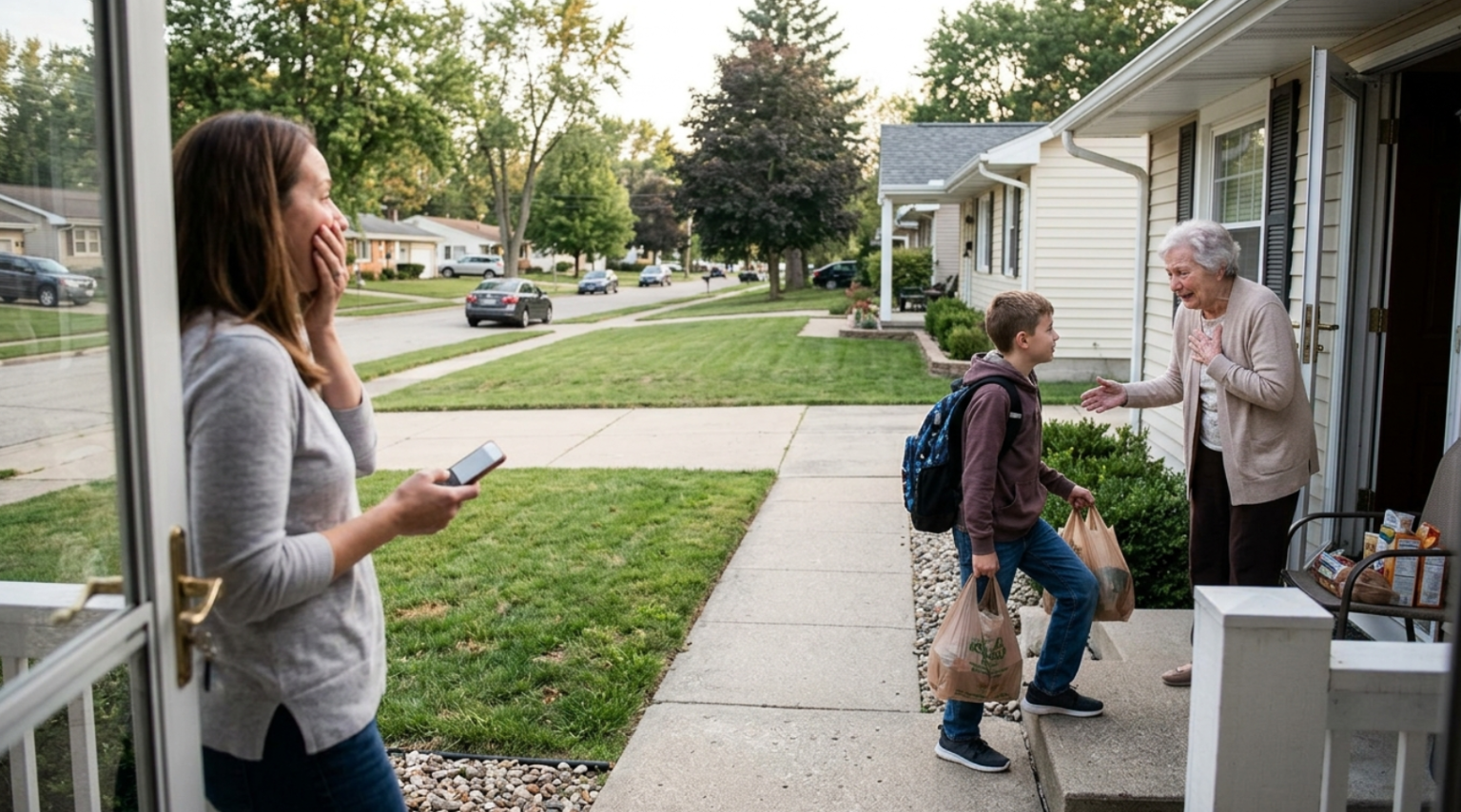
Six months earlier, I’d opened my front door terrified because my neighbor was crying and telling me I needed to see what my son had done.
That day, I thought I was about to discover my boy had made a terrible mistake.
Instead, I discovered that his small act of kindness would change more lives than I could count.
And if there’s one thing I hope Joel remembers when he’s grown, it’s this:
You don’t have to be rich to give someone hope.
You don’t have to be powerful to make a difference.
And you don’t have to be an adult to remind the world what compassion looks like.
Sometimes, all it takes is an eleven-year-old boy, twenty dollars, an old blue sweater, and the courage to stop when everyone else keeps walking.
Because the smallest act of kindness can become the beginning of someone’s greatest second chance.
THE END.