PART 23 — REBECCA’S SECRET I stared at Rebecca. “You knew?” She nodded.
“How long?” “Eleven years.” Scott swore under his breath.
Laura looked at her sister as if she no longer knew where to stand. I asked the only question that mattered. “Why didn’t you tell me?”
Rebecca’s eyes filled. “Because I didn’t know you.” “You came to the credit union knowing there might be children buried under my land.”
“Yes.” “And you said nothing.” “Yes.”
I almost laughed. Apparently secrecy was hereditary even when blood wasn’t. “What exactly did you know?”
Rebecca sat down. “Thomas found the first map eleven years ago.” “The burial map?”
“Part of one.” “Where?” “In Daniel’s old company archive.”
Scott frowned. “How did he access that?” “Someone sent it anonymously.”
“Who?” “We never found out.” I thought of Caroline.
Dottie. Richard. My grandmother.
Too many people had been passing secrets around like recipes. Rebecca continued. “The map showed a section of Fairview marked with numbers.”
“Graves?” “We suspected.” “Why didn’t Thomas report it?”
“He tried.” “To police?” “To the county first.”
“And?” “They searched the property records and found no cemetery registration.” “That doesn’t mean there weren’t graves.”
“I know.” “So why stop?” “Because three days later Thomas’s garage burned.”
Silence. “Accident?” “Officially.”
“And unofficially?” “He believed it was a warning.” Detective Marquez raised a hand.
“Believed. We need to keep that distinction.” Rebecca nodded.
“After that, Thomas became careful.” “So he spent eleven years gathering proof.” “Yes.”
“Why come to me now?” “Because he was dying.” That hurt more than I expected.
Not because it was cruel. Because it made sense. Thomas had run out of time.
“And the bank statements?” “Thomas knew Scott was taking money.” Scott looked away.
“How?” Rebecca hesitated. “Caroline.”
Of course. “She told him?” “Yes.”
“Then why didn’t Caroline tell me?” “She was afraid you’d tell Scott.” I stared at my son.
He didn’t defend himself. Rebecca continued. “Thomas wanted you to discover the financial abuse yourself.”
“So the quilt raffle?” “Was luck.” “The teller?”
“Luck.” “The mailed statements?” “That was you.”
At least one thing in my life had happened without someone secretly arranging it. I almost found that comforting. Then I remembered Raymond’s message.
“Why would Raymond say to ask you?” Rebecca swallowed. “Because I met him before the credit union.”
My heart sank. “When?” “Six weeks ago.”
“Your biological father?” “Yes.” “Thomas knew?”
“No.” That surprised me. “Why meet Raymond secretly?”
“Because Raymond contacted me.” “What did he want?” “The ledger.”
Scott looked up. “Why?” “He said Thomas had misunderstood what happened at St.
Agnes.” “Did you believe him?” “No.”
“Then why meet him?” “Because I wanted information.” “What information?”
Rebecca looked at me. “About you.” My anger paused.
“What about me?” “I wanted to know whether you really believed I died.” I understood.
She had spent forty-two years believing I might have abandoned her. Raymond offered answers. “What did he say?”
“That you knew.” My stomach twisted. “He lied.”
“I know that now.” “But six weeks ago?” “I wasn’t sure.”
“What did he ask you to do?” “Stay away from you.” Scott stared at her.
“And you didn’t?” “No.” “Why?”
Rebecca looked at me. “Because Thomas gave me the hospital record.” Alive.
Female. Four pounds, eleven ounces. The proof that I had been lied to too.
“So Raymond tried to stop you coming.” “Yes.” “What did he offer?”
“Money.” Of course. “How much?”
“Five hundred thousand dollars.” Laura gasped. “To stay away from Mom?”
“To give him the ledger and sign away any claim to Fairview.” My skin went cold. “You knew you might own part of the land?”
“No. Not then.” “What did you think the claim meant?”
“I thought Thomas had owned part of it.” “And you refused?” “Yes.”
“Why?” Her eyes met mine. “Because I wanted a mother more than I wanted half a million dollars.”
I couldn’t speak. Rebecca looked away immediately, almost embarrassed by the admission. I crossed the room.
I didn’t ask permission. I hugged her. This time she hugged me back without hesitation.
Then Scott’s voice broke the moment. “Raymond still has the burial register.” He was right.
I stepped away from Rebecca. Detective Marquez was already speaking into his phone. “No one is going alone.”
I nodded. “I wasn’t planning to.” Good.
I had finally learned that bravery and stupidity were not the same thing. Within forty minutes, police were at Raymond’s house. We waited at Rebecca’s.
Longest forty minutes of my life. Then Detective Marquez received a call. His expression changed.
“What happened?” “Raymond isn’t there.” My stomach tightened.
“The register?” “Gone.” “Did he leave anything?”
“Yes.” “What?” “A letter addressed to Rebecca.”
Rebecca went pale. Police photographed it before allowing the detective to read it to us. Raymond’s letter began: Rebecca, I have spent most of my life trying to keep one terrible act from becoming twenty.
Rebecca closed her eyes. The letter said Raymond had known about St. Agnes.
Not everything. Enough. As a young man, he had gotten Anne Keller pregnant.
Twins. He had been married. Afraid.
His family paid St. Agnes to arrange a private placement. One twin died shortly after birth.
The other was placed. Raymond did nothing. Years later, when he learned about Rebecca’s birth, he panicked again.
Again he let other people decide. Again he stayed silent. “He’s admitting it,” Rebecca whispered.
Detective Marquez continued. Raymond wrote that he spent decades trying to locate the surviving Keller twin. Eventually he found him.
Michael Keller. The man police had just found inside St. Agnes.
Raymond had secretly supported Michael financially for years. But Michael wanted something Raymond couldn’t give him. Proof of his twin brother’s death.
“That’s why Raymond wanted the register,” I said. Rebecca nodded. But the letter wasn’t finished.
Raymond admitted arranging Scott’s loan. Not to steal the land. To prevent Scott from selling it to an outside developer who might excavate the burial area without proper oversight—or destroy evidence.
Scott stood. “He could have told me.” Rebecca gave him a look.
“So could everyone else.” Fair. Then came the sentence that changed the room.
I did not send Margaret the message asking her to come alone. I stared at Detective Marquez. “What?”
He read again. If she received a message from my phone, someone else has it. My skin went cold.
“Where is Raymond?” Nobody knew. The letter continued.
The burial register is not with me. I gave it to the person I believed would finally turn it over. “Who?”
I whispered. Detective Marquez read the final line. Melissa.
Every head turned toward Scott. “No.” He called his wife.
Straight to voicemail. Again. Voicemail.
Laura whispered, “Where is she?” Scott checked location sharing on his phone. His face drained.
“What?” “She turned it off.” Rebecca stood.
“When?” “Forty minutes ago.” Detective Marquez immediately contacted officers.
Then my phone buzzed. Another photograph. The burial register.
This time it was open. A page of names. At the bottom was a fresh handwritten note.
Your family has lied long enough. Tonight everyone learns the truth. Scott whispered, “Melissa.”
I looked at him. “Are you sure?” “No.”
That was the first sensible answer anyone had given all day. Then another image arrived. A photograph of an old brick building.
St. Agnes. The timestamp was current.
Detective Marquez was already moving. “We’re going back.” “I’m coming.”
“No.” I looked at him. “Detective—” “No.
If someone is attempting to lure you there, you stay here.” He was right. I hated it.
But he was right. Scott insisted on going with police because Melissa might be there. The detective refused that too.
So we waited. Me. Rebecca.
Laura. Scott. Dottie.
Five people connected by blood, lies, marriage and theft. At 2:06 a.m., Detective Marquez called. “We found Melissa.”
Scott jumped up. “Is she okay?” “Yes.”
“Where?” “St. Agnes.”
“Did she send the messages?” “No.” My heart sank.
“Then who did?” “We’re still determining that.” “Does she have the burial register?”
“No.” Scott closed his eyes. “Did she ever have it?”
“Yes.” “What happened?” “She says Raymond gave it to her this afternoon.”
“And?” “She brought it to St. Agnes because someone contacted her claiming they could identify her biological mother.”
Catherine. My stomach tightened. “Who contacted her?”
“A woman.” “Name?” “She used the name Catherine Harper.”
Melissa’s biological mother. Scott whispered, “Was it really her?” “No.”
“How do you know?” “Because Caroline Mercer is with the real Catherine right now.” Silence.
So someone had used Catherine’s name to lure Melissa. “Did Melissa see the woman?” “Yes.”
“Who was she?” Detective Marquez paused. “She recognized her.”
Scott gripped the table. “Who?” “Judith Harper.”
Nobody spoke. Melissa’s adoptive mother. The woman whose notebooks we’d just found.
The woman we had been told was dead. Scott whispered: “Judith died three years ago.” Detective Marquez answered carefully.
“Then either Melissa is mistaken…” A pause. “…or Judith Harper is very much alive.” I thought of my grandmother. A funeral.
A death that wasn’t a death. A woman who lived decades under another name. And suddenly I knew better than to trust a gravestone.
“Where is Judith now?” “We don’t know.” “Did she take the register?”
“Melissa says yes.” My stomach tightened. “Why?”
“According to Melissa, Judith said there was one page that could never become public.” Rebecca whispered, “Which page?” Detective Marquez answered: “The final page.”
“What is on it?” “We don’t know.” Then Dottie stood so quickly her chair fell backward.
“I do.” We turned toward her. Her face had gone gray.
“What?” “The burial register wasn’t only for infants.” Nobody spoke.
Dottie continued. “There was one adult burial.” My skin went cold.
“Who?” She stared at me. “The woman everyone was told died when you were ten.”
I could barely breathe. “My grandmother?” Dottie nodded.
“Eleanor Porter.” I shook my head. “No.
We know Eleanor lived until eighty-one.” “Yes.” “Then she can’t be buried at St.
Agnes.” Dottie whispered: “Exactly.” The room went silent.
And then I understood. If a body had been buried under Eleanor Porter’s name while the real Eleanor was alive, the grave belonged to someone else. Someone whose disappearance had been hidden beneath my grandmother’s fake death.
I looked at Dottie. “Who is actually in that grave?” Tears filled her eyes.
“I think that’s what Judith has spent fifty years trying to hide.” “Who?” Dottie swallowed.
Then answered: “Your mother’s first husband.” I stared at her. “My mother was married before my father?”
“Yes.” “What was his name?” Dottie looked at the floor.
“Samuel Harper.” Melissa’s family name. My heart began hammering.
“And what happened to him?” Dottie lifted her eyes to mine. “Nobody knows.”
A pause. “But three days after Samuel Harper disappeared, your grandmother supposedly died.” And now the only record that might explain both events was in the hands of a woman who had already faked her own death once.
PART 24 — THE LAST PAGE
I stared at Dottie.
“My mother had a husband before my father?” “Yes.”
“And nobody thought I should know?” Dottie gave a tired, broken laugh. “Maggie, in your family, knowing things was apparently considered dangerous.”
For once, I couldn’t disagree. Rebecca sat beside me. “Who was Samuel Harper?”
Dottie looked toward Melissa’s storage boxes. “Judith’s older brother.” Scott went still.
“Melissa’s uncle?” “Yes.” The room seemed to shrink.
“So my mother married into the Harper family before she married my father?” “Yes.” “How old was she?”
“Nineteen.” “What happened to Samuel?” “He disappeared.”
“When?” “1958.” I calculated.
Years before I was born. “Did they divorce?” “No record of one.”
“Then how did she marry my father?” Dottie looked at me. “Samuel was eventually declared dead.”
Of course. Another death certificate. Another person conveniently removed on paper.
“Who had him declared dead?” “Your grandmother.” Eleanor.
The woman who later spent years collecting evidence against St. Agnes. Nothing in this family stayed simple long enough to breathe.
“Why?” “I don’t know.” Rebecca opened Judith’s notebook again.
“There has to be something.” Detective Marquez had photographed the pages before leaving, and Evelyn had told us not to handle the originals further. Laura searched through the photographs on her phone.
“Here.” She enlarged one page. An entry from 1958.
S.H. confronted E.P. regarding lower field. Threatened sheriff. My heart quickened.
“Lower field?” “Fairview,” Rebecca said. Then another entry.
Three days later. S.H. gone. E.P. identity closed.
I stared at the words. “Identity closed?” Dottie whispered, “That’s what they wrote when someone needed to disappear from the records.”
Laura looked at me. “Grandma Eleanor didn’t die.” “No.”
“So maybe Samuel didn’t either.” Hope appeared for half a second. Then vanished when Rebecca pointed to the next line.
One adult transferred with infants. No marker. Nobody spoke.
I felt sick. “We need that final page.” At 2:41 in the morning, Detective Marquez called again.
They had found Raymond. Alive. Sitting in his car outside a motel twenty miles away.
He had not been abducted. He had not been hiding from police. He had been looking for Judith.
“Does he know where she is?” I asked. “He believes so.”
“Where?” Detective Marquez hesitated. “Fairview.”
My stomach tightened. “The land?” “Yes.”
“Why?” “Raymond says Judith told him she was going to finish what their families should have finished fifty years ago.” “What does that mean?”
“He doesn’t know.” I looked at Rebecca. She was already reaching for her coat.
“No,” I said. She stared at me. “She may have the burial register.”
“And police are going.” “Margaret—” “No.” My voice surprised even me.
“I spent two days rushing toward every secret somebody dangled in front of me.” I took her hand. “Tonight we let people trained for this do their jobs.”
Rebecca stared at me. Then slowly sat back down. At 3:18, we received another call.
Police had located Judith. She was standing near the oldest section of the Fairview property. Alone.
The burial register was beside her. And she had been digging. Scott closed his eyes.
“Is she hurt?” “No.” “Arrested?”
“Detained.” “Did they recover the register?” “Yes.”
My chest loosened for the first time in hours. “The final page?” “Intact.”
Nobody moved. “What does it say?” “I can’t read evidence over the phone.”
Fair enough. “Then when can we know?” “Later this morning.”
Later that morning turned out to mean 9:36. We met at Evelyn Shaw’s office. Detective Marquez came with copies authorized for review.
Raymond was there with his own attorney. Melissa sat beside Scott. Dottie sat beside me.
Rebecca and Laura sat across from us. Nobody looked like the same person who had entered the credit union days earlier. Detective Marquez placed the copied final page on the table.
“Before we begin, I need to be clear. This document is old, and some entries are ambiguous. Investigators will verify what can be verified independently.”
I nodded. No more building entire lives on one person’s handwriting. He turned the page toward us.
Seven infant entries. Then one adult. Samuel Harper.
My hands went cold. Date of burial. June 14, 1958.
Location: Lower Fairview — Row A, Position 1. Cause: Blank. Authorization: E.P.
I looked at Raymond. “Eleanor Porter?” He shook his head.
“I don’t know.” Detective Marquez continued. “There is a handwritten annotation added later.”
“What does it say?” He read: E.P. did not authorize. Signature copied by M.P.
M.P. My mother. My chest tightened.
“My mother forged Eleanor’s authorization?” “That is what the notation alleges.” “Who wrote the notation?”
“Judith Harper.” Melissa whispered, “Mom knew.” Apparently.
Then Detective Marquez turned over a second copy. A letter Judith had kept folded inside the back cover. It was written two months ago.
A confession. Judith admitted she had faked her death after Daniel died because she believed Scott’s attempts to sell Fairview would expose everything. She admitted taking the burial register.
She admitted hiding parts of the St. Agnes history. But then came the sentence that made Dottie gasp.
Samuel Harper was my brother, and he was killed because he discovered the babies. I closed my eyes. “Killed by who?”
Detective Marquez pointed to the next paragraph. Judith had written: For most of my life, I believed Eleanor Porter killed him. I was wrong.
I stared. Then: Eleanor tried to save him. My grandmother.
The woman whose death had been faked. “Then who?” The detective continued.
Judith claimed Samuel confronted Dr. Franklin about infant burials. My mother was there.
So was Henry Cole. Samuel threatened to report everything. A fight followed.
And according to Judith— My mother struck Samuel. Once. He fell.
Hit his head. And never got back up. Nobody spoke.
I felt no dramatic scream inside me. Only emptiness. My mother.
The woman who taught me to bake biscuits. Who brushed my hair. Who held me after telling me Rebecca was dead.
Maybe that was the hardest truth of all. Terrible people do not always look terrible in our memories. “What happened afterward?”
Detective Marquez continued summarizing Judith’s statement. Dr. Franklin panicked.
Henry Cole prepared paperwork. My mother begged Eleanor to help. Eleanor refused.
So my mother forged Eleanor’s authorization and used Eleanor’s name in the burial register. Then she created a second lie. Eleanor Porter was “dead.”
Not because Eleanor had died. Because Eleanor knew too much. “She had her own mother institutionalized afterward,” I whispered.
“Yes,” Caroline said from the speakerphone. Her voice broke. “That was why.”
Everything connected. Not neatly. Not kindly.
But finally. Samuel Harper’s disappearance. Eleanor’s false death.
St. Agnes. Fairview.
My mother’s fear of scandal. Rebecca. Dottie.
Scott. Melissa. All of it grew from people learning that lies could solve immediate problems.
Until the lies became the family. Rebecca asked, “What happens to the burial site?” Detective Marquez answered carefully.
“Authorities will seek the necessary legal approvals and use forensic specialists. No one here should attempt to search or excavate anything.” Good.
Some things deserved more care than our family had ever given them. Scott looked at me. “And Monday?”
The sale. The loan. The company.
Evelyn answered. “There will be no Monday closing.” Melissa lowered her head.
“The buyer?” “Your company is withdrawing.” Melissa nodded.
“Yes.” “And Fairview Capital Recovery has agreed to suspend enforcement while the ownership and fraud issues are investigated.” I looked at Raymond.
He had made that happen. “Why?” He met my eyes.
“Because I should have told the truth forty years ago.” Rebecca looked at him. “You had plenty of chances.”
“Yes.” “Why now?” Raymond’s eyes filled.
“Because I’m tired of confusing cowardice with protection.” Nobody forgave him. But nobody argued either.
Then Evelyn turned to Scott. “As for you, the financial investigation continues.” He nodded.
“I understand.” “You may face civil liability and potentially criminal consequences depending on what investigators establish.” “I understand.”
I watched him. No excuses. No Dad told me.
No I was helping. Just: “I understand.” It did not repair anything.
But it was the first brick. Then Detective Marquez placed one final item on the table. A sealed envelope.
My name. Not Daniel’s handwriting. Not my mother’s.
Eleanor’s. My grandmother. Caroline whispered through the phone: “She wrote that for you before she died.”
I opened it. The letter was short. Eleanor wrote that she had watched me from a distance for years.
That she had wanted to come home. That fear had become a habit. Then came the line I read three times.
Margaret, if truth ever reaches you, do not spend the rest of your life punishing yourself for believing people you loved. Spend it refusing to continue their lies. I stopped reading.
Rebecca reached for my hand. Laura took the other. For once, I let both daughters hold me.
Then my phone buzzed. A message from the credit union. For several seconds I simply stared at it.
Scott noticed. “What is it?” I opened the notification.
The account changes were complete. His access had been removed. All recurring “management” transfers had been blocked.
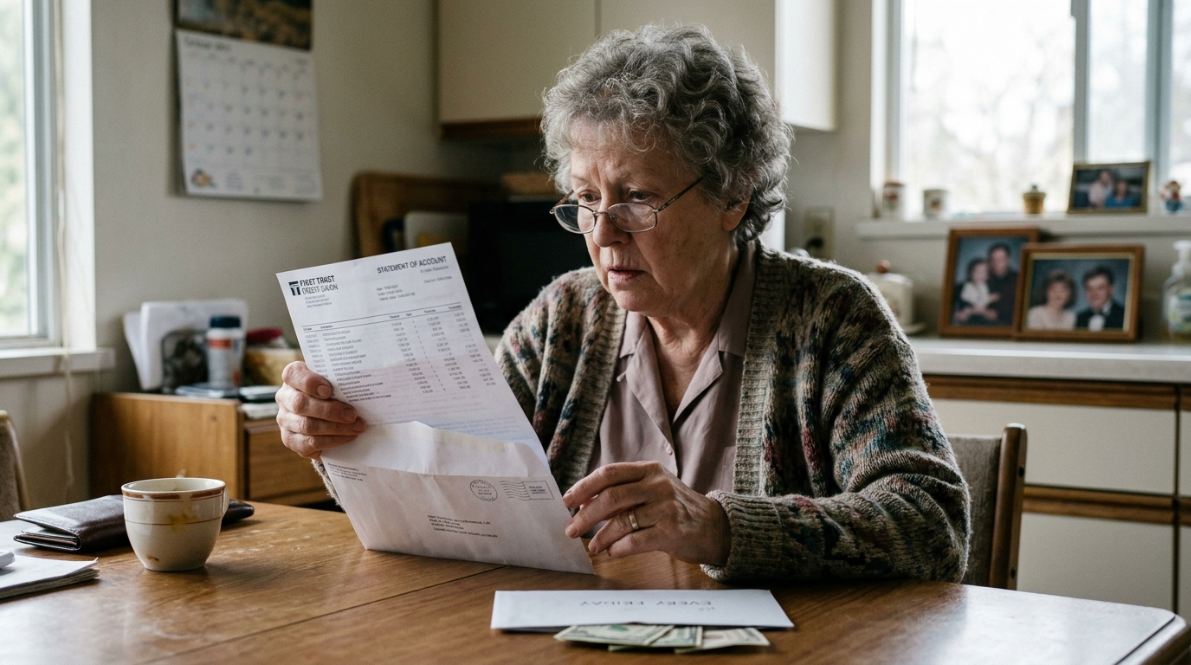
Paper statements would now come directly to me. My money. My name.
My decisions. I looked at Scott. “It’s done.”
His eyes lowered. “I know.” “No.”
I put my phone on the table. “You don’t.” Everyone looked at me.
“For four years, Friday meant waiting for my son to decide how much of my own money I was allowed to touch.” I thought of the shoebox. One hundred and ninety envelopes.
Forty dollars each. I had once believed they proved how small my life had become. Now I understood something else.
They proved I had survived every Friday. I stood. “Tomorrow is Friday.”
Scott looked at me. “Yes.” “For the first time in four years, don’t come to my house with an envelope.”
His eyes filled. “I won’t.” “And don’t call to ask whether I need help managing.”
“I won’t.” “If you want to call me…” I paused. “…call because I’m your mother.” He nodded.
“I’d like that.” “We’ll see.” That hurt him.
It needed to. Trust was not another inheritance he automatically received. Then Dottie touched my sleeve.
“What about us?” Fifty years. One question could not answer fifty years.
“I don’t know yet.” She nodded through tears. Fair.
Rebecca stood. “What happens now?” I looked around the room.
At the daughter I had lost. The daughter I had raised. The son who had betrayed me.
The friend who had betrayed me and been betrayed herself. The people who had spent decades living inside other people’s decisions. “Now?”
I picked up Eleanor’s letter. “Now we stop hiding.” But before anyone could move, Detective Marquez’s phone rang.
He listened. His expression changed. “Detective?”
I asked. He looked directly at me. “Forensic teams completed the first non-invasive survey of the suspected burial area.”
My heart began pounding. “How many?” He hesitated.
“Margaret…” “How many graves?” His answer silenced the room. “Not seven.”
Rebecca squeezed my hand. “Then how many?” Detective Marquez took a slow breath.
“The preliminary survey indicates at least thirty-one possible burial locations.” Thirty-one. My mother’s confession had listed seven.
Thomas’s records had listed twenty-three children. But underneath Fairview, there might be thirty-one graves. And Detective Marquez wasn’t finished.
“One of the locations is separate from the others.” “The adult grave?” “Possibly.”
I thought of Samuel Harper. But he shook his head. “No.
There’s another one.” My skin went cold. “Another adult?”
“We don’t know yet.” “Then why is it different?” “Because it’s beneath the foundation of the original Bennett Construction office.”
Daniel’s first building. Built on the twelve acres covered by the false deed. I stared at Scott.
He stared back. Then I remembered something Daniel had said on the cassette. The deed covered twelve acres.
The forty-eight acres belonged to the trust. For all this time, we had been focused on what was buried under the forty-eight. Nobody had asked why Daniel had been so desperate to control those twelve.
I whispered: “What did they find?” Detective Marquez’s expression hardened. “A metal container appears to be buried with the remains.”
“What kind of container?” “We won’t know until the site is lawfully examined.” Then he added: “But the imaging shows lettering on the lid.”
My mouth went dry. “What does it say?” He looked down at the preliminary report.
Then back at me. Two words. BENNETT RECORDS.
Daniel had left us one final secret. And whatever was inside that box had been buried beside a body. One part remained.:::
PART 25 — FINAL PART:
THE LAST FRIDAY ENVELOPE The metal box came out of the ground eleven days later.
I was not there when they excavated it. None of us were. By then, I had learned there are moments when love does not give you the right to stand close.
The Fairview site belonged to investigators now. To forensic specialists. And, most importantly, to the people whose names had been reduced to lines in ledgers for decades.
Detective Marquez called me that afternoon. “The container is intact.” My hand tightened around the phone.
“And the remains?” “An adult male.” “Samuel Harper?”
“We don’t know yet.” That answer would once have frustrated me. Now I respected it.
“What’s in the box?” “Documents.” My heart began pounding.
“What kind?” “Enough that I think you should come to Evelyn’s office.” So I did.
Rebecca came with me. Laura arrived ten minutes later. Scott came alone.
Melissa had gone to stay with relatives while she began sorting through the truth about Catherine Harper. Dottie came too. She sat at the far end of the conference table.
There was space between us now. Not punishment. Just truth.
Some wounds need room. Raymond did not attend. He had given investigators a full statement and, for the moment, Rebecca wanted nothing from him.
Caroline joined by video. Evelyn Shaw sat at the head of the table. Detective Marquez entered carrying copies.
Not originals. The originals were evidence. He sat.
“The identification process for the remains will take time.” Nobody interrupted. “But the container has already answered several questions.”
He placed the first photograph down. The metal box. Corroded.
Mud-stained. Across the lid: BENNETT RECORDS. Inside had been waterproof packets.
Daniel had prepared them carefully. There were deeds. Bank records.
St. Agnes correspondence. Copies of altered birth certificates.
Payments. Names. And one handwritten ledger.
Scott stared at it. “Dad’s?” “Yes.”
My son closed his eyes. The detective continued. “Daniel appears to have documented payments made by Bennett-related companies to individuals connected with St.
Agnes.” “How far back?” “Decades.”
Rebecca whispered, “So Thomas was right.” “About some things, yes.” That distinction mattered.
Nobody was entirely right. Nobody was entirely wrong. That was part of the tragedy.
Then Detective Marquez placed another photograph on the table. A letter. Addressed to Scott.
My son went still. “Dad wrote to me?” “Yes.”
“Can I read it?” The detective nodded. Scott took the copy.
His hands shook. He read silently at first. Then stopped.
“What?” He shook his head. “Nothing.”
I waited. Finally, he read one paragraph aloud. Daniel had written: Scott, I taught you that protecting the family meant controlling information.
If you learned that lesson well, then I failed you more completely than I failed myself. Scott lowered the page. Nobody rescued him from those words.
Not even me. Especially not me. He continued reading silently.
Then tears rolled down his face. “What else?” Laura asked.
Scott swallowed. “He knew.” “Knew what?”
“About the money.” I frowned. “What money?”
“The distributions.” My stomach tightened. “Before he died?”
Scott nodded. “He knew I’d started moving some of them.” There it was.
The last shield disappeared. Scott could no longer blame everything on Daniel. “What did he do?”
“He confronted me.” “When?” “About a month before he died.”
“And you continued afterward.” Scott stared at the letter. “Yes.”
“Why?” He wiped his face. “Because by then I had debts.”
“The company?” “Some.” “Your lifestyle?”
His face reddened. “Yes.” “The truck?”
“Yes.” “The deck?” “Yes.”
“Vacations?” “Yes.” Each answer hurt.
But each answer was clean. No excuse attached. Finally.
“And the forty dollars?” Scott looked at me. “I thought if you had enough to get by, you wouldn’t ask questions.”
Silence. There it was. The truth that had started everything.
Not protection. Not management. Control.
I nodded. “Thank you.” He blinked.
“For what?” “For finally saying it without dressing it up.” His face crumpled.
“I am sorry.” “I believe you.” Hope appeared in his eyes.
I stopped it before it grew too quickly. “That doesn’t mean everything is fixed.” “I know.”
Maybe he finally did. Detective Marquez placed another document down. “This is likely the most important financial record in the box.”
It was a handwritten accounting prepared by Daniel shortly before his death. Money diverted from my trust. Property income.
Payments. Transfers. Every dollar Daniel believed had been improperly taken.
At the bottom was a total. $1,742,860. I stared at it.
Scott whispered, “Jesus.” Nearly $1.75 million. Not including the land.
Not including appreciation. Not including whatever legal claims might follow. For four years, I had been handed forty dollars every Friday while money moved around me in amounts I could barely imagine.
Evelyn said, “We will have accountants verify everything independently.” I nodded. Numbers could wait.
Then Rebecca pointed toward another packet. “What is that?” Detective Marquez’s expression changed.
“Letters.” “From who?” “Several people.”
One was my mother. One was Eleanor. One was Thomas.
And one was Daniel. Addressed to me. I almost didn’t open it.
I had spent enough time listening to dead people explain why they had controlled the living. But eventually, I did. Daniel did not ask me to forgive him.
That surprised me. He wrote: Maggie, if this reaches you, then the truth survived me. That is more than I deserve.
I continued. He admitted lying about Rebecca. Admitted helping my mother.
Admitted using my land. Admitted allowing Scott to learn that secrecy was a form of loyalty. Then: I kept waiting for a moment when telling you would hurt less than continuing the lie.
That moment never came because I was waiting for something that does not exist. Truth delayed does not become kinder. It only becomes older.
I stopped. Rebecca put her hand over mine. I kept reading.
The final paragraph was short. You will be tempted to spend what remains of your life asking which memories were real. Don’t.
Your love was real even when the circumstances around it were not. Nobody can forge that. I folded the letter.
I didn’t forgive Daniel that afternoon. Maybe I never would. But I stopped letting his secrets decide what I did next.
Six weeks later, the financial case was moving forward. The Monday sale never happened. Fairview Capital’s claim was being challenged.
The trust amendment passed its first independent legal review. For the moment, Rebecca and I were recognized as the likely beneficiaries of the remaining trust property, pending final court determination. She still hated talking about the money.
So did I. We talked about other things instead. I learned she hated mayonnaise.
I learned she loved mystery novels. I learned she had broken her ankle at fourteen. I learned my grandson’s name was Nathan.
And one Sunday afternoon, I met him. He stood awkwardly in my doorway holding flowers. “Grandma?”
One word. Forty-two years late. I cried before he finished saying it.
Rebecca cried too. Nobody pretended it made up for anything. But we had stopped asking new moments to repair old ones.
We simply let them be new. Laura and Rebecca became sisters slowly. Coffee first.
Then phone calls. Then an argument about which one of them had inherited my stubbornness. That was the first argument I enjoyed hearing.
Melissa eventually met Catherine. Privately. I didn’t ask what they said.
That story belonged to them. Dottie agreed to DNA testing. Her biological identity took longer to establish than any of us expected.
But one thing became clear. Thomas had been wrong. Evelyn Marsh was not Dottie’s mother.
The records suggesting it had been another false trail. Eventually, investigators found a match through Helen Cole’s surviving family. Dottie really was Helen’s daughter.
Richard Cole was her uncle. When Richard learned, he cried. Dottie did too.
Their relationship would be theirs to figure out. As for me and Dottie? We started with coffee.
One cup. No pretending. No promise that fifty years could be repaired in an afternoon.
She apologized. I listened. Then I told her I was still angry.
She said: “You should be.” For once, that was enough. Scott’s situation was harder.
He cooperated with the financial investigation. He returned what money he could immediately. The truck disappeared.
Then the expensive vacations. Then the house went up for sale. The deck stayed.
I found that strangely funny. All that trouble, and the deck outlived the lie. There would be legal consequences.
I did not interfere. That was part of loving him differently. I would not save him from accountability.
And I would not abandon him either. He was my son. DNA eventually confirmed Raymond was his biological father.
Scott took the news badly. Then quietly. Then angrily.
Then quietly again. He had not decided whether he wanted a relationship with Raymond. I told him he didn’t owe anybody an immediate answer.
Neither did I. The Fairview investigation continued. More possible burial sites were identified.
Families were contacted carefully. Records were compared. Names were restored where possible.
Some questions found answers. Others probably never would. The adult remains beside Daniel’s records were eventually identified as Samuel Harper.
The truth Judith had carried for decades was no longer only a story. Samuel finally had his name back. And Fairview?
Rebecca and I made one decision before the lawyers finished arguing about everything else. If the land legally became ours, the burial area would never be developed. No shopping center.
No parking garage. No luxury apartments. Whatever portion contained graves would be preserved.
Rebecca wanted a memorial. So did I. Not a monument to our family.
Quite the opposite. A place for the names our families had tried to erase. Then came Friday.
I woke before seven. For a moment, habit made me listen for Scott’s car. Nothing.
At eight, I made coffee. At nine, I drove myself to the credit union. The young teller who had started all of this by asking which account should receive my quilt raffle check recognized me.
“Mrs. Bennett!” “Hello, sweetheart.”
“What can I do for you?” I smiled. “I’d like some cash.”
“How much?” I almost said forty dollars. Instead: “Two hundred.”
She counted it onto the counter. Five twenties. Then five more.
My money. No envelope. No permission.
On my way home, I stopped at a department store. My granddaughter’s thirteenth birthday had passed weeks earlier. I went to the section where young people bought things I did not understand.
A salesgirl helped me choose a bracelet. Nothing extravagant. Just pretty.
I paid for it myself. Then I went home. At 4:17, someone knocked.
Scott. He stood on the porch. Empty-handed.
No envelope. “Hi, Ma.” “Hello, honey.”
He looked nervous. “I was wondering if you’d like some company.” I studied him.
Trust wasn’t back. But perhaps this was where it started. “You can come in.”
He smiled. Then noticed the gift bag on my table. “What’s that?”
“Your daughter’s birthday present.” His smile faded slightly. “Ma, you didn’t have to spend—” He stopped himself.
I waited. Then he tried again. “I think she’ll love it.”
Better. Much better. We sat at the kitchen table.
No spreadsheets. No account statements. No discussions about what I could afford.
Just coffee. After a while, Scott looked toward the closet. “Do you still have those Friday envelopes?”
“Yes.” “All of them?” “One hundred and ninety.”
He lowered his head. “Why?” “I used to think they were proof of what you did to me.”
“Aren’t they?” “Yes.” I took the shoebox from the closet.
Set it between us. “But they’re something else too.” “What?”
“Proof that I finally noticed.” I opened the box. The envelopes were stacked in order.
Four years of Fridays. Four years of asking permission to live inside my own life. I took the final empty envelope.
Then wrote today’s date across the front. Scott watched. “What are you doing?”
I wrote one more thing beneath the date. $0. He stared at it.
I placed it on top of the others. “No allowance today.” His eyes filled.
“No.” “No management fee.” “No.”
“No signatures.” “No.” I closed the shoebox.
“Just coffee.” Scott nodded. “Just coffee.”
And that was how the story ended. Not with millions. Not with arrests.
Not with land. Not even with the secrets underneath Fairview. It ended at my kitchen table with my son sitting across from me and nothing passing between our hands.
No money. No papers. No permission.
Because after four years of receiving forty dollars every Friday, I finally understood the most important number in my bank account. It wasn’t the balance. It was one.
One name. One signature. One woman in charge of her own life.
Mine. And the next Friday, when I opened my mailbox, there was a bank statement waiting for me. Addressed directly to: Margaret Bennett.
I carried it inside. Opened it myself. And for the first time in four years, I didn’t need anyone to tell me what was mine.