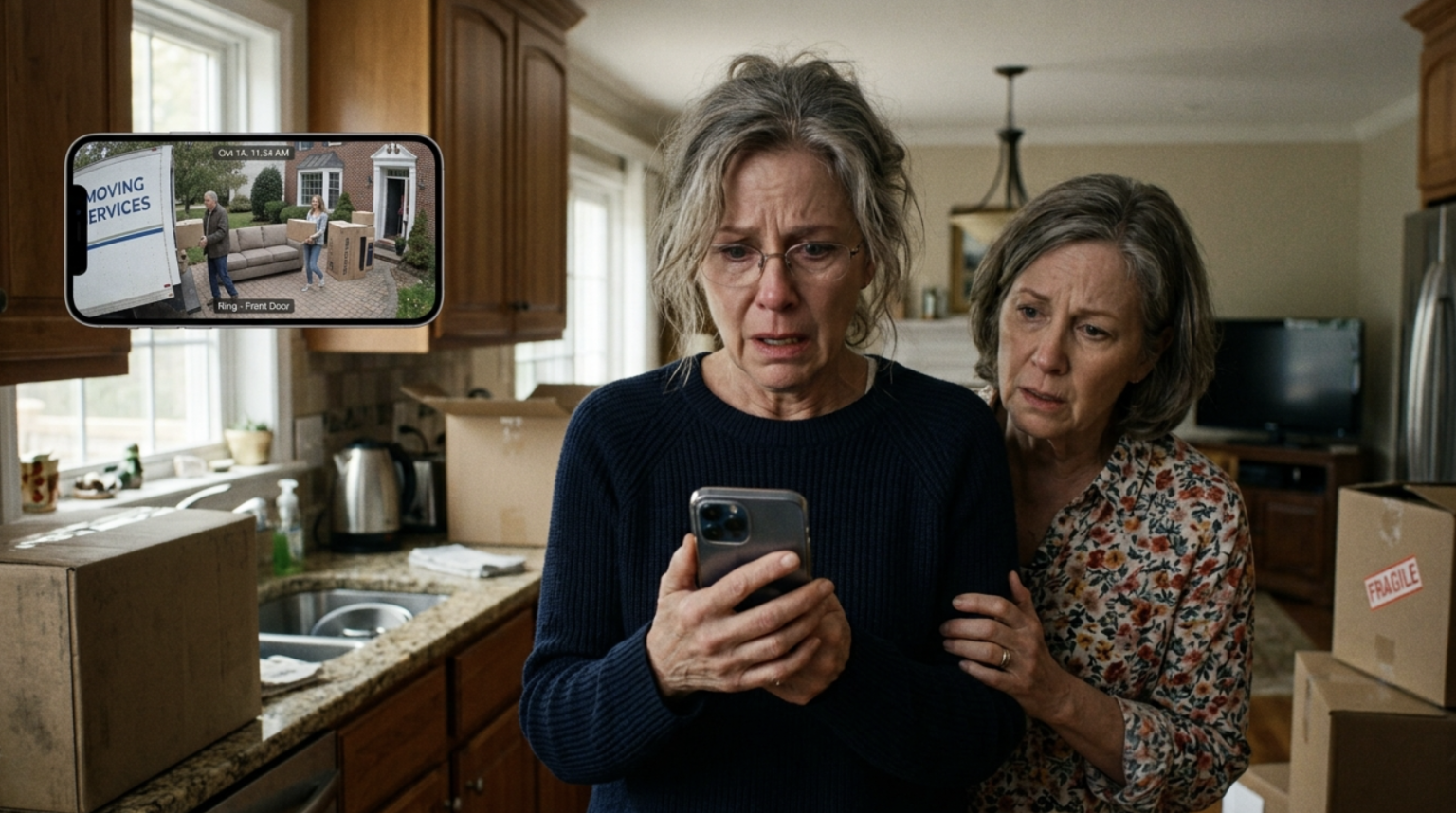
PART 4
For several seconds, I couldn’t speak.
Rachel was crying.
I was staring at the photograph.
Mark had been there eleven days earlier.
Before I moved in.
Before the furniture.
Before the moving truck.
Before I even realized what the house meant to me.
He had been watching.
Planning.
Waiting.
And somehow, my own family had been pulled into it.
“Rachel,” I said quietly, “I need you to tell me everything.”
She wiped her eyes.
“I don’t know anything.”
“Then tell me what you do know.”
She looked at the photograph again.
“Emily came to my house the morning you closed.”
I frowned.
“Why?”
“She said she wanted to help you.”
“I didn’t ask her to.”
“I know.”
“Did she know where the house was?”
Rachel hesitated.
Then nodded.
“How?”
“She asked me.”
“When?”
“About a week before closing.”
I stared at her.
“You told her?”
“I didn’t know it was supposed to be a secret.”
My stomach tightened.
“I specifically told you I didn’t want Mark knowing.”
“I know.”
“Rachel…”
“I didn’t tell her the address!”
Her voice cracked.
“She kept asking where you were moving. I told her you had bought a house somewhere across the river. That’s all.”
“Then how did she find it?”
Rachel shook her head.
“I don’t know.”
I looked at the photograph.
Emily was standing beside Mark.
My niece had always been friendly with him.
Too friendly, perhaps.
But I had never imagined she would help him.
Then Rachel suddenly remembered something.
“Wait.”
“What?”
“Emily asked me for your old iPad.”
I froze.
“When?”
“A few weeks ago.”
“Why?”
“She said she wanted to use it for school.”
I closed my eyes.
The old iPad.
The one I had given Mark.
The one that had just logged into my account from my house.
Rachel whispered:
“Emily had it.”
My heart sank.
“No.”
“Yes.”
“She couldn’t have.”
“Why?”
“Because Mark had it.”
Rachel stared at me.
I slowly realized what that meant.
Mark hadn’t needed to steal my password.
He had my old device.
A device that was already trusted.
A device that contained years of saved information.
Emails.
Addresses.
Documents.
Photos.
Passwords.
And possibly my new address.
The question was no longer whether Mark had help.
The question was how many people had helped him.
I called Officer Davis.
“Officer, I need to update you.”
He answered immediately.
“What happened?”
“I think my ex-husband had access to one of my old devices.”
“Was the device in your possession?”
“No.”
“Who had it?”
“My ex-husband.”
“Do you believe he accessed your accounts?”
“Yes.”
“Can you prove that?”
“I have a security alert showing a login from my house.”
“I’m going to document that.”
“There’s more.”
I explained everything.
The forged occupancy agreement.
The administrator access.
The contractor.
Karen.
The photograph.
Emily.
When I finished, Officer Davis was quiet.
Then he said:
“Ma’am, I strongly recommend you do not confront any of these people directly.”
“I wasn’t planning to.”
“Good.”
“Can you search the house?”
“We’ll need to establish the legal basis.”
“I own it.”
“Yes.”
“But if they left something behind…”
“Don’t touch anything.”
That sentence stayed with me.
Don’t touch anything.
So when I returned home that afternoon, I didn’t go inside.
Instead, I drove straight to the police station with Rachel.
We handed over copies of everything.
The closing documents.
The fraudulent agreement.
The security logs.
The email history.
The photograph.
The account login.
The police took statements.
Rachel gave hers.
I gave mine.
And then something unexpected happened.
Officer Davis asked:
“Did your ex-husband ever have access to your financial records during the marriage?”
“Yes.”
“Joint accounts?”
“We had several.”
“Did you separate them completely after the divorce?”
“Yes.”
“Any shared passwords?”
I thought for a moment.
“No.”
Then I remembered.
“Actually…”
“What?”
“There was one.”
“What was it?”
“The password to our old family cloud account.”
“Was that account still active?”
“I don’t know.”
Officer Davis wrote it down.
Then he looked at me.
“Change every password tonight.”
“I will.”
“And contact your bank.”
“I already will.”
He nodded.
Then he said something that made me realize this might be much bigger than a house.
“Ma’am, people don’t usually prepare forged occupancy documents, obtain security access, and move an entire household into a property by accident.”
“I know.”
“You need to find out what they were trying to accomplish.”
That night, Rachel stayed with me at a hotel.
Neither of us slept.
At 2:13 a.m., my phone buzzed.
Another unknown number.
You are making this harder than it needs to be.
I stared at the message.
Then another came.
Just give him the house.
I didn’t answer.
A third message appeared.
You don’t understand what happens if you don’t.
I took screenshots.
Sent them to Officer Davis.
Then blocked the number.
The next morning, my attorney called.
She had reviewed the fraudulent occupancy agreement.
Her first words were:
“This is not a normal mistake.”
“I know.”
“The signature is clearly designed to resemble yours.”
“Can it be used against me?”
“No.”
“Then why create it?”
She paused.
“That is the important question.”
I sat silently.
She continued.
“Judith, I reviewed your closing file. There’s something unusual.”
“What?”
“Your purchase was financed partly with your own money and partly with proceeds from the sale of marital property.”
“Yes.”
“Do you remember the settlement agreement?”
“Yes.”
“There’s a clause concerning the division of proceeds.”
I knew what she meant.
The house had been purchased with money from my side of the settlement.
Money that belonged to me.
My attorney continued.
“If Mark could establish that the new house was purchased with marital funds, he could potentially attempt to claim an interest in it.”
“But the divorce settlement says otherwise.”
“I know.”
“Then what is he doing?”
“I think he may be trying to create evidence after the fact.”
My heart sank.
Evidence.
That was it.
The forged agreement wasn’t designed to make him the owner immediately.
It was designed to create a story.
A story that he had permission.
A story that I had agreed.
A story that he had some legitimate connection to the property.
And if he could create enough documents, witnesses, messages, and records, he might force me into a legal fight.
My attorney said:
“Do not communicate with him.”
“I won’t.”
“Let me handle everything.”
I agreed.
Then she said:
“One more thing.”
“What?”
“Karen Mitchell called me.”
I froze.
“What did she want?”
“She wants to meet.”
“Why?”
“She says she can explain.”
I laughed bitterly.
“Of course she can.”
My attorney didn’t laugh.
“She says she has evidence.”
“Evidence of what?”
“She wouldn’t tell me.”
I thought about it.
“Where does she want to meet?”
“My office.”
“Go,” I said.
“Are you sure?”
“Yes.”
“But don’t go alone.”
“I won’t.”
Three hours later, Karen sat across from me.
She looked completely different from the confident realtor who had handed me the keys eleven days earlier.
Her hands were shaking.
She looked exhausted.
“I made a terrible mistake,” she said.
I didn’t answer.
She placed a folder on the table.
“I didn’t know how far he would take it.”
“Who?”
“Mark.”
I stared at her.
“You gave him my address.”
“Yes.”
“You gave him my closing documents.”
“Yes.”
“You helped him get into my house.”
She lowered her eyes.
“Yes.”
My chest tightened.
“Why?”
Karen began to cry.
“Because he threatened me.”
“With what?”
“He knew about a financial problem I had.”
“What financial problem?”
She hesitated.
Then finally told me.
She had been taking money from clients to cover personal debts.
Not huge amounts at first.
But enough that she was drowning.
Mark had discovered it.
He threatened to report her.
Then he offered a deal.
Help him get access to my property.
Help him establish that he had permission to use the house.
And he would make the evidence disappear.
I stared at her.
“So you sold me out.”
“I know.”
“You were my realtor.”
“I know.”
“You knew how important that house was to me.”
“I know.”
“And you still did it.”
Karen covered her face.
“I was scared.”
I leaned back.
“You should have been.”
She opened the folder.
“There’s more.”
Inside were printed emails.
Text messages.
Copies of documents.
And photographs.
One photograph showed Mark and Dennis standing together outside my house.
Another showed Karen handing Mark an envelope.
Another showed Emily holding my old iPad.
My stomach turned.
“How long?”
Karen whispered:
“Three weeks.”
Three weeks.
They had been planning this before I closed.
I looked through the messages.
Mark had written:
She won’t suspect anything.
Karen had replied:
What if she finds out?
Mark:
She won’t. She trusts family.
I stared at those words.
She trusts family.
That sentence hurt more than the betrayal itself.
Because it was true.
I had trusted family.
I had trusted Rachel.
I had trusted Emily.
I had trusted Mark for twenty-seven years.
And even after the divorce, I had still believed I knew who he was.
But the next message made my hands go cold.
Mark had written:
The house isn’t the real objective.
I stopped breathing.
I read it again.
The house isn’t the real objective.
Karen had replied:
Then what is?
Mark:
The safe.
I looked at Karen.
“What safe?”
She shook her head.
“I don’t know.”
“There is no safe in my house.”
“There is.”
My heart stopped.
“What?”
Karen looked at me.
“The previous owner had one.”
I remembered.
During the inspection, the inspector had mentioned an old built-in cabinet in the basement.
I had ignored it.
Karen continued.
“Mark believes the previous owner left something behind.”
“Like what?”
“I don’t know.”
“Then why did he need my house?”
“He believes there are financial records inside.”
“What kind?”
Karen swallowed.
“Records connected to a company he used to work with.”
I stared at her.
“What company?”