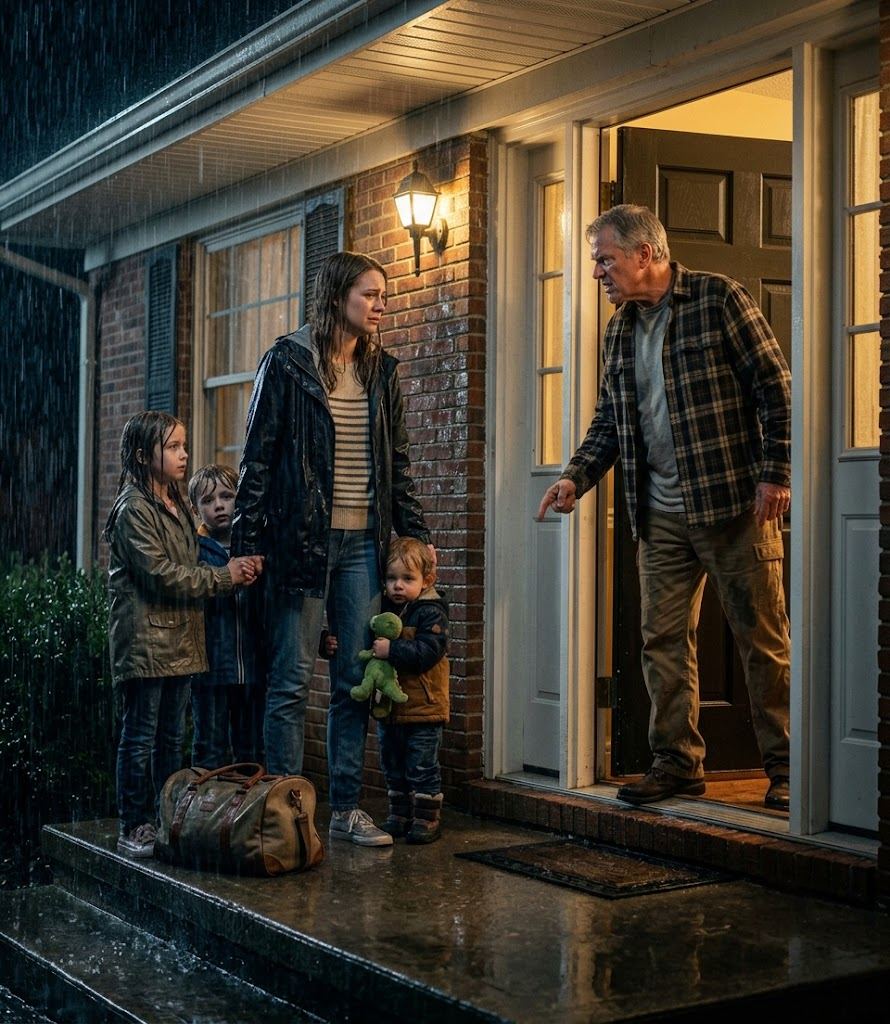
“At a motel.”
There was a pause.
“Oh, Laurel.”
The disappointment in her voice made my stomach twist.
Not concern.
Disappointment.
“Mom, Dad sent us away.”
“He was upset.”
“He wouldn’t let his grandchildren sleep in two empty bedrooms.”
“You know how your father feels about divorce.”
“I’m not divorced.”
“You know what I mean.”
I walked into the bathroom and closed the door so the children wouldn’t hear.
“Grant cheated on me for almost a year.”
“I’m not saying what he did was right.”
That sentence usually means the next thing someone says will excuse exactly what they just claimed was wrong.
Mom continued.
“But marriages survive worse things than this. You have three children, Laurel. Sometimes you have to think beyond your own feelings.”
I went quiet.
My own feelings.
Apparently, betrayal was a feeling. Being lied to was a feeling. Watching the father of my children defend an affair was a feeling.
“Did Dad tell you to call me?”
Another pause.
“He thinks you should go home before things become harder.”
“They became harder when you shut the door.”
I ended the call.
My brother, Brent, sent me a message an hour later.
You’ve always been dramatic. Just go home and deal with your marriage.
My younger sister, Callie, followed.
The kids need stability. Don’t punish them because you’re angry at Grant.
I read both messages, then turned off my phone.
That day, I found a furnished apartment above a laundromat.
It had two bedrooms, thin walls, and a kitchen barely large enough for a table.
I signed a three-month lease.
Holly slept with me. The boys shared the other room.
For the first several weeks, every part of our life felt temporary.
Our clothes stayed in plastic drawers because I did not want to spend money on furniture. I bought dishes from a thrift store and learned exactly which grocery store marked down meat on Thursday evenings.
The children adjusted faster than I did.
Mason decided the noise from the laundromat downstairs sounded like trains.
Eli liked sitting on the kitchen floor while the washing machines rumbled beneath us.
Holly did not complain about anything.
That worried me more.
One night, I found her packing half of her birthday money into an envelope.
“What are you doing?”
She froze.
“Nothing.”
I sat beside her.
“Holly.”
She looked embarrassed.
“I thought you could use it for rent.”
There are moments when being a parent makes you feel stronger than you knew possible.
There are others when it tears you open.
I handed the money back to her.
“You keep this.”
“But we need—”
“No. I handle rent. You handle being nine.”
She studied my face.
“Are we poor now?”
I smiled despite myself.
“We’re rebuilding.”
That answer became something I repeated in my own head whenever fear threatened to overwhelm me.
Not ruined.
Rebuilding.
I increased my hours at the dental office.
After the children went to bed, I picked up freelance bookkeeping work for two small businesses owned by patients from the clinic.
Years earlier, before Mason was born, I had taken accounting courses and planned to become a certified bookkeeper.
I never finished the certification.
At the time, Grant and I decided it made more financial sense for me to stay home more often.
For years, I never regretted that decision.
Now I needed every forgotten skill I had.
My first client was a bakery whose owner, Marlene, had receipts stuffed into grocery bags and no idea what she owed in quarterly taxes.
I spent four nights organizing everything.
When I finished, she stared at the spreadsheet.
“You made sense of that?”
“Mostly.”
“You want another client?”
A week later, I had three.
Then five.
I worked early mornings, evenings, and weekends when Grant had the children.
The divorce began badly.
Grant alternated between apologies and anger.
One day he told me he still loved me. The next, he accused me of poisoning the children against him because Holly did not want to stay overnight at his apartment.
He also wanted me to accept less child support because, according to him, I had chosen to leave.
My attorney explained that was not how child support worked.
Fortunately, Grant and I eventually stopped fighting over every detail.
There was no dramatic courtroom victory.
No judge gave a speech about justice.
We divided what we had. The house was sold. The children spent most school nights with me and regular weekends with their father.
Grant married Celeste less than two years later.
By then, it barely mattered to me.
What mattered was what happened inside that cramped apartment after the children went to sleep.
My bookkeeping work kept growing.
Marlene referred me to a restaurant owner. He introduced me to his cousin, who owned two landscaping companies. Eventually, I had more clients than I could manage alone.
I hired another woman part-time.
Then another.
Three years after leaving Grant, I stopped working at the dental office.
It terrified me.
For the first month, I checked my bank balance almost every morning.
But the business survived.
Then it grew.
I rented a small office above a real estate agency.
The sign on the door read:
Parker Bookkeeping Solutions.
Parker was my maiden name.
Seeing it there felt strangely important.
During those years, my family remained mostly absent.
Mom sent birthday cards to the children.
Dad signed his name beneath hers.
Brent occasionally liked photographs online.
Callie sent a Christmas message once that said, Hope everyone is doing well.
None of them apologized.
I stopped expecting them to.
That turned out to be a kind of freedom.
Four years after the night at the motel, I bought a house.
It was not enormous.
Three bedrooms, a small backyard, pale siding, and a maple tree near the driveway.
The first time I unlocked the front door, the children ran through every room shouting.
Mason immediately claimed the bedroom facing the backyard.
Eli wanted whichever room was closest to mine.
Holly, now thirteen, stood quietly in the kitchen.
“What?” I asked.
She looked around.
“This is ours?”
“Yes.”
“No landlord?”
“No landlord.”
“No one can tell us to leave?”
Something caught in my throat.
“No one.”
She smiled.
That evening, we ate pizza on the living room floor because our furniture had not arrived yet.
I remember looking at my children and thinking about my father’s porch.
For years, I imagined I would feel triumphant when I finally had something to prove.
Instead, I felt peaceful.
I did not need Dad to see the house.
I did not need Brent to know how well my business was doing.
I did not need Callie to regret calling me selfish.
Our life no longer depended on their opinion of it.
That peace lasted another eighteen months.
Then Callie called.
I nearly ignored the number.
“Hi,” she said when I answered.
“Hi.”
Her voice sounded overly cheerful.
“I heard you bought a house.”
“A while ago.”
“Mom showed me pictures.”
I had sent Mom one Christmas card with a photograph of the children standing outside.
Callie talked about the kids for a few minutes.
Then she said, “We should all get together sometime.”
I waited.
Five years without one invitation, and suddenly we should all get together.
“Why?”
The question surprised her.
“What do you mean?”
“Why now?”
She became defensive.
“Can’t I just miss my sister?”
“You can.”
“But?”
“But you didn’t miss me when I was living above a laundromat.”
Silence.
Eventually, she said, “Are you seriously still holding onto that?”
I almost smiled.
That was the first time I understood something important.
People who benefit from your silence often call your memory bitterness.
“I have to go, Callie.”
We did not get together.
Two months later, Brent appeared at my office.
He had gained weight, lost hair, and somehow still carried the same confidence he had when we were younger.
He looked around at the reception area.
“Wow. You really did all this?”
“My employees did quite a bit of it too.”
He laughed.
“Still sarcastic.”
I waited.
Eventually, he explained why he was there.
His construction business had collapsed after losing two major contracts. He was behind on payments and needed a temporary loan.
“How much?”
“Thirty thousand.”
I stared at him.
He shifted in the chair.
“I’ll pay you back.”
“You laughed at me.”
His expression changed.
“What?”
“The night Dad sent me away. You laughed.”
“Come on, Laurel. That was years ago.”
“I remember.”
“I thought you were being dramatic.”
“I had three children in the car.”
He sighed.
“You’ve obviously done fine.”
The sentence landed harder than I expected.
As though my survival proved they had been right to abandon me.
I folded my hands on the desk.
“I’m not lending you thirty thousand dollars.”
He stood.
“So this is revenge?”
“No. This is me not making a financial decision out of guilt.”
He left angry.
A week later, Mom called and told me I had humiliated my brother.
I reminded her that he came to my office asking for money.
She said families help each other.
I almost asked whether she could hear herself.
Instead, I said, “Apparently families have different definitions of help.”
Then I ended the conversation.
After that, everything became quiet again.
Until one rainy Saturday in November.
I was making soup when the doorbell rang.
Holly opened it before I could stop her.
A second later, she called from the hallway.
“Mom?”
Something in her voice made me put down the spoon.
I walked toward the front door.
My parents were standing outside.
Dad looked smaller than I remembered.
He had always been broad-shouldered and rigid, the kind of man who filled a doorway simply by standing in it.
Now his coat hung loosely around him.
Mom held her purse against her chest.
For several seconds, nobody spoke.