Then Dad looked past me at the house.
“This is nice.”
“Thank you.”
Mom smiled nervously.
“Can we come in?”
I hesitated.
Holly stood behind me.
She remembered them.
Of course she remembered.
Still, I stepped aside.
They sat at the kitchen table.
I offered coffee because manners were easier than conversation.
Dad refused.
Mom accepted but never touched the cup.
Eventually, I sat across from them.
“What happened?”
Dad looked at Mom.
She looked down.
Then he said, “We’re having some financial trouble.”
I waited.
He explained that several years earlier, he had borrowed against the house to invest in a business opportunity with an old friend.
The investment failed.
Instead of telling Mom the full amount, Dad borrowed again.
Then interest rates increased.
Now they were months behind.
“If we can’t fix it,” Mom whispered, “we may lose the house.”
The house.
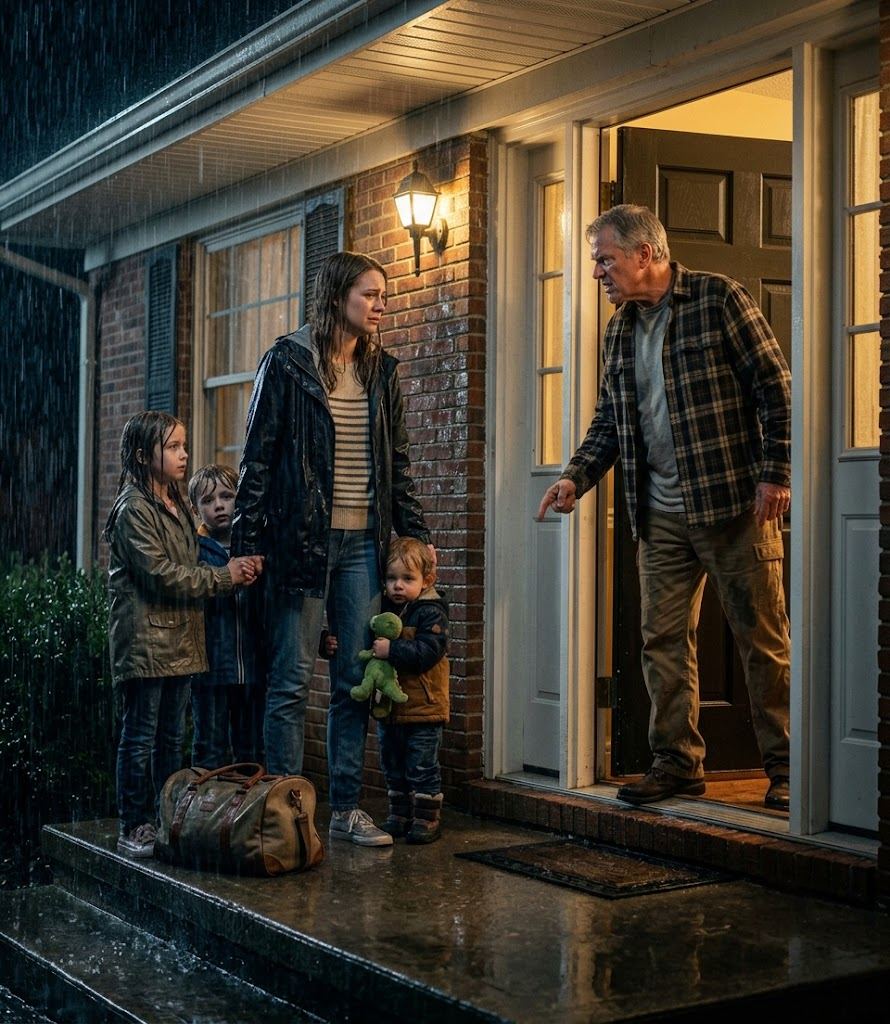
For a moment, I saw that porch again.
I saw Mason half asleep against my shoulder.
Holly standing behind me with her backpack.
Dad’s hand on the door.
Go home and try again with your husband.
“How much do you need?” I asked.
Dad cleared his throat.
“Enough to clear the overdue amount and give us some time.”
“How much?”
“Eighty-five thousand.”
I stared at him.
Mom finally lifted her eyes.
“We wouldn’t ask if we had another option.”
I leaned back in my chair.
Dad started explaining that I would get the money back once they sold some land. He said this was only temporary.
Then he used the sentence I had already heard from Brent.
“We’re family, Laurel. Family helps family.”
The room became very quiet.
I looked at Holly.
She was standing near the hallway, pretending to check something on her phone.
I knew she was listening.
Then I looked at my father.
“Do you remember the night I came to your house with the children?”
His jaw tightened.
“This again?”
“Yes. This.”
“That situation was different.”
“How?”
“You were angry at your husband. We thought sending you home would force you to work things out.”
“You knew he cheated on me.”
“Marriage is complicated.”
“You had two empty bedrooms.”
Mom interrupted.
“Your father regrets how that happened.”
I turned to her.
“He has never told me that.”
Dad’s face hardened.
“What do you want me to say?”
“The truth would be a start.”
He pushed his chair back slightly.
“Fine. Maybe I handled it badly. But look at you now. You built something. Maybe being forced to stand on your own was good for you.”
For several seconds, I could not speak.
Then something unexpected happened.
I started laughing.
Not because anything was funny.
Because I finally understood him.
He had rewritten the worst night of my life into a lesson he had generously provided.
“You think you did me a favor.”
“That isn’t what I said.”
“It is exactly what you said.”
Dad crossed his arms.
“I’m not going to sit here and be punished forever.”
“I’m not punishing you.”
“You won’t help us.”
“Those are not the same thing.”
Mom began crying quietly.
That made everything harder.
I loved my mother.
Even after everything, part of me still remembered being sick at eight years old while she sat beside my bed all night.
People rarely fit neatly into good or bad.
Sometimes the same person who once made you feel safe can later fail you in a way you never forget.
I reached for a folder on the counter.
Earlier that year, one of my clients had worked with a nonprofit financial counselor, and I had kept the information.
I placed it in front of Dad.
“This organization negotiates with lenders. They can review the mortgage, your debts, and your options. I also know an attorney who handles foreclosure cases. I’ll pay for your first consultation.”
Dad stared at the folder.
“You’re serious?”
“Yes.”
“You have the money.”
I did.
That was not the point.
“I’m not giving you eighty-five thousand dollars.”
His face turned red.
“So you’d let your own parents lose their home?”
I held his gaze.
“You let your daughter leave yours with three children and nowhere to sleep.”
Mom closed her eyes.
Dad said nothing.
“I’m not throwing you into the street,” I continued. “I’m giving you professional help and paying for legal advice. But I’m not becoming responsible for the decisions that put you here.”
He stood abruptly.
“I knew this was a mistake.”
Mom remained seated.
“Harold.”
“No. She’s been waiting years for this.”
I shook my head.
“That’s what you still don’t understand. I wasn’t waiting for this at all.”
He looked at me.
“For a long time, I imagined you showing up one day and realizing you were wrong. I thought I needed that. I don’t anymore.”
Dad picked up his coat.
Mom slowly stood beside him.
Before she left, she touched my arm.
“I am sorry,” she whispered.
The words were so quiet I almost missed them.
I looked at her.
“For which part?”
Her eyes filled again.
“All of it.”
I believed she meant it.
That did not erase what happened.
But it mattered.
Dad was already outside.
Mom followed him.
I watched their car disappear down the street.
Then I closed the door.
Holly was standing behind me.
At fourteen, she had become tall enough that we were nearly eye level.
“Are you okay?” she asked.
“I think so.”
She leaned against the wall.
“Do you feel good?”
“What do you mean?”
“You know. Because now Grandpa needs you.”
I thought about it.
Years ago, I might have imagined this moment differently.
In my head, Dad would apologize. Brent would admit he had been cruel. Callie would understand exactly how deeply her words had hurt me.
I would stand in front of all of them successful, confident, and completely untouched by the past.
Real life was messier.
“I don’t feel good that they’re struggling,” I said.
“Then do you feel bad for not giving them the money?”
“No.”
Holly nodded.
“So what do you feel?”
I looked around the house.
Mason was upstairs complaining loudly because Eli had taken his headphones. Soup was still simmering on the stove. A stack of mail sat unopened near the fruit bowl.
It was an ordinary home.
Our home.
“Free,” I said.
She smiled.
Later that evening, after the kids went upstairs, I stood by the kitchen window and watched rain slide down the glass.
For the first time in years, I allowed myself to think about that night on my parents’ porch without feeling angry.
I remembered the woman I had been.
Thirty-four years old.
One bag.
Three children.
Almost no plan.
Terrified of what would happen next.
She believed the closed door behind her meant she had lost everything.
She had no idea that, over the next few years, she would learn how to manage a business, raise three children through a divorce, negotiate contracts, hire employees, buy a house, and build a life that belonged entirely to her.
Most of all, she had no idea that one day she would stop needing the people behind that door to understand what they had done.
I had whispered, “Watch what happens next.”
At the time, I thought I was making a promise to them.
Standing there in my kitchen all those years later, I finally understood.
I had been making it to myself.