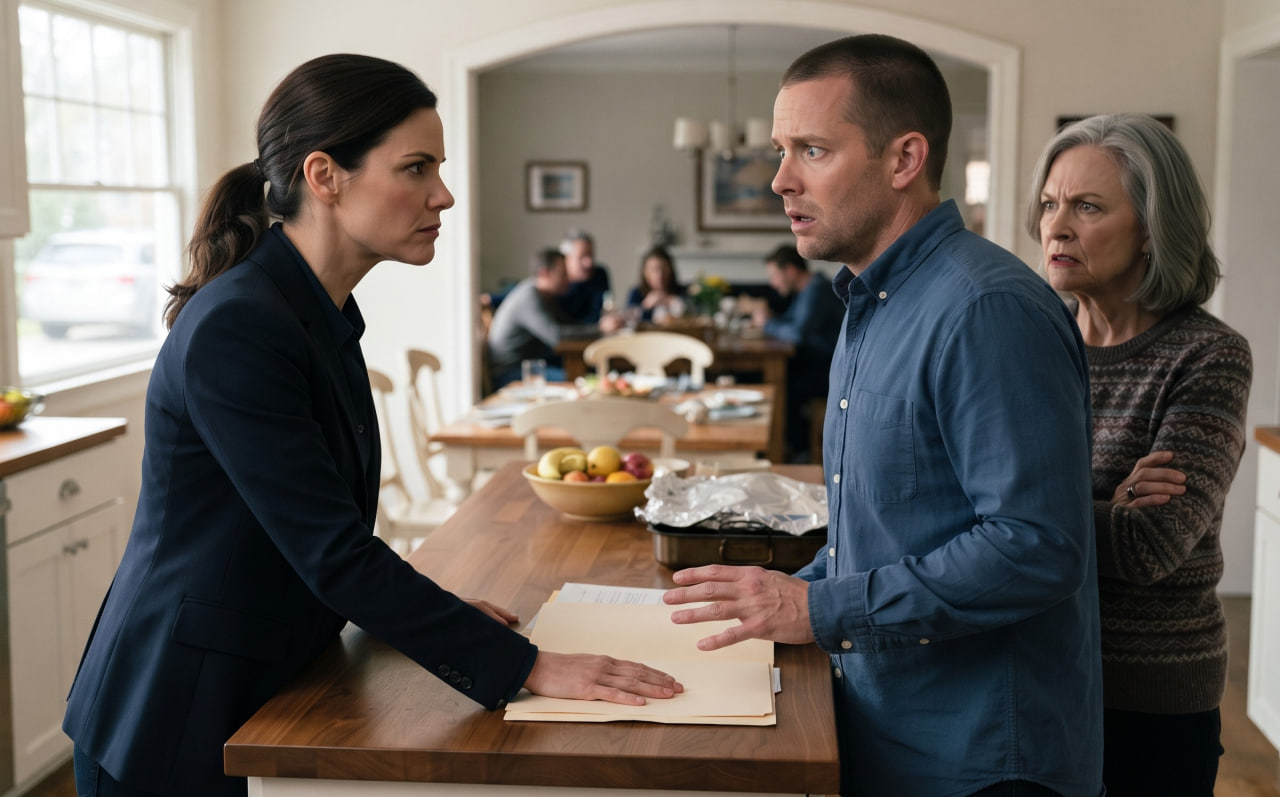
“All of it.”
“What about your mother?”
“I’ll deal with her.”
“No.”
He looked confused.
“You won’t deal with her for me.”
“I won’t.”
“You’ll deal with her because you finally have to deal with your own choices.”
He nodded.
“You’re right.”
I stood.
“You should leave.”
He stood too.
“Can I see you again?”
“Maybe.”
“When?”
“When I know who I am without you.”
He looked devastated.
But he nodded.
“Okay.”
He walked to the door.
Before leaving, he turned.
“Claire?”
“Yes?”
“Happy Thanksgiving.”
I almost smiled.
“It’s over.”
“I know.”
He left.
Three days later, I met with Margaret.
She had already begun reviewing everything.
She found inconsistencies.
Unauthorized transfers.
Improperly prepared documents.
Financial arrangements Richard had never disclosed.
And evidence that Evelyn had been moving money between accounts for years.
The most important discovery was hidden in an old trust document.
Richard’s father had created a protected inheritance for his children.
Evelyn had controlled the account while Richard was young.
When he became an adult, some of the money was supposed to transfer to him.
It never did.
Instead, Evelyn had used portions of it to pay debts, purchase property, and cover personal expenses.
Richard had known pieces of the truth.
He had never confronted her.
And when his own finances collapsed, he became dependent on her.
Then he met me.
I became the stable part of his life.
The person who earned.
The person who paid.
The person who fixed.
The person who stayed.
And because I stayed, the system worked.
Until Thanksgiving.
Margaret eventually helped me secure the accounts and protect my ownership interests.
The house remained legally mine and Richard’s jointly until everything could be resolved.
The marriage itself took longer.
There was no dramatic courtroom scene.
No screaming.
No public revenge.
Just paperwork.
Meetings.
Hard conversations.
And the slow realization that sometimes a marriage doesn’t end because love disappears.
Sometimes it ends because truth finally becomes more important than comfort.
Six months later, Richard moved into a small apartment.
Evelyn sold her car.
Several accounts were frozen pending investigation.
The family stopped speaking about Thanksgiving.
Not because they had forgotten.
Because they finally understood what they had witnessed.
One cousin eventually apologized.
Then another.
Then another.
The cousin who had stared at his phone during the dinner came to my house one Saturday afternoon.
“I should have said something,” he told me.
“Yes.”
He looked ashamed.
“I was afraid of your mother-in-law.”
I shook my head.
“She wasn’t my mother-in-law anymore by then.”
He smiled sadly.
“You know what I mean.”
“I do.”
He apologized.
I accepted.
Not because what he did was okay.
But because I no longer wanted other people’s cowardice taking up space in my life.
A year after Thanksgiving, I hosted dinner again.
Not at the old house.
I had moved into a smaller place.
It was quieter.
Brighter.
Mine.
There were only eight people at the table.
No twenty-person performance.
No one controlling the seating.
No one tapping a fork against a glass.
My closest friends sat around the table.
We laughed.
We argued about football.
Someone burned the rolls.
Everyone made fun of the person who had done it.
And nobody cared.
Before dinner, I stepped outside.
The evening air was cool.
The sky was turning orange.
I heard footsteps behind me.
Richard.
We had remained in contact during the divorce process.
Not as husband and wife.
Not anymore.
But as two people trying to understand seventeen years of shared history.
He stood beside me.
“Can I ask you something?”
“Sure.”
“Do you ever regret leaving?”
I thought about it.
“No.”
He nodded.
“I figured.”
I looked at him.
“Do you?”
He smiled sadly.
“Every day.”
“Why?”
“Because I finally understand what I had.”
I shook my head.
“No, Richard.”
He looked at me.
“You understand what you lost.”
He nodded.
“That too.”
For a moment, we stood quietly.
Then he handed me an envelope.
“What is that?”
“Something my father wrote.”
I looked at it.
“Why are you giving it to me?”
“Because it was addressed to you.”
My eyebrows rose.
“How could your father have written something to me before we met?”
“He didn’t.”
I opened the envelope.
Inside was a letter written by Richard.
Not his father.
Richard.
The first line read:
Claire, I spent seventeen years confusing being loved with being rescued.
I kept reading.
He apologized.
Not for leaving.
Not for his mother.
Not for the money.
For choosing comfort over courage.
He admitted that I had carried responsibilities that should have been shared.
He admitted that he had allowed his mother to disrespect me because confronting her required more courage than apologizing to me afterward.
And at the end he wrote:
You once told me that a home is not a building. It’s the place where you know you belong.
I finally understand.
You belonged with me.
I just didn’t know how to make myself worthy of belonging beside you.
I folded the letter.
“Thank you.”
He nodded.
“I don’t expect anything.”
“I know.”
He looked toward the house.
“Are they waiting for you?”
“Yes.”
“Then go.”
I smiled.
“You’re not coming?”
He smiled back.
“No.”
He paused.
“I think that’s the point.”
I watched him walk down the driveway.
Then I went inside.
The dining room was warm.
The table was full.
Someone called my name.
“Claire! We’re waiting for you!”
I looked around.
Nobody was telling me where to sit.
Nobody was deciding whether I belonged.
Nobody was measuring my usefulness.
I simply walked to the table.
And sat down.
That night, after everyone left, I washed the last glass and turned off the kitchen light.
For years, I had thought walking away meant losing everything.
I finally understood something different.
Sometimes walking away is how you find out what was never truly yours.
The house hadn’t been the family.
The money hadn’t been the security.
The marriage hadn’t been the promise.
The promise was the part of me that had survived seventeen years of being told to stay quiet.
And that part of me was still there.
Stronger.
Wiser.
Free.
I stood at the window and looked outside.
My phone was silent.
No demands.
No emergencies.
No accusations.
No one telling me where I belonged.
For the first time in a very long time, the silence didn’t feel lonely.
It felt like peace.
And when Thanksgiving came around again the following year, I didn’t think about the twenty people who had watched me leave.
I thought about the one woman who had finally learned to stop asking for permission to belong.
Me.
I had spent seventeen years helping build a home where everyone else felt comfortable.
It took one humiliating Thanksgiving dinner to teach me that I deserved a place at the table too.
And if the table didn’t have a seat for me?
I could always build my own.
This time, I would choose who sat beside me.