Some promises don’t become lies because they were never fulfilled.
They become lies because the person who made them eventually stops remembering they said them.
That afternoon, I packed a suitcase.
Not everything.
Just enough.
When I came downstairs, Richard was sitting alone at the table.
Evelyn was gone.
He looked at the suitcase.
“You’re leaving?”
“For a few days.”
“Where?”
“A hotel.”
“You can’t keep running away.”
“I didn’t run away yesterday.”
He looked down.
“I know.”
“I walked away.”
He nodded.
“What happens now?”
“I don’t know.”
He stood.
“Can we fix this?”
I looked at him.
“That depends.”
“On what?”
“Whether you actually want to fix the marriage or whether you just want your life to go back to being convenient.”
He looked hurt.
“I love you.”
“Then why was it so easy for you to let your mother humiliate me?”
He had no answer.
I picked up my suitcase.
At the front door, he spoke again.
“Claire.”
I turned.
“I’m sorry.”
It was the first time he had said it without adding an excuse.
I nodded.
“Thank you.”
Then I left.
The following morning, I received another message.
This time it wasn’t from Richard.
It was from the bank.
There had been an attempted change to one of the household accounts.
I stared at the notification.
My stomach tightened.
I opened the account.
A pending request had been submitted the previous evening.
Someone had attempted to remove one of the authorized users.
Me.
I sat completely still.
Then I called the bank.
After several minutes of verification, the representative confirmed what I already suspected.
“Yes,” she said. “A request was submitted.”
“Who submitted it?”
“I can’t disclose that over this channel.”
“I understand.”
“There is also a note on the account.”
“What note?”
She paused.
“It says the account holder is reviewing financial arrangements following a separation.”
I closed my eyes.
Separation.
I had never requested a separation.
I hadn’t told anyone I was leaving my marriage.
I had simply walked out of Thanksgiving dinner.
Someone had already decided what my departure meant.
And that someone wasn’t me.
I opened the folder again.
There was something I hadn’t looked at closely enough.
A property document.
I read it twice.
Then a third time.
The house wasn’t simply jointly owned.
There was a line I had never paid attention to.
A transfer had been filed six months earlier.
My signature appeared on the document.
I stared at it.
I knew that signature.
But I had never signed that paper.
My hands began to shake.
I called the attorney whose name appeared on the document.
She answered after two rings.
“Ms. Bennett?”
“Yes.”
“This is Claire.”
There was silence.
“Claire, I’ve been expecting your call.”
My heart started pounding.
“Why?”
“Because Richard contacted our office yesterday.”
I gripped the phone.
“What did he ask you?”
“He asked about the transfer document.”
“Did he say why?”
“He said you were considering moving out.”
“I wasn’t.”
Another pause.
“Claire, I think you should come into the office.”
“Why?”
“Because there are several documents here that you need to see in person.”
My mouth went dry.
“Were they signed by me?”
She didn’t answer immediately.
“That’s what I want to discuss.”
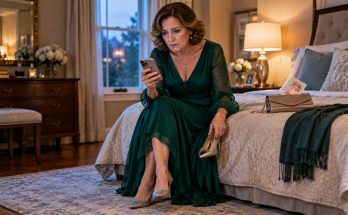
I looked through the hotel window.
Cars moved along the street below.
People walked past coffee shops carrying paper cups.
The world continued as though nothing had changed.
But my entire understanding of my marriage had just shifted.
“I’ll come in this afternoon,” I said.
When I arrived at the attorney’s office, she was waiting with a thick file.
Her name was Margaret Ellis.
I had met her once, years earlier, when we refinanced the house.
She closed the door behind me.
“Claire, I want you to remain calm.”
I sat down.
“That usually means something is very wrong.”
She gave me a careful look.
“There are several financial documents connected to your household.”
“Which ones?”
“The home.”
“The accounts.”
“Some investment arrangements.”
I frowned.
“I don’t have investments.”
Margaret looked at the file.
“You do.”
I stared at her.
“What?”
She turned the folder around.
A brokerage statement sat on top.
The account was in my name.
The balance made my breath stop.
I looked at the number again.
Then again.
“That can’t be right.”
“It is.”
“I’ve never seen this.”
Margaret nodded.
“I suspected that.”
“Who opened it?”
“That’s part of the problem.”
She turned another page.
“Most of the contributions came from a business account.”
I looked at the account information.
Richard’s business.
I felt cold.
“What is this?”
Margaret leaned back.
“Claire, did Richard ever ask you to sign blank financial forms?”
I thought about it.
Years ago.
There had been refinancing paperwork.
Insurance renewals.
Tax documents.
Business documents.
He often brought things home after dinner.
“Sometimes.”
“Did you ever sign documents without reading every page?”
I didn’t answer.
Margaret didn’t need me to.
She slowly closed the file.
“I want you to understand something. I’m not accusing Richard of anything.”
“Then what are you saying?”
“I’m saying you should not sign another document until you’ve had independent legal advice.”
I stared at her.
“Why?”
“Because some of these documents appear to have been prepared with the assumption that you had agreed to financial changes.”
“I didn’t.”
“I know.”
The words hit me harder than they should have.
“You know?”
“I’ve reviewed the signatures.”
My heart pounded.
“And?”
Margaret looked directly at me.
“I don’t believe you knowingly signed some of these documents.”
I sat back.
For several seconds, neither of us spoke.
Then I asked the question I had been avoiding.
“What was Richard trying to do?”
Margaret shook her head.
“I can’t tell you what he intended.”
“But you can tell me what the documents would do.”
“Yes.”
“And?”
She opened the file again.
“One document would reduce your ownership interest in the house.”
My stomach dropped.
“Another changes access to certain funds.”
“And the third?”
She hesitated.
“The third appears to establish that you voluntarily agreed to a separation of finances.”
I laughed once.
Not because anything was funny.
Because the alternative was crying.
“So he was preparing for me to leave.”
“Possibly.”
“Or preparing to make it look like I chose to leave.”
Margaret didn’t answer.
She didn’t have to.
I looked down at the documents.
For seventeen years, I had believed my biggest mistake was staying quiet.
Now I wondered if my biggest mistake had been trusting someone with my signature.