Children ask questions adults aren’t prepared to answer.
I stroked her hair.
“No.”
“Why?”
I thought carefully.
Because he hurt us.
Because he lied.
Because he tried to take away our freedom.
Because he was dangerous.
But Hope was too young to carry all of that yet.
So I said:
“Because some people make choices that mean they can’t be part of our home.”
She was quiet.
Then she asked:
“Are we safe?”
I looked around the room.
The windows were open.
The hallway light was on.
The front door was locked.
And for the first time, I knew the answer without forcing myself to believe it.
“Yes.”
Hope smiled.
“Good.”
Then she fell asleep.
I stayed awake for a while.
Not because I was afraid.
Because I was listening.
There were no footsteps.
No shouting.
No keys.
No cage.
Only the sound of my daughter’s breathing.
And somewhere outside, a dog barked.
I smiled.
That sound would once have terrified me.
Now it sounded like freedom.
Years later, Hope asked me to tell her about the night she was born.
She was old enough to understand more.
We were sitting beneath the lemon tree.
She was thirteen.
“Was I really born that night?”
“Yes.”
“Were you scared?”
I looked at her.
“Very.”
“Did you think we were going to die?”
I didn’t lie.
“Yes.”
She was quiet.
Then she took my hand.
“But we didn’t.”
“No.”
“Because Aunt Lena found you?”
“Because Aunt Lena never stopped looking.”
She thought about that.
Then she asked:
“What did Daddy do?”
I looked toward the garden.
For years, I had avoided saying his name.
But I had finally learned that speaking about something didn’t give it power.
Silence sometimes did.
“He hurt me,” I said.
Hope’s face changed.
“Why?”
“I don’t know.”
“Did you do something wrong?”
The question hit me harder than anything else.
“No.”
I squeezed her hand.
“Never believe someone hurts you because you weren’t good enough.”
She nodded.
“Then why did he do it?”
“Because his choices were his.”
She looked at me for a long moment.
Then she leaned against my shoulder.
“I think you’re brave.”
I smiled.
“No.”
She looked surprised.
“You’re not?”
“I was terrified.”
“That’s what brave means.”
I laughed.
“Maybe.”
She smiled.
Then she pointed toward the garden.
“Mom?”
“Yes?”
“Look.”
She had planted a tiny apple tree.
I stared at it.
An apple tree.
For a moment, I couldn’t breathe.
She saw my expression.
“What’s wrong?”
I shook my head.
“Nothing.”
She frowned.
“Mom.”
I walked over and touched one of the small leaves.
The memory came back.
One rotten apple through steel bars.
One apple meant to humiliate me.
One apple used as a weapon.
And now, years later, my daughter had planted an entire tree.
I looked at her.
“Nothing is wrong.”
I smiled.
“Everything is right.”
She didn’t understand.
Not yet.
But she would.
The first apple appeared the following summer.
It was tiny and imperfect.
Hope picked it carefully.
“Should we eat it?”
I laughed.
“Absolutely.”
We cut it in half.
She took the first bite.
Then she made a face.
“It’s sour.”
I laughed so hard I cried.
She started laughing too.
And standing there beneath that tree, I realized something.
Marcus had once used food to remind me that he controlled whether I lived.
Now my daughter and I were standing in our own garden, eating fruit from a tree we had planted ourselves.
No one was telling us when we could eat.
No one was watching.
No one was counting.
No one was holding a key.
For the first time, something as ordinary as eating an apple felt like freedom.
Years later, I finally returned to the courthouse.
Not for Marcus.
For someone else.
A woman had been rescued from an abusive relationship, and the local support organization had asked me to speak at an event.
I almost refused.
Then I remembered the woman I had been.
The woman who thought nobody would believe her.
The woman who thought her voice didn’t matter.
So I went.
There were dozens of people in the room.
Survivors.
Families.
Counselors.
Police officers.
Doctors.
People who had spent years helping others escape situations like mine.
When I stepped onto the stage, my hands shook.
I looked at the audience.
Then I began.
“I used to think strength meant not being afraid.”
The room became silent.
“I was wrong.”
I took a breath.
“Strength can mean being terrified and still reaching for the phone.”
Someone in the audience began crying.
I continued.
“Strength can mean recording one more conversation when you believe nobody will ever hear it.”
I looked toward the back of the room.
“Strength can mean surviving one more night.”
My voice cracked.
“And sometimes strength is simply believing that tomorrow deserves a chance.”
When I finished, nobody spoke for several seconds.
Then the room filled with applause.
But I wasn’t thinking about applause.
I was thinking about that basement.
That cold floor.
That one-percent battery.
That tiny piece of hope hidden beneath a metal panel.
And I finally understood.
I hadn’t survived because I was stronger than everyone else.
I survived because some part of me refused to believe that the cage was the end of my story.
That part of me had been very small.
But it was still alive.
And sometimes, that’s all you need.
Years later, Marcus sent one final letter.
I almost didn’t open it.
But I did.
He didn’t apologize.
Not really.
He wrote about his regrets.
His loneliness.
His lost career.
His ruined reputation.
He said he had spent years thinking about what happened.
At the bottom, he wrote:
“I hope someday you can forgive me.”
I stared at those words for a long time.
Then I folded the letter.
I didn’t tear it up.
I didn’t burn it.
I didn’t answer it.
Because forgiveness didn’t mean I owed him access to my life.
It didn’t mean forgetting.
It didn’t mean pretending.
And it certainly didn’t mean reopening a door I had fought so hard to close.
I placed the letter in a box.
Then I closed the lid.
That was all.
Some doors don’t need to be slammed.
They simply need to stay closed.
That night, I went outside.
Hope was sitting beneath the apple tree.
She was seventeen now.
Older.
Taller.
Still stubborn.
Still kind.
She looked up.
“Mom.”
“Yes?”
“Come sit with me.”
I sat beside her.
The evening sky was turning orange.
She rested her head against my shoulder.
“You know something?”
“What?”
“I’m glad you survived.”
I looked at her.
My eyes filled with tears.
“Me too.”
She smiled.
Then she reached for my hand.
We sat beneath the tree until the sun disappeared.
And I thought about the woman I had been that night.
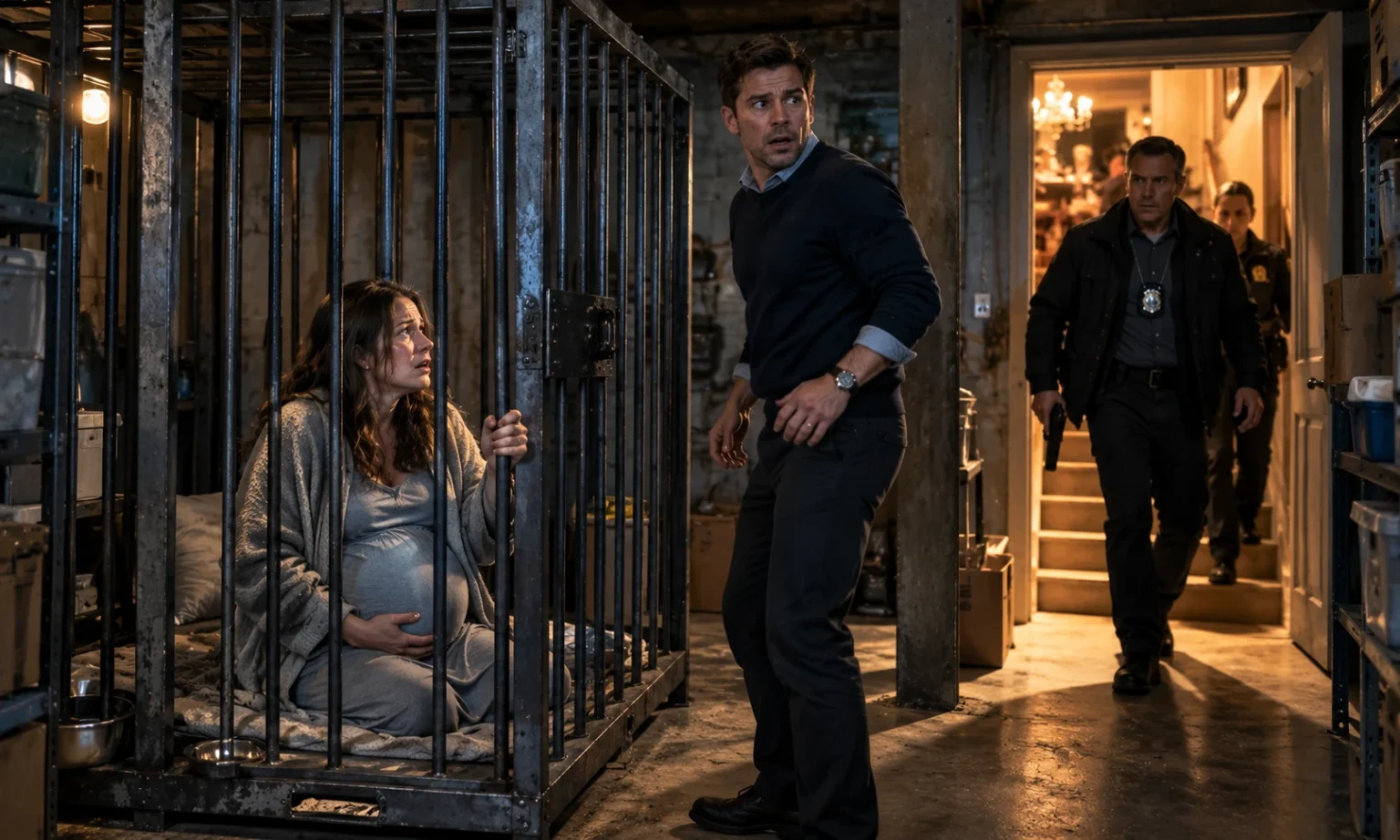
Nine months pregnant.
Bleeding.
Starving.
Locked behind steel.
Listening to people laugh upstairs while believing nobody knew she was there.
That woman had thought she was fighting for one more breath.
She didn’t know she was fighting for an entire future.
She didn’t know that her sister was already searching.
She didn’t know that the hidden phone would survive.
She didn’t know the door would eventually open.
She didn’t know her baby would live.
She didn’t know she would someday sit beneath an apple tree with that same baby, now grown nearly as tall as she was.
She didn’t know.
But she kept fighting.
And that’s what mattered.
Because Marcus thought the cage was the end of my life.
It wasn’t.
It was the place where my old life ended.
And the moment that door opened was the moment I began building a new one.
A life where nobody owned my choices.
A life where my daughter knew she was loved.
A life where the doors stayed unlocked because I wanted them open.
A life where an apple was just an apple.
And when the wind moved through the branches above us, I closed my eyes.
For a moment, I could almost hear the basement again.
The metal.
The footsteps.
The lock.
Then I opened my eyes.
There was only sunlight.
Only trees.
Only my daughter.
Only freedom.
And this time, when I heard a door close somewhere inside the house, I didn’t flinch.
I smiled.
Because I knew something Marcus had never understood.
A door can close without becoming a cage.
Sometimes a closed door simply means that the past is finally behind you.
And I had spent years walking toward the light.
I wasn’t going back.