New Twist in Deadly LaGuardia Airport Crash: Two Air Traffic Controllers Left Work Early Before Collision
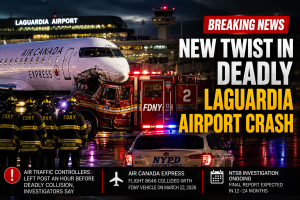
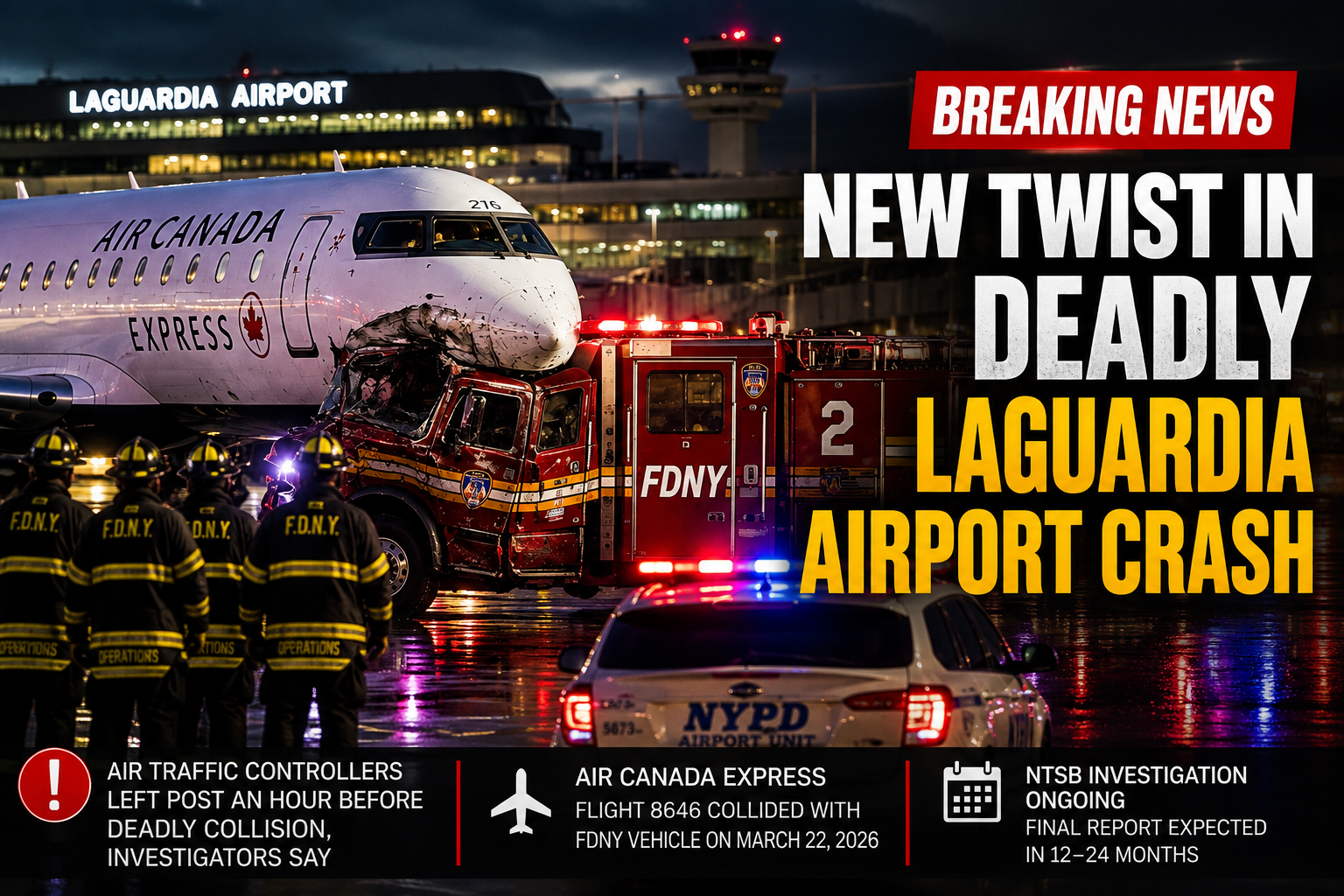
NEW YORK — New details have emerged in the investigation into the deadly March collision at New York’s LaGuardia Airport, with federal officials examining the actions of two air traffic controllers who allegedly left work early before an Air Canada Express jet collided with an airport fire truck.
The Federal Aviation Administration is moving to fire the two controllers, according to Reuters and the Associated Press. Officials familiar with the matter said they were scheduled to remain on duty but left the facility roughly an hour before their shifts ended on March 22, 2026.
The revelation adds another major focus to an investigation into a crash that killed both pilots aboard Air Canada Express Flight 8646 and injured dozens of other people.
What Happened at LaGuardia?
The accident occurred late on March 22, 2026, as Air Canada Express Flight 8646 was arriving at LaGuardia from Montreal.
The CRJ-900 regional jet, operated by Jazz Aviation for Air Canada, had 72 passengers and four crew members aboard. As the aircraft landed on Runway 4, it struck an Aircraft Rescue and Firefighting vehicle that was crossing the runway.
The fire truck was responding to a separate emergency involving a United Airlines aircraft whose crew had reported an odor onboard.
Air traffic control communications from the night captured a controller urgently telling the fire truck to stop shortly before the collision.
The two Air Canada pilots were killed. Authorities initially reported that 41 people were taken to hospitals, including passengers and two firefighters.
Two Controllers Reportedly Left About an Hour Early
The latest development centers on staffing inside LaGuardia’s air traffic control facility.
According to a government official cited by the Associated Press, two controllers left work approximately an hour early that night. Their scheduled shifts would have kept them at the facility beyond the time of the crash.
That left two controllers on duty as the airport dealt with an unusually demanding period of operations.
Weather-related delays had pushed additional flights later into the evening, while controllers were simultaneously dealing with the separate emergency involving the United Airlines aircraft. AP reported that the airport was handling significantly more traffic than normally scheduled during the late-night period.
The controllers who left early potentially could have provided backup to the remaining staff during the increased workload, according to the government source cited by AP.
However, that does not mean investigators have concluded their absence caused the collision.
FAA Moves Toward Firing Controllers
Reuters reported that the FAA is moving to fire the two controllers believed to have left before the end of their scheduled shifts.
The FAA said it is committed to holding employees accountable and would not compromise the safety or efficiency of the National Airspace System.
The National Air Traffic Controllers Association said it was discussing the allegations with FAA leadership but declined to comment further on the specific case.
The controversy is also drawing attention to a practice sometimes referred to among controllers as an “early shove,” in which workers leave before their scheduled shift officially ends. Reuters reported that the issue is facing increased scrutiny as federal officials examine work practices and accountability within the air traffic control system.
Airport Was Handling an Unusually Heavy Workload
The night of the crash was particularly complicated for LaGuardia controllers.
According to AP, weather delays had shifted a large number of arrivals and departures into the late-night hours. A dozen flights arrived between 11 p.m. and the collision less than 40 minutes later.
At the same time, emergency crews were responding to the United Airlines aircraft.
The fire truck that ultimately collided with Flight 8646 was leading a group of emergency vehicles responding to that separate incident.
The combination of regular aircraft movements, weather-related delays and an active emergency created an unusually demanding environment for the controllers still working.
Investigators Have Not Determined the Final Cause
The new information about the controllers is significant, but it is important to distinguish it from a determination about what actually caused the crash.
The National Transportation Safety Board has not issued its final conclusion on the cause of the LaGuardia collision.
The NTSB investigation is examining multiple factors, including air traffic control staffing and communications, airport emergency-vehicle movements and other circumstances surrounding the accident.
A final NTSB report is expected to take considerably longer. ABC News reported that investigators expect the final report in approximately 12 to 24 months.
That means it would be premature to say that the two controllers leaving early caused the crash.
Instead, their absence has become another potentially important piece of a much larger investigation into how the fatal runway collision occurred.
Crash Renewed Concerns Over Air Traffic Control Staffing
The LaGuardia accident has also renewed attention on staffing pressures throughout the U.S. air traffic control system.
Even before the latest revelation, investigators and aviation officials were examining whether staffing levels played a role in the circumstances surrounding the collision.
Reuters reported that the accident renewed scrutiny of chronic staffing shortages and working practices within U.S. air traffic control.
Determining whether those broader staffing problems — or the early departure of the two controllers — actually contributed to the LaGuardia collision will ultimately be up to investigators.
For now, the FAA’s effort to discipline the two employees represents one of the most significant developments since the March tragedy.