PART5
She began to cry again, and this time I reached for her hand.
I wasn’t ready to forgive her.
But I wasn’t ready to throw away eight years of marriage in one evening, either.
We sat quietly until the kitchen door opened.
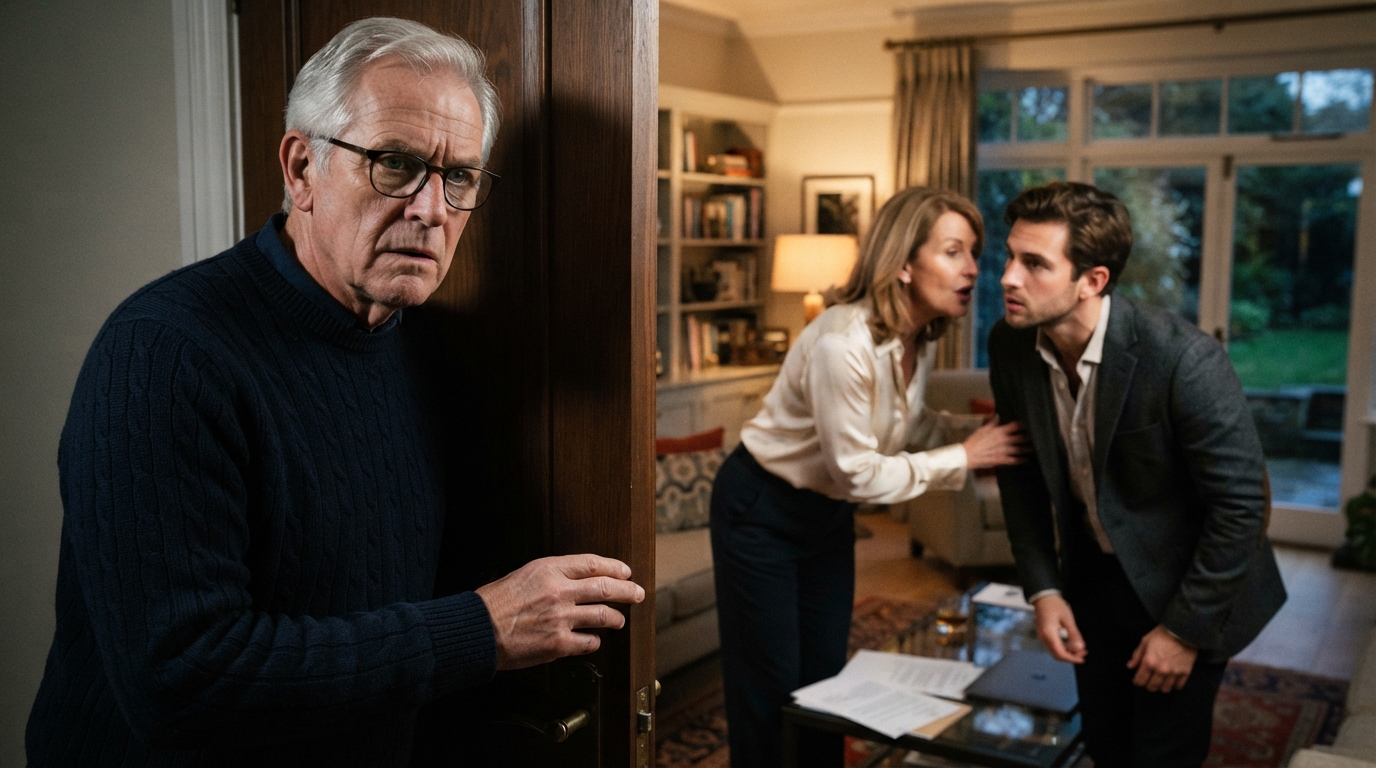
Jordan appeared in the doorway, his phone in one hand.
“I have to go,” he said.
Pam stood up.
“Where?”
“Out.”
“It’s almost ten.”
“I’m forty-one years old, Mom. I don’t need permission to leave the house.”
He grabbed his keys from the counter.
I stood.
“Jordan.”
He turned.
“Do not use my name, Social Security number, credit, or any financial information connected to me again. Do you understand?”
He gave me a hard look.
“Yeah.”
“And don’t attempt to open another account using my information.”
“I said I understand!”
“Good.”
He stormed toward the front door.
Pam followed him as far as the hallway.
“Jordan, please. Don’t leave like this.”
He turned back.
“You know what the problem is, Mom? You spent your whole life trying to be a good person, and now you’ve married somebody who thinks he’s better than everybody else.”
Pam looked stunned.
Jordan pointed at me.
“He has no idea what it’s like to struggle. He’s sitting on his high horse while I’m trying to survive.”
Then he walked out and slammed the door.
A few seconds later, his car started.
We watched the headlights sweep across the front window and disappear down the road.
Pam sank onto the hallway bench.
“He wasn’t always like this,” she whispered.
I sat beside her.
“No. But he’s forty-one now. We have to deal with the man he is, not just remember the boy he used to be.”
She leaned against my shoulder.
For the first time that evening, I let her cry without trying to find the right words.
I stayed awake long after she went to bed.
At midnight, I called my attorney.
His name was Robert Ellis. We’d known each other since the late 1990s, when he helped me review the paperwork for my second storage lot.
He answered on the fourth ring.
“Gary? Everything all right?”
“No.”
He sat up on the other end. I could hear the rustle of sheets.
“What’s happened?”
I explained the credit cards, the forged applications, and the money Pam had been paying.
Robert listened without interrupting.
When I finished, he asked one question.
“Have you told them about the sale?”
“No.”
“Good. Don’t tell them yet.”
I looked toward the hallway to make sure Pam’s bedroom door was still closed.
“Why?”
“Because we need to separate the issues. The identity theft is one matter. Your wife’s retirement money is another. And your recent business sale is a third. We need a clear record of what happened before anybody starts making promises, moving money, or trying to persuade you to handle this privately.”
I rubbed my eyes.
“I don’t want a war with my family.”
“Then don’t start one. But don’t confuse avoiding a war with refusing to protect yourself.”
He asked me to send him the documents the next morning.
“Don’t confront Jordan again tonight,” he said. “Don’t threaten him. Don’t make any decisions about the marriage while you’re angry. And don’t let anyone persuade you to pay these debts just to make the problem disappear.”
“I understand.”
“One more thing, Gary. If he used your personal information without permission, you need to protect your credit immediately. Contact the credit bureaus, place fraud alerts or freezes as appropriate, and dispute accounts you didn’t open. Keep copies of everything.”
After we hung up, I sat in the dark and thought about the three storage lots.
For nearly thirty years, they had been my life’s work.
I had bought the first one when I was thirty-seven, after my first marriage ended and I realized I needed something that would belong to me regardless of what happened in my personal life.
The first lot had only seventy units.
The roof leaked over the office. The gate jammed in cold weather. One tenant stored an old boat that hadn’t moved in eleven years, and another forgot to pay for six months before finally showing up with cash and an apology.
I loved that place.
Not because it made me rich, but because it taught me that a man could build something lasting one small decision at a time.
I reinvested every dollar I could. When the second lot became available, I took the risk. When the third came along, I had enough experience to know what I was buying.
The business grew slowly.
I never drove a new truck just because I could afford one. I never bought a big house to impress strangers. I never felt the need to explain my bank balance to people who measured a man’s worth by his possessions.
I had watched too many people spend their lives trying to look wealthy while quietly drowning in debt.
So I kept working.
And a week earlier, I had signed the papers that changed everything.
The sale proceeds had arrived in my account two business days later.
Nineteen million eight hundred thousand dollars.
After taxes, fees, and the final adjustments, the amount available to me would be smaller. My accountant was already working through the numbers. But I had more money than I would ever need for a comfortable retirement.
I had planned to tell Pam on our anniversary.
I had imagined taking her to dinner, giving her a small envelope, and watching her open a letter from Robert explaining what I’d done.
I wanted to tell her that she wouldn’t have to worry about the future. That we could travel. That we could help her grandchildren with college if we chose to. That I could finally spend a few mornings fishing without checking the office phone every twenty minutes.
Instead, I was sitting alone at my desk, looking at fraudulent credit-card applications with my name on them.
And the strangest thing was that the money didn’t make me feel powerful.
It made me feel exposed.
If Jordan discovered the sale, would he suddenly apologize?
Would Pam’s relatives begin calling?
Would everyone who had ever dismissed me as an ordinary man start telling me how much they’d always admired my work ethic?
I didn’t want to become a different person in their eyes just because a bank account had changed.
I wanted to know who they were when they thought I had nothing.
By morning, I had my answer about Jordan.
I wasn’t so sure about Pam.
At 7:30, I drove to Robert’s office with the folder.
He read the credit-card applications, examined the statements, and made notes in a legal pad. He then called an identity-theft specialist at his firm and asked what additional records would be useful.
He didn’t promise me that everything could be resolved quickly. He explained that the credit-card companies would need to investigate, that disputed balances could take time to untangle, and that any recovery of the money Pam had paid would depend on the facts and the available legal options.
I appreciated that.



One Comment on “PART5: At 69, I Sold My Storage Lots for $19.8 Million—Then Overheard My Wife and Stepson Planning to Steal My Money”
Comments are closed.