PART6
I had lived long enough to distrust anyone who promised an easy solution to a complicated problem.
When we finished, Robert closed the folder.
“Gary, there’s something I need to ask. Are you certain the only accounts involved are these three?”
“As far as I know.”
“Then we should verify that.”
He recommended that I review my full credit files with all three major bureaus and check my banking records for unfamiliar accounts or transactions.
I agreed.
Then I told him about the sale.
He knew I had been negotiating with a storage company, but he hadn’t known the deal had closed.
When I told him the final price, he removed his glasses.
“Congratulations,” he said.
“Thank you.”
“Does Pam know?”
“No.”
“Does Jordan?”
“No.”
Robert was quiet for a moment.
“Well, that makes the situation more delicate. Not because you owe anyone an explanation of every dollar you own, but because money has a way of changing people’s behavior. We should document your current assets, make sure your accounts are secure, and review your estate documents.”
I nodded.
I had already been thinking about that.
My will was old. It had been drafted years before I met Pam. I needed to update it to reflect my current circumstances, but I wanted to do that carefully and without making decisions out of anger.
Robert understood.
“Your estate plan should reflect your considered wishes,” he said. “Not punishments you invent in the middle of a family crisis.”
That sentence stayed with me.
I wasn’t interested in revenge.
I wanted to protect what I’d built, make sure my retirement was secure, and decide what kind of relationship I could have with people who had betrayed my trust.
Before I left, Robert asked me to send him the closing documents from the storage sale and the relevant bank records.
“I’ll review everything,” he said. “And Gary? Until we understand the full situation, don’t announce the sale.”
I agreed.
Then I drove to my office.
The little window unit was rattling as usual. The coffee pot was nearly empty. A tenant had left a message about a jammed gate, and somebody had forgotten to put a lock on Unit 214.
For an hour, I did the ordinary work.
I called the gate technician. I spoke to a tenant who wanted to extend her payment date. I swept the office floor.
I didn’t tell anyone I’d sold the business.
I didn’t tell anyone that I could buy the entire block of buildings and still have enough left to retire comfortably.
At noon, my phone rang.
It was Pam.
“Gary, where are you?”
“At the office.”
“Can you come home?”
“Is something wrong?”
She hesitated.
“Jordan called.”
I put down my pen.
“What did he say?”
“He says he wants to apologize.”
I leaned back in my chair.
“What exactly did he say?”
“He told me he knows he made a terrible mistake. He said he wants to sit down with us tonight and explain everything.”
“Did he say he would bring the account records?”
“No.”
“Did he say he would provide a list of every card he opened and every dollar he spent?”
“No.”
“Did he say he would pay back the money he took from you?”
A pause.
“He said he would make things right.”
I looked through the office window at the gravel lot.
“Pam, those are different things.”
“I know.”
“Do you?”
Her voice broke.
“Gary, please. He’s my son.”
“I know he’s your son.”
“I don’t want to lose him.”
“Neither do I want to see you lose your retirement.”
She went quiet.
I felt sorry for her. I really did.
She was trapped between the man she’d married and the child she’d spent decades trying to protect. Even though Jordan was a grown man with children of his own, some part of her still seemed to believe that if she could just find the right words, she could bring him back to the person she remembered.
But love without boundaries can become a kind of surrender.
And Jordan had learned that his mother would surrender almost anything to keep him from facing consequences.
“I’ll come home this evening,” I told her. “But we are not making any promises until we know the facts.”
“Thank you.”
“And Pam?”
“Yes?”
“Don’t give him any more money.”
“I won’t.”
I hung up.
At 3:20, Robert’s office called to say they had received the first batch of records from my credit-card disputes. It was too early to draw conclusions about every transaction, but one detail stood out.
The cards had been linked to contact information associated with Jordan.
That was consistent with what we’d already seen.
The attorney’s office was preparing a more complete timeline, and they wanted me to keep every original document.
I agreed.
Then, at 4:05, I received a call from an unfamiliar number.
A woman introduced herself as a representative of one of the credit-card companies’ fraud departments.
She needed to verify several details.
Had I applied for a card ending in 1842?
No.
Had I authorized cash advances totaling several thousand dollars?
No.
Had I lived at the apartment address listed on the application?
No.
Had I given anyone permission to use my Social Security number to obtain that account?
“No,” I said. “I did not.”
She explained the next steps and gave me a case reference number.
I wrote it down.
After the call, I sat for a long time, staring at the page.
There was something humiliating about having to prove that you hadn’t done something you had never done.
But humiliation wasn’t a reason to stop.
I had built my business by keeping records, checking numbers, and refusing to accept explanations that didn’t make sense.
I would do the same here.
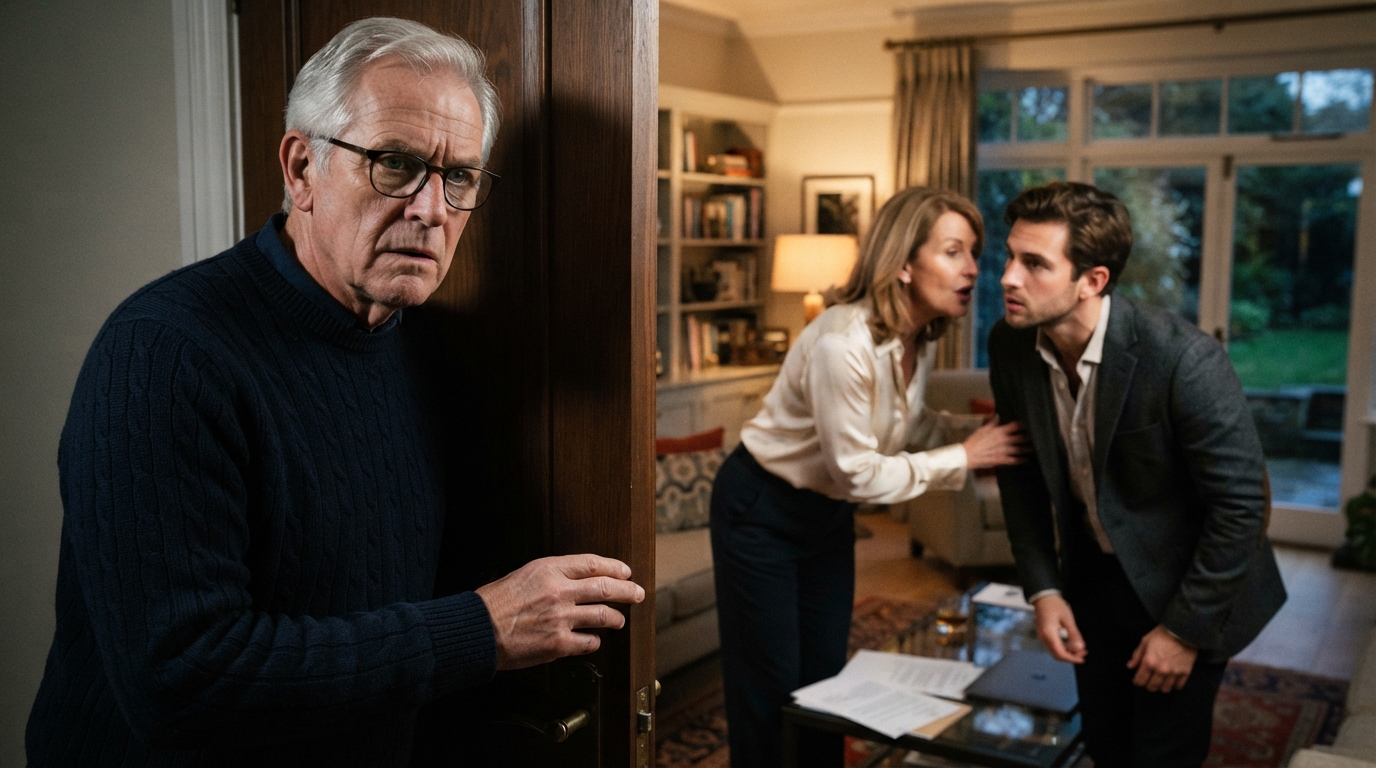
That evening, I arrived home at six.
Pam was waiting in the living room. She had changed clothes and put her hair up. There was a plate of food on the dining table, but neither of us was hungry.
Jordan arrived twenty minutes later.
He came alone.
He wore a clean shirt and had shaved. He looked like a man preparing for a job interview rather than someone who had spent the previous evening admitting to financial fraud.
“Gary,” he said, “I owe you an apology.”
I motioned toward the chair opposite me.
“Sit down.”
He sat.
“I know I crossed a line. I was desperate, and I made a stupid decision. I never intended for it to get this far.”
“How long have you been using my information?”
He looked at Pam.
“Gary asked you a question,” she said.
He exhaled.
“About three years.”
“Three years,” I repeated.
“Yes.”
“How many accounts?”
“Three.”
“Are you certain?”
He hesitated.
“I think so.”
“Think so?”



One Comment on “PART6: At 69, I Sold My Storage Lots for $19.8 Million—Then Overheard My Wife and Stepson Planning to Steal My Money”
Comments are closed.