PART5
He couldn’t walk into the house, say the right words, and expect seven years of hurt to disappear.
Paige stood up.
“I’m going to bed. You can sleep in the guest room.”
“Can we start over?”
“Grant, starting over doesn’t mean pretending nothing happened. It means you have to prove you understand what happened.”
He nodded slowly.
That night, he slept in the guest room.
And Paige slept peacefully in her own bed.
Three days later, Dolores showed up at the house without calling.
She walked into the living room wearing the diamond necklace.
“Paige, we need to have a conversation.”
Paige set down her coffee.
“About what?”
“About Grant. He’s been acting strangely since you started all this.”
Paige glanced at the necklace.
“Is that the one you bought with his paycheck?”
Dolores touched it proudly.
“Yes. It’s beautiful, isn’t it?”
“I’m sure it is.”
“You know, Paige, I think you’ve been very unfair. Grant has always been generous to me. I raised him alone for many years, and I deserve to enjoy the success he’s finally achieved.”
Paige nodded.
“You do deserve to enjoy your life.”
Dolores seemed surprised by the response.
“Then why are you making all of this so difficult?”
“Because enjoying your life is different from expecting someone else to finance it.”
Dolores’s smile disappeared.
“You’re his wife. You should be supporting him.”
“And you’re his mother. You should be supporting yourself.”
“How dare you!”
Dolores stood up.
“You have no respect for family!”
Paige remained seated.
“Respect isn’t the same as unlimited access to someone else’s money.”
Dolores pointed at her.
“You’ve poisoned Grant against me!”
“No. Grant is finally making his own decisions.”
Dolores turned toward the hallway.
“Grant! Come here!”
Grant appeared a moment later.
“Mom, what’s going on?”
“Your wife is insulting me!”
Grant looked at Paige, then at his mother.
“What did she say?”
“She said I should support myself!”
Grant took a deep breath.
“Mom, that’s not an insult.”
Dolores stared at him.
“Excuse me?”
“Paige is right. I gave you my paycheck because I wanted you to manage it. But you spent thousands of dollars without even discussing my expenses. I still have bills to pay.”
Dolores’s face flushed.
“I bought one necklace!”
“And several other things.”
“You’re counting every dollar I spend now?”
Grant looked exhausted.
“Mom, I can’t do this anymore.”
Dolores’s eyes filled with tears.
“So this is what she wanted. She wants you to abandon your mother.”
Grant shook his head.
“No. I want you to stop making me choose between being your son and being a responsible husband.”
Dolores looked at Paige.
Then she turned back to Grant.
“After everything I did for you?”
Grant’s voice softened.
“I know what you did for me when I was growing up. I will always be grateful. But being grateful doesn’t mean I have to give you my entire paycheck.”
Dolores began crying.
For a moment, Grant almost stepped forward to comfort her.
Then he stopped.
He remembered how often tears had ended every conversation.
How many times he had transferred money because his mother was upset.
How many times Paige had been told to wait because Dolores needed something.
He reached for a tissue and handed it to her.
“Mom, I love you. But I can’t continue like this.”
Dolores took the tissue.
She looked at the necklace around her neck.
Then she said something neither Grant nor Paige expected.
“Fine. I’ll return it.”
Grant blinked.
“What?”
“I’ll return the necklace. Happy now?”
Paige shook her head.
“That’s your decision, Dolores. This isn’t about the necklace.”
Dolores looked at her angrily.
“You always have to have the last word.”
“No. I just don’t want you to think returning a necklace fixes everything.”
Dolores picked up her purse.
“I don’t know what happened to this family.”
Then she left.
Grant stood in the living room.
Paige didn’t say anything.
After a few minutes, he whispered, “I should have stopped this a long time ago.”
Paige looked at him.
“Yes. You should have.”
Two weeks passed.
Grant and Paige began talking about their finances.
Not arguing.
Not blaming.
Talking.
They sat at the dining table every Sunday evening and reviewed their bills.
Grant opened his own checking account.
He stopped transferring his salary to Dolores.
He agreed to contribute a fixed amount toward household expenses.
Paige agreed to contribute a fixed amount as well, based on their incomes and the expenses they both shared.
They created a separate savings account for emergencies.
They agreed that any financial assistance to relatives would be discussed before money was sent.
And they agreed that neither of them would ever again make a major financial decision without discussing it with the other.
For the first time, Grant saw their marriage as a partnership instead of a place where Paige quietly handled everything.
But Paige was careful.
She didn’t immediately restore his cards.
She didn’t restart the gourmet grocery service.
She didn’t reinstate the golf membership.
She didn’t suddenly begin preparing every meal.
Grant had to learn how to do things himself.
He learned to shop for groceries.
He learned how to cook simple dinners.
He learned that cleaning a house took time.
He learned that keeping track of bills wasn’t something that magically happened.
One Saturday, he came home carrying grocery bags.
Paige looked at them.
“What’s all this?”
“Groceries.”
“You bought groceries?”
“Yeah.”
He placed the bags on the counter.
“I found a recipe for chicken and pasta. I thought I’d make dinner.”
Paige raised an eyebrow.
“Are you sure?”
Grant smiled awkwardly.
“There’s a possibility we might have to order pizza afterward.”
She laughed.
It was the first genuine laugh they had shared in weeks.
That evening, Grant cooked.
The pasta was slightly overcooked.
The chicken was a little dry.
He forgot to buy parmesan cheese.
But when he placed two plates on the table, Paige looked at the meal and smiled.
“Thank you.”
Grant sat down.
“I know it’s not perfect.”
“It’s dinner.”
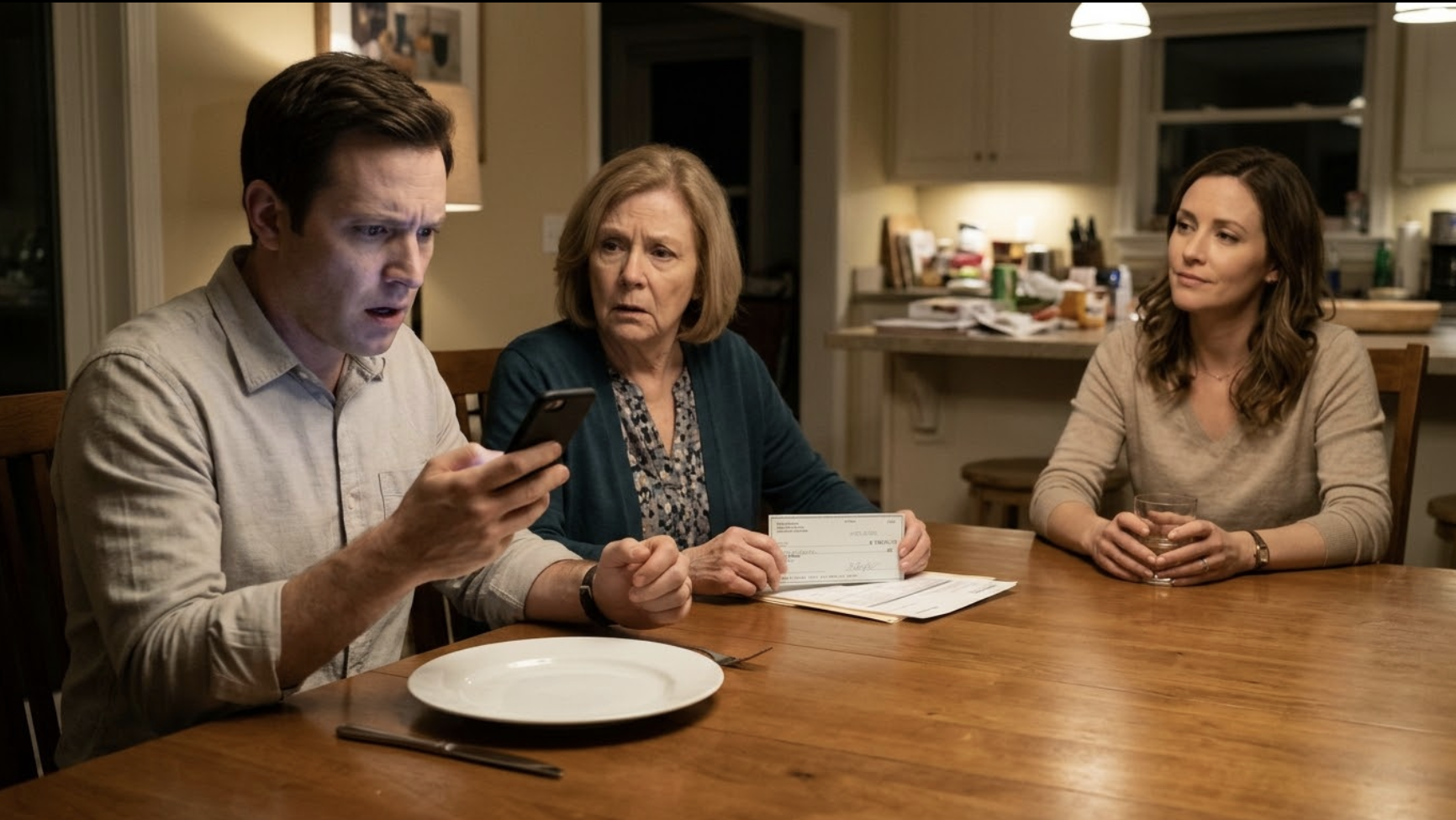
He looked at the empty plate from that first night, which he had left on the kitchen counter as a reminder.
“I deserved that empty plate.”
Paige looked at him.
“Do you know why I put it there?”
“Because I told you to take care of yourself?”
“Because I wanted you to see what it felt like when someone expected you to provide everything without appreciating it.”
Grant nodded.
“I understand now.”
Paige took a bite of the pasta.
“It’s not bad.”
Grant grinned.
“That’s the nicest review I’ve received all week.”
For a moment, the house felt normal again.
But normal wasn’t the same as repaired.
And Paige knew that.
A month after Grant’s promotion, Dolores called him.
Her voice sounded different.
“Grant, I need help.”
He was sitting at his desk when the call came.
“What happened, Mom?”
“I have a problem with the bank.”
“What problem?”
She hesitated.
“I can’t pay the credit card.”
Grant closed his eyes.
“How much?”
Dolores whispered.
“Almost eight thousand dollars.”
Grant sat up.
“Eight thousand?”
“I bought a few things. I thought I could pay them off when you gave me your next paycheck.”
“Mom, I told you I wasn’t giving you my entire paycheck anymore.”
“I know. But I thought you could help me this one time.”
Grant looked at the calendar.
He had mortgage payments.
Car payments.
Household expenses.
And for the first time, he had been saving money consistently.
He wasn’t rich.
He wasn’t struggling.
He was simply learning to live within his means.
“Mom, I can’t pay your credit card.”
Dolores began crying.
“After everything I’ve done for you?”
Grant felt the familiar pressure.
The guilt.
The expectation.
The feeling that saying no made him a terrible son.
But this time, he didn’t transfer money.
“Mom, I’ll help you look at your expenses. I’ll help you make a payment plan. But I won’t pay off a credit card you used to buy things you couldn’t afford.”
Dolores went silent.
“You’re really not going to help me?”
“I am helping you. I’m just not giving you money.”
She hung up.
Grant stared at his phone.
Then he walked into the living room.
Paige was reading.
“Mom called,” he said.
Paige looked up.
“What happened?”
“She owes almost eight thousand dollars on her credit card.”
Paige closed her book.
“And?”
“I told her I wouldn’t pay it.”
Paige didn’t smile.
She didn’t praise him.
She simply nodded.
“That’s a reasonable boundary.”
Grant sat down beside her.
“I feel terrible.”
“That’s normal.”
“She’s my mother.”
“I know.”
“What if she really needs help?”
“Then help her make a plan. Don’t destroy your own financial stability to rescue her from decisions she refuses to take responsibility for.”
Grant stared at the floor.
“I think I finally understand.”
Paige put her book down.
“Grant, I don’t want you to stop loving your mother. I never wanted that. I wanted you to understand that loving someone doesn’t mean you have to sacrifice everything you have for them.”
He reached for her hand.
“I wish I had understood that before.”
Paige let him hold her hand.
But she didn’t forget the months, the years, the words he had spoken.
She was learning that forgiveness could be slow.
And that trust wasn’t rebuilt through one apology.
It was rebuilt through hundreds of small decisions.
Six months later, Grant came home from work carrying a small package.
Paige was in the kitchen.
“What is that?”
“Something I bought.”
She looked suspiciously at the package.
“Should I be worried?”
“No.”
He opened it.
Inside was a simple white ceramic plate.
Not expensive.
Not decorated.
Just an ordinary plate.
Paige looked at him.
“Why did you buy that?”
Grant smiled.
“Because I wanted to replace the one from that night.”
Paige looked toward the kitchen counter.
The original empty plate was still there.
She had never put it away.
Grant picked it up.
“I know this plate probably seems ridiculous. But that night, when you gave me an empty plate, I thought you were being cruel.”
He paused.
“Now I realize it was the first time you stopped letting me take you for granted.”
Paige looked at the new plate.
“Grant, a plate isn’t going to fix our marriage.”
“I know.”
“Neither is a necklace.”
“I know.”
“Neither is an apology.”
He nodded.
“I know.”
He placed the new plate beside the old one.
“I don’t expect you to forget what happened. I just want to remember it, too.”
Paige looked at him for a long time.
Then she said, “That’s a good reason to buy a plate.”
Grant smiled.
They didn’t hug dramatically.
They didn’t suddenly pretend everything was perfect.
They simply stood together in the kitchen.
And for the first time, Paige felt that her husband was beginning to understand what marriage actually meant.
Not ownership.
Not obligation.
Not one person serving another.
Partnership.
PART 6
Dolores never became the woman Paige had hoped for.
She remained proud.
She continued believing that her son should help her whenever she needed it.
But Grant changed.
He stopped sending money without discussing it.
He helped his mother when she had genuine needs, but he never again handed over his entire paycheck.
When Dolores complained, he listened.
When she demanded, he set boundaries.
And when she tried to blame Paige, he stopped allowing it.
One Christmas, Dolores arrived at their house carrying a small gift.
Paige opened the door.
“Hello, Dolores.”
Dolores held out the package.
“I bought you something.”
Paige looked surprised.
“Thank you.”
It was a simple scarf.
Nothing extravagant.
Paige accepted it graciously.
They didn’t suddenly become best friends.
They didn’t erase the past.
But they managed to sit at the same table without turning every conversation into a fight.
Grant watched them from the kitchen.
He had learned that peace wasn’t always about making everyone happy.
Sometimes peace meant disappointing someone who had been accustomed to getting their way.
Sometimes it meant saying no without shouting.
Sometimes it meant letting people be upset without rushing to rescue them.
And sometimes it meant accepting that the people you loved might never fully understand the boundaries you needed.
One evening, years later, Grant and Paige were sitting at their dining table.
The house was quiet.
Dinner was simple.
Grant had cooked.
Paige looked at him and smiled.
“Do you remember the night you demanded dinner?”
Grant laughed.
“Unfortunately, yes.”
“You were furious.”
“I was an idiot.”
“You ordered two hundred dollars of food.”
“And my cards declined.”
Paige laughed.
“And then you asked your mother for money.”
Grant shook his head.
“That’s the part I wish I could erase.”
Paige leaned back.
“Do you know what I remember most?”
“What?”
“The empty plate.”
Grant looked at the white plate sitting on the shelf.
“I remember it, too.”
He reached across the table and held her hand.
“I’m glad you didn’t give me dinner that night.”
Paige raised an eyebrow.
“That’s a strange thing for a husband to say.”
“Because that was the first time I realized I couldn’t keep expecting you to give everything while I gave nothing.”
He squeezed her hand gently.
“I thought I was the man of the house because I earned a paycheck. I didn’t realize being a husband meant being responsible, being fair, and showing up.”
Paige smiled softly.
“And being a wife doesn’t mean paying for everything.”
“No,” Grant said. “It doesn’t.”
They sat quietly for a moment.
Then Grant looked at her.
“Thank you for not giving up on me.”
Paige shook her head.
“Don’t thank me for staying. Thank yourself for finally changing.”
He smiled.
And in the kitchen, the two white plates sat side by side.
One was the empty plate from the night everything fell apart.
The other was the plate Grant had bought to remind himself never to take his wife for granted again.
Paige had once believed that keeping a marriage together meant being patient, giving, and understanding.
But she had learned something far more important.
Love is not measured by how much you sacrifice for someone who refuses to sacrifice for you.
A marriage doesn’t survive because one person keeps carrying the other.
It survives when both people choose to carry it together.
And sometimes, the most powerful thing a woman can do isn’t to argue, beg, or prove her worth.
Sometimes, she simply puts an empty plate on the table…
…and stops serving someone who has forgotten what partnership means.