FINAL PART
Serene held the baby against her chest.
“Come meet your granddaughter,” she whispered.
I approached the bed slowly.
Lily was tiny, with soft dark hair and a wrinkled little forehead. Her eyes were closed, and her fingers curled around the edge of the blanket.
I reached out one finger.
Her hand closed around it.
And suddenly, the entire world seemed to become very still.
“Hello, little one,” I whispered. “I’ve been waiting to meet you.”
Serene watched me.
“Would you like to hold her?”
I looked at Fletcher.
He nodded, smiling.
I sat in the chair beside the bed, and Serene carefully placed Lily in my arms.
She was so small.
I thought about Fletcher as a baby, about the years that had passed, and about all the moments I had believed were gone forever.
Then I looked at Lily’s face.
I understood that love did not move backward.
It moved forward.
The future was not something I had to surrender to anyone.
It was something I could welcome.
Over the next few months, I visited them regularly.
Sometimes I brought dinner. Sometimes I helped watch Lily while Fletcher and Serene rested. Sometimes I simply sat with them, drinking tea and listening to stories about their sleepless nights.
But our relationship had changed.
They asked before making plans involving me.
I asked before rearranging anything in their apartment.
When Fletcher needed help, he told me honestly what he needed instead of expecting me to guess. When Serene felt overwhelmed, she learned to say so without treating my time as something she automatically owned.
We weren’t perfect.
There were occasional disagreements, tired conversations, and moments when old habits threatened to return.
But we had learned to talk about them.
And every time we did, we became a little stronger.
One afternoon, when Lily was four months old, Fletcher and Serene brought her to my house.
Serene stood in the kitchen, looking at the blue pottery mug hanging beside the sink.
“You still have it,” she said.
“Of course.”
She smiled faintly.
“I remember moving it to the back cupboard because I thought it didn’t match the kitchen.”
I laughed.
“I remember.”
She looked embarrassed.
“I really thought I was helping.”
“I know.”
She paused.
“Can I ask you something?”
“Certainly.”
“Did you ever think about selling the house after everything happened?”
I considered the question.
“Yes. For a moment.”
Her eyes widened.
“Really?”
“Not because I wanted to leave. Because I wondered whether it would be easier than fighting to stay.”
She looked down.
“I’m glad you didn’t.”
“So am I.”
I picked up Lily, who was beginning to fuss in her mother’s arms.
Serene watched us for a moment.
Then she said, “I think I understand something now.”
“What is that?”
“When someone gives you a place to stay, it doesn’t mean they owe you their place.”
I looked at her.
“No. It doesn’t.”
“And being family doesn’t mean you get to decide everything for one another.”
I smiled.
“Now you’re learning.”
She laughed, and I laughed with her.
There was no grand speech, no dramatic declaration, and no promise that we would never hurt each other again.
There was simply a kitchen, a cup of tea, and a family learning how to love one another without trying to control one another.
Sometimes, that is the beginning of a better life.
The Envelope on the Counter
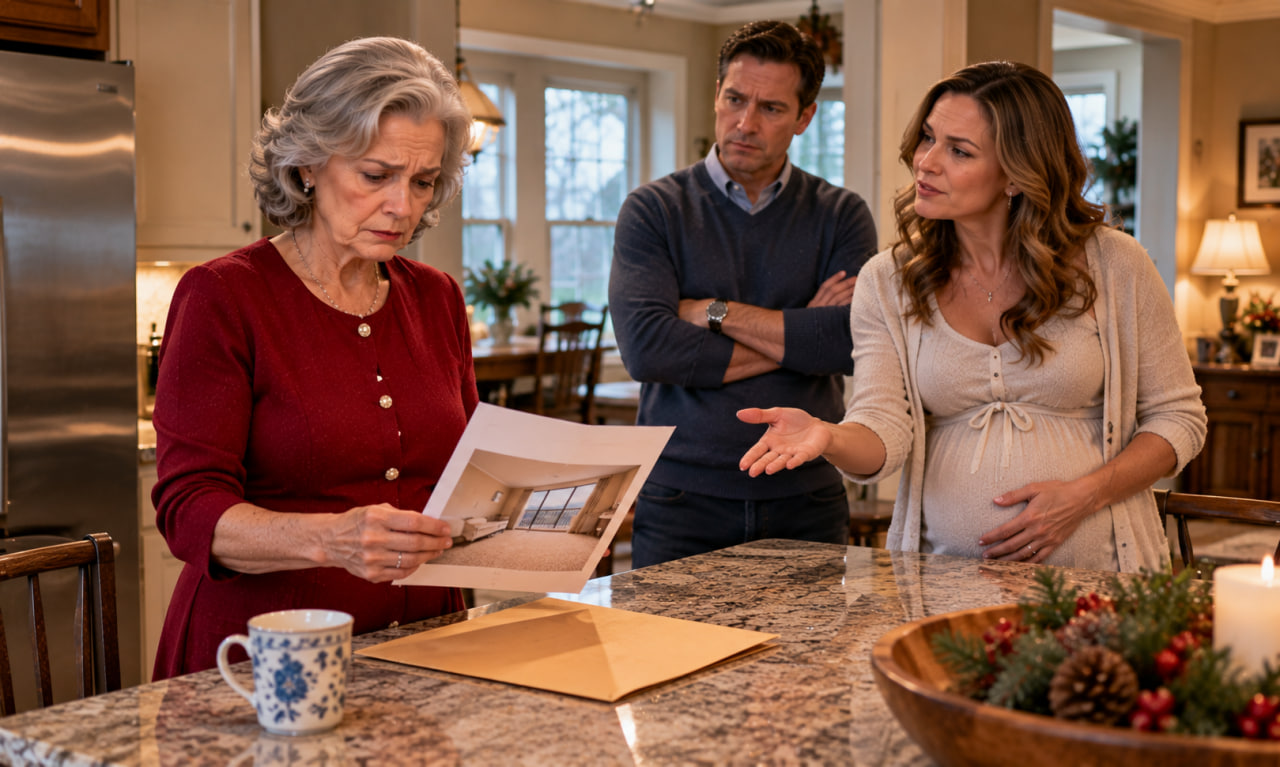
Almost a year after the day Serene left the apartment listing on my kitchen counter, I found myself standing in the same place, holding another envelope.
This one was different.
It contained a letter from Gail confirming that the estate planning documents we had discussed were properly prepared and that my wishes regarding my property had been recorded in the appropriate legal documents.
I had also updated my financial records and made sure that the arrangements for my future care reflected my own preferences.
I hadn’t done these things to punish Fletcher.
I had done them because my life mattered, even when the people I loved needed something from me.
That afternoon, Fletcher and Serene came over with Lily.
She was beginning to walk, taking tiny, uncertain steps while Fletcher followed behind her with his arms stretched out.
“Come on, Lily!” he encouraged.
She toddled toward me.
I knelt down, laughing as she stumbled into my arms.
“Look at you!” I exclaimed. “You’re getting so big!”
Serene took a photograph.
Then she looked toward the kitchen counter.
“What’s that envelope?”
I glanced at it.
“Some paperwork from my attorney.”
She nodded.
“Everything all right?”
“Everything is fine.”
She smiled and returned her attention to Lily.
A year earlier, that envelope might have caused an argument. Someone might have demanded to know what I was planning or assumed the documents were an obstacle to their future.
Now, no one asked me to explain myself.
Because they had finally learned that I was allowed to make decisions about my own life without seeking permission from my family.
That evening, after they left, I walked upstairs to the study.
I took Leonard’s letter from the wooden box and read it once more.
Then I returned it to its place.
I sat in his old chair, looking out over the garden where the roses were beginning to bloom.
For years, I had believed that protecting my home meant preserving every memory exactly as it was.
Now I understood that a home was not just a building, and it was not an inheritance waiting for someone else to claim.
It was a place where people should be able to feel safe, respected, and loved.
And that included me.
I was seventy-three years old.
I was still a mother, still a widow, still learning how to live with the loss of the man I loved.
But I was also a woman with her own wishes, her own boundaries, and a future that belonged to her.
My son had learned that love did not mean silence.
My daughter-in-law had learned that a home could not be claimed simply because it would be convenient.
And I had learned that setting a boundary did not mean closing the door forever.
Sometimes, it meant giving everyone the chance to walk through it with more respect than before.
I finished my tea and placed the cup beside Leonard’s photograph.
Then I looked around the kitchen.
The apartment listing was long gone.
In its place was a drawing Fletcher had made with Lily’s help. It showed a crooked little house, a giant yellow sun, and three stick figures standing beside a rosebush.
Across the top, in Fletcher’s handwriting, were the words:
“Grandma’s House.”
I smiled.
Not because the house belonged to my son.
Not because he had finally accepted that I was right.
But because the words no longer felt like a claim.
They felt like affection.
I turned off the kitchen light and walked toward the stairs, my hand resting on the banister Leonard had built.
The wood was still smooth beneath my palm.
The roses were still growing outside.
And for the first time in a long while, I knew exactly where I belonged.
At home.
And this time, no one had to be asked to understand why.



One Comment on “FINAL PART: My Daughter-in-Law Tried to Move Me Out of My Own House at 72—Then I Placed an Envelope on the Kitchen Counter”