PART7
I watched him walk away.
I hoped he understood that forgiveness and trust were not the same thing.
Trust would have to be rebuilt, one honest decision at a time.
And I had a feeling the hardest decision was still ahead of him.
That evening, I was in the kitchen preparing soup when Serene entered.
She stood beside the counter for a long time without speaking.
Finally, she said, “Fletcher told me what you said.”
I continued stirring the pot.
“What part?”
“That you’re willing to help us find somewhere else.”
“Yes.”
She folded her arms across her chest.
“I don’t understand you.”
I turned off the stove.
“Tell me what you don’t understand.”
“You have this beautiful house. You’re alone most of the time. We could make it lively again. The baby could grow up here. Fletcher could help you with things. We could all be together.”
I looked at her carefully.
“Those are lovely ideas, Serene. But did you ever stop to ask whether I wanted to live that way?”
She looked down.
“You never seemed to mind before.”
“Because when you first arrived, we were sharing a home. We ate together, talked together, and helped one another. I enjoyed that. But slowly, sharing became deciding. You began deciding where my furniture belonged, which rooms you wanted, and where I should live.”
She shook her head.
“I wasn’t trying to hurt you.”
“I believe you may not have intended to hurt me. But that doesn’t mean I wasn’t hurt.”
Her eyes filled with tears again.
For a moment, she looked much younger than she usually did.
“I’ve been frightened,” she admitted.
“Of what?”
“Money. The baby. Whether Fletcher will be able to provide everything we need. My parents keep telling me that we should have a house of our own before the baby arrives. Fletcher says we can’t afford one. Every time I think about renting another apartment, I imagine us struggling for years.”
I listened without interrupting.
She continued.
“When we moved in here, I thought it would be temporary. Then I started imagining how everything could work. There was so much space. And I thought that if we made the upstairs room into a nursery, everything would finally feel settled.”
“So you started planning as though I had already agreed.”
She nodded, ashamed.
“I thought if everything was ready, you would see how sensible it was.”
I leaned against the counter.
“Serene, I have been frightened, too.”
She looked up.
“Frightened?”
“Yes. Frightened that my own son was beginning to see me as a problem to be solved. Frightened that I would lose the last home I shared with my husband. Frightened that I would have to fight my family simply to remain where I belong.”
Her expression crumpled.
“I never thought about it like that.”
“I know.”
I took a clean dish towel and placed it beside her.
“You’re going to become a mother. One day, your child will grow up and make decisions you don’t understand. I hope you remember that loving someone doesn’t give you ownership over their life.”
Serene covered her mouth.
Then, unexpectedly, she began to cry.
This time, I did not rush to comfort her or tell her that everything was fine.
I let her cry.
Sometimes people need to feel the consequences of their choices before they can understand them.
After a while, she whispered, “I’m sorry.”
I looked at her.
“Are you sorry because I wouldn’t give you the house, or because you understand what you did?”
She lowered her eyes.
For several seconds, she said nothing.
Then she answered, “Because I understand what I did.”
It was not a perfect answer. I couldn’t know whether her understanding would last beyond that evening.
But it was the first apology she had offered without blaming someone else.
“Thank you,” I said.
She wiped her cheeks.
“Will you ever forgive me?”
“I hope so. But forgiveness doesn’t mean we go back to pretending nothing happened. We have to do things differently.”
She nodded.
Then she asked the question I had been waiting for.
“Can we start looking for an apartment tomorrow?”
I felt the tension in my shoulders ease slightly.
“Yes,” I said. “Tomorrow.”
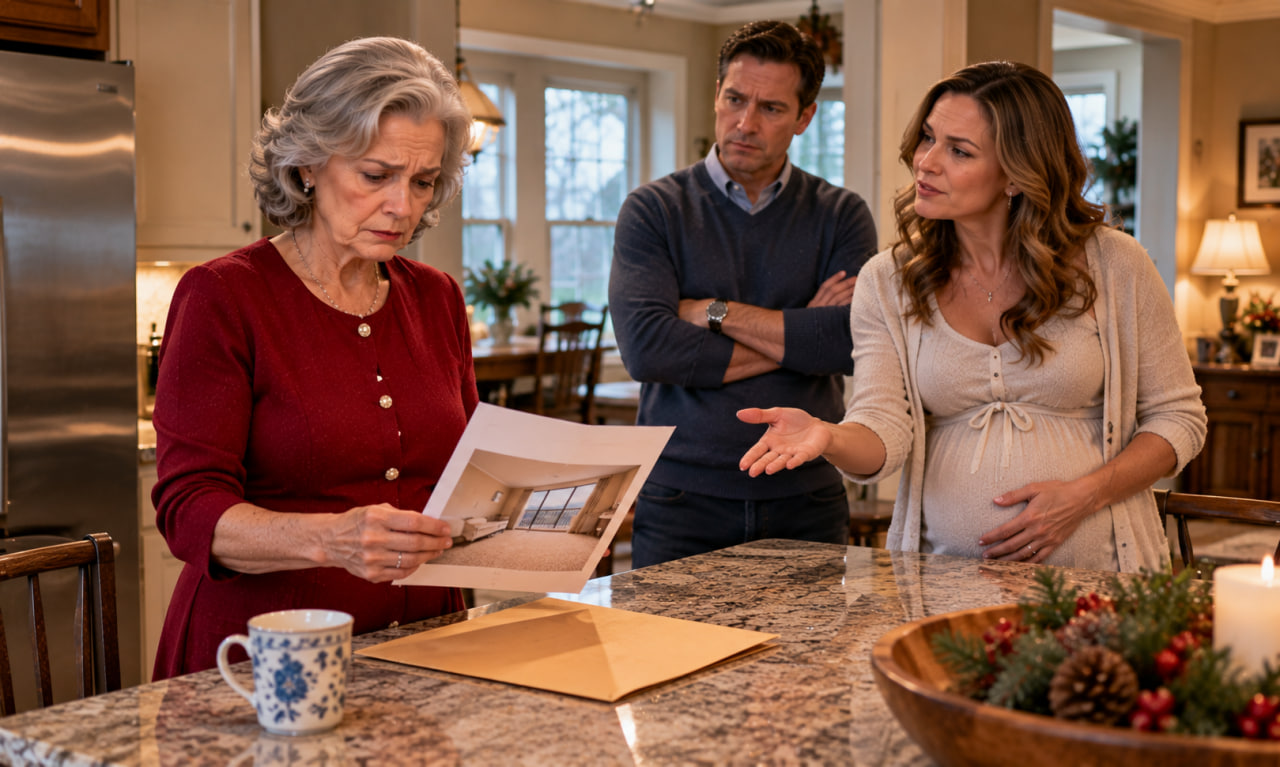
For the first time since the apartment listing had appeared on my kitchen counter, we were discussing a future that none of us had tried to force on the others.
It was a small beginning.
But it was a beginning.
Over the following week, Fletcher and Serene began looking at apartments.
Their first choices were too expensive. One was too far from Fletcher’s workplace, and another had a staircase that Serene worried would be difficult to manage later in her pregnancy.
They argued about budgets, locations, and whether they should rent a larger apartment or a smaller one with a little money left over each month.
This time, I stayed out of their decisions unless they asked for my opinion.
It was surprisingly difficult.
I had spent much of my life trying to make things easier for Fletcher. When he was a child, I prepared his school lunches, helped him with homework, and worried about every fever. When he grew older, I tried to give advice without making him feel controlled.
Sometimes the most loving thing a mother can do is allow her adult child to solve his own problems.
I put down my book.
“Of course.”
He sat in the chair beside Leonard’s desk.
“Would you be willing to help us review our finances? Not pay our rent. Just help us figure out what we can actually afford.”
I smiled.
“I would be happy to.”
We spent nearly two hours reviewing their monthly income, bills, debts, and expenses. There were things they could reduce and subscriptions they had forgotten about. Fletcher admitted he had been embarrassed to discuss money honestly because he wanted to appear more successful than he felt.
Serene joined us halfway through the conversation.
She brought a notebook and began writing down the numbers.
For once, no one spoke about turning the study into a nursery.
We were simply a family trying to solve a problem together.
By the end of the afternoon, they had found a modest two-bedroom apartment within their budget.



One Comment on “PART7: My Daughter-in-Law Tried to Move Me Out of My Own House at 72—Then I Placed an Envelope on the Kitchen Counter”