PART6
The blue pottery mug was still missing from its hook. The beige glider remained in the living room. My husband’s study had acquired a stack of unopened baby furniture catalogs.
Every day, another little piece of my life seemed to be treated as negotiable.
“Yes,” I said. “I think it’s time.”
Gail explained the next steps and reminded me that the appropriate notice and any deadline had to comply with the rules governing their living arrangement. Nothing would be done through threats, force, or an attempt to bypass the legal process.
That mattered to me.
I wasn’t trying to punish my family.
I was trying to protect myself.
By the following afternoon, the paperwork was ready.
Gail had prepared a formal written notice addressing the occupancy arrangement and explaining that, if we could not reach a mutually acceptable agreement, I intended to pursue the lawful process necessary to recover possession of my home.
I read every line carefully.
Then I signed where instructed.
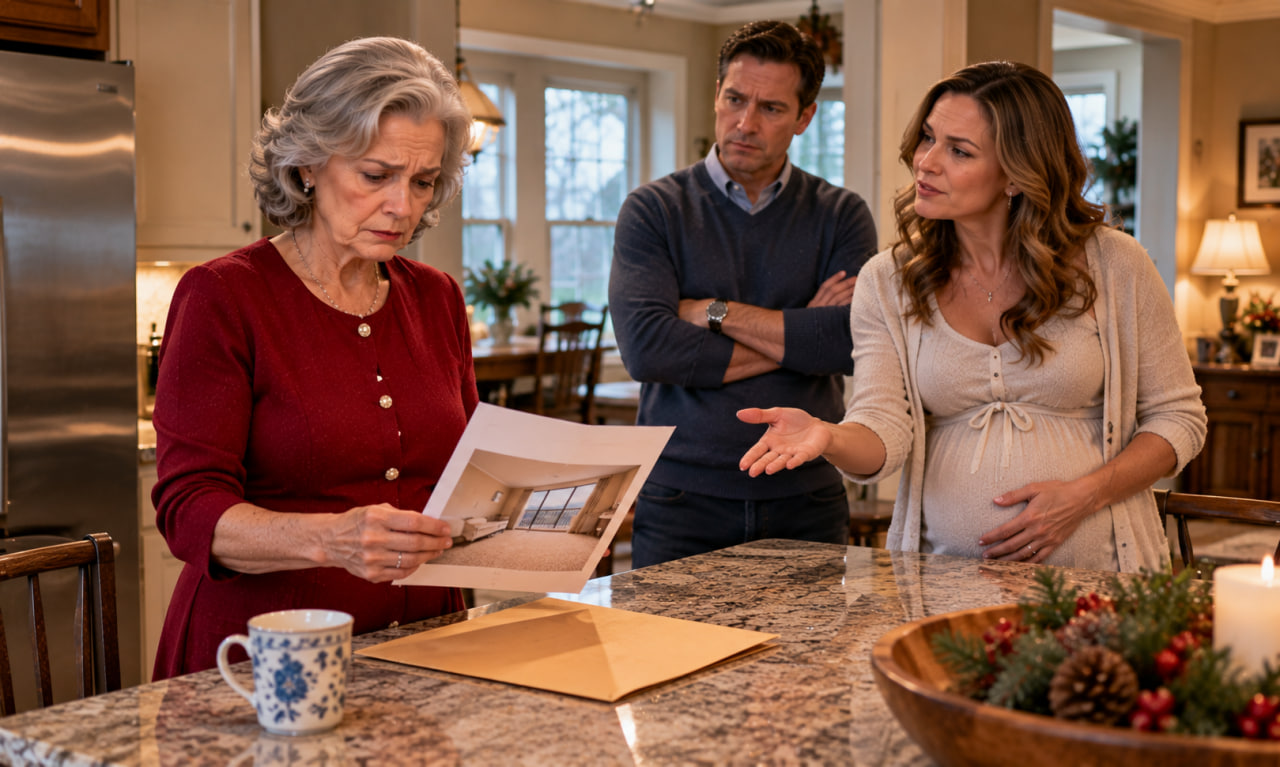
When I returned home, Fletcher and Serene were sitting in the living room.
A baby blanket lay across Serene’s lap.
I placed the envelope on the kitchen counter.
“Both of you need to read this.”
Fletcher looked at it.
“What is it?”
“A formal notice from my attorney.”
Serene’s face went pale.
“You’re kicking us out?”
“I am setting out my legal position and the next steps if we cannot agree on a respectful arrangement. You should read it carefully and obtain your own legal advice if you need to.”
She stared at me as if I had become a stranger.
“You can’t do this to us!”
“I am not doing anything to your baby. I am protecting my home.”
Fletcher picked up the envelope.
His hands trembled slightly as he read the first page.
Then he looked at me.
“Mom, is this really necessary?”
I thought of the moving company they had contacted.
The real estate agent across the street.
The conversations about my ability to manage my own property.
The study that had been quietly claimed for a nursery.
And the apartment listing, still sitting on my counter like an instruction.
“Yes,” I said. “Because asking politely has not been enough.”
Serene began to cry.
Not quietly, either.
She covered her face with both hands and sobbed as Fletcher put his arm around her.
For a moment, I nearly abandoned everything.
I imagined the baby arriving, the little cries in the middle of the night, the smell of fresh laundry, and Fletcher carrying his child down the stairs to introduce us.
I wanted those things.
I wanted them more than I could explain.
But I also wanted to wake up in my own bedroom without wondering whether someone had already decided where I would live next.
I wanted to read in Leonard’s study.
I wanted to keep my belongings where I chose to keep them.
I wanted to be a grandmother without being treated as an obstacle.
Serene looked at me through her tears.
“I thought you wanted us to be happy.”
“I do.”
“Then why are you doing this?”
I answered as gently as I could.
“Because your happiness cannot depend on taking away mine.”
She turned toward Fletcher.
“Say something!”
He looked at the notice again.
Then he looked at me.
For the first time in weeks, he didn’t ask me to compromise.
He simply said, “We need to talk.”
I nodded.
“Yes. We do.”
And as I watched them carry the envelope into the living room, I realized that the papers were not the end of our family’s story.
They were the moment when pretending finally became impossible.
For the next two days, my house felt like a place where everyone was waiting for a storm.
Serene barely spoke to me. Fletcher left early for work and returned late, often disappearing into the bedroom with his phone pressed to his ear. I heard their arguments through the walls, but I stopped trying to understand every word.
I had spent too many nights wondering what they were planning.
Now, I was determined to live my life without constantly anticipating the next insult.
On Thursday morning, I found Fletcher sitting alone on the back porch.
He was holding an old photograph of himself and his father. He must have found it in the study while looking for something else.
I sat beside him.
“That’s from the summer we repaired the garden gate,” I said.
He nodded.
“I remember.”
“You complained about holding the wood while your father measured it.”
A faint smile appeared on his face.
“He made me do it again because I held it crooked.”
“He said the gate would be standing long after we were gone.”
Fletcher looked at the photograph.
“I miss him.”
“So do I.”
For a while, we listened to the birds in the garden.
Then he spoke.
“Dad would be disappointed in me, wouldn’t he?”
I could have said yes. Part of me wanted him to feel the weight of what he had done.
But I had no desire to use his father’s memory as a weapon.
“I think your father would ask you why you allowed things to get this far.”
Fletcher swallowed.
“I thought I was keeping the peace.”
“Whose peace?”
He looked at me.
I continued quietly.
“You kept Serene from being disappointed by allowing me to be disappointed instead. You kept arguments away from your marriage by bringing them into mine with you. You stayed silent because you thought silence was harmless.”
I paused.
“But silence can hurt people, too, Fletcher. Especially when they’re waiting for someone they love to stand beside them.”
He wiped his eyes with the heel of his hand.
“I never wanted you to feel unwanted.”
“Then why did you let me?”
He had no answer.
I reached over and touched his arm.
“I love you. That has never changed. But loving you doesn’t mean I can pretend everything is acceptable.”
He nodded.
“Serene says the notice means you don’t want us here anymore.”
“The notice means I will not surrender my home. It doesn’t mean I want to lose my family.”
He looked toward the kitchen window.
“What if we moved out?”
I studied him.
“Would that be your decision, or would it be another decision you made because you were afraid of disappointing someone?”
He considered the question carefully.
Then he said, “I think we need our own home. Somewhere we can raise the baby without expecting you to change your life around us.”
It was the first time he had spoken about their future without treating my house as the answer to every problem.
I nodded.
“That sounds reasonable.”
“But we can’t afford much.”
“Then you’ll have to find something within your means. I can help you look at your budget if you want me to. I won’t pay for everything, and I won’t give up my home, but I can help you think through your options.”
He looked relieved, though there was still fear in his expression.
“Would you really help us?”
“You are my son.”
I paused.
“But help has to be something we agree on. It cannot be something you simply take.”
He nodded slowly.
For the first time in months, I believed we might be moving toward something better.
Then the porch door opened.
Serene stood there, her eyes swollen from crying.
“Fletcher, can I speak to you?”
He rose.
Before following her inside, he turned toward me.
“Thank you, Mom.”




One Comment on “PART6: My Daughter-in-Law Tried to Move Me Out of My Own House at 72—Then I Placed an Envelope on the Kitchen Counter”