PART4
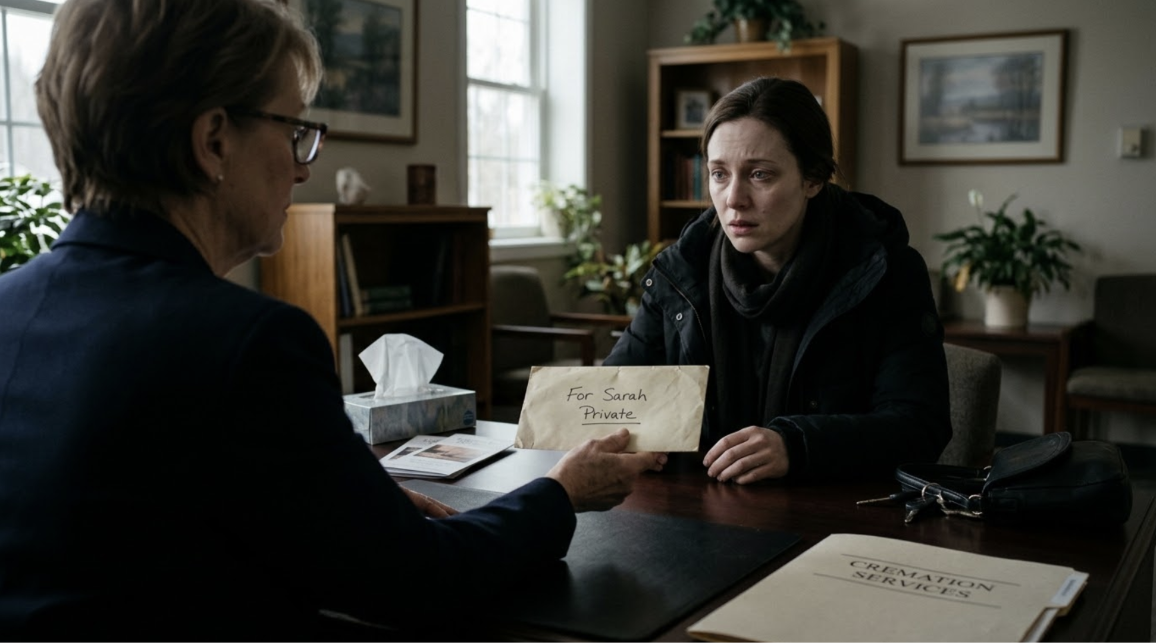
Inside was a USB drive, three printed photographs, and a handwritten note.
Margaret unfolded the note.
She read it silently.
Then she passed it to Daniel.
His expression changed.
“What?” I asked.
Margaret looked at me.
“Your father left specific instructions for this recording to be preserved and reviewed by his legal representatives.”
She connected the USB drive to her computer.
A file appeared.
The date was November 2nd.
The night before Dad’s stroke.
Margaret clicked play.
At first, there was only the sound of a chair moving.
Then Dad’s voice filled the room.
“Ray, I told you I’m not signing anything.”
My brother answered.
“You’re making this much harder than it needs to be.”
“That’s because you’re asking me to sell something I don’t want to sell.”
“It’s just a house, Dad.”
“It’s your mother’s house.”
There was a long silence.
Then Ray spoke again.
“Mom’s been gone for seventeen years. You need to stop living in the past.”
I closed my eyes.
That was the house where Mom had raised us.
The house where she’d measured our heights against the kitchen doorframe.
The house where Dad had slept alone after she died, refusing to move because he said he could still feel her presence in every room.
On the recording, Dad’s voice became firmer.
“I made a promise to your mother.”
Ray laughed.
“What promise? That you’d keep the place empty forever?”
“That our children would always have somewhere to come home.”
“Well, I’m here. I’m the one who comes home. Janet doesn’t even live here.”
“Your sister is still my daughter.”
“Then give her some money and let me handle the property.”
I felt my fingernails dig into my palm.
The recording continued.
Ray lowered his voice.
“You don’t understand, Dad. The buyer is ready. We have an agreement.”
“We have no agreement.”
“You’re going to sign it.”
“No.”
There was a sharp sound.
A chair scraping backward.
Then Ray said something that made my entire body freeze.
“You think Janet is going to save you? She’s six hours away. She won’t even know what’s happening until it’s too late.”
Dad answered quietly.
“She doesn’t have to save me. I can take care of myself.”
Ray’s voice grew louder.
“You’re eighty-one years old!”
“And you’re still my son. I keep hoping you’ll remember what that means.”
The recording ended.
Nobody spoke.
I stared at the computer screen.
My brother had stood in front of me and told me Dad’s cremation was what he wanted.
He had handed me half of Dad’s ashes.
He had told me there was no will.
And all the while, he had been trying to sell our father’s house.
Margaret paused the recording.
“Janet, I want you to understand something. This recording is potentially important evidence, but we will need to preserve its authenticity and have it properly reviewed before relying on it in any legal proceeding.”
I nodded.
“What were the photographs?”
Margaret opened the first one.
It showed Ray standing beside a man in a dark coat outside Dad’s house.
The second showed the two men shaking hands.
The third showed them standing in front of a real estate sign.
I recognized the other man immediately.
My stomach dropped.
It was my mother’s cousin, Harold Bennett.
Harold had attended every family holiday when we were growing up. He had helped Dad repair the fence after a storm and had even given me my first car when I graduated high school.
He had been at Dad’s funeral.
He had hugged me and told me how sorry he was.
And now I was looking at a photograph of him standing with Ray in front of the house.
“Why would Harold be involved?”
Margaret folded her hands.
“Your father believed Harold was acting as an intermediary for a property investor. Someone who wanted the land surrounding your father’s home.”
“Who?”
She turned her computer toward me.
A printed company profile appeared on the screen.
Bennett Development Group.
The company belonged to Harold’s son, Michael.
I remembered Michael.
He had once been arrested for a financial dispute, although the family had always described it as a misunderstanding.
Margaret explained that the developer had been buying properties in Dad’s neighborhood for a large redevelopment project.
The land was valuable.
Much more valuable than Dad had ever let on.
“How much?” I asked.
Margaret opened another document.
“Based on the preliminary valuation your father received, the house and adjoining parcel were worth approximately $310,000. But the larger development proposal could make the combined property substantially more valuable.”
“How much more?”
She looked at me.
“Your father was offered $780,000.”
I couldn’t breathe.
Seven hundred and eighty thousand dollars.
Ray had been trying to sell a property worth nearly three-quarters of a million dollars while telling me it was just an old family house.
“Did Dad refuse the offer?”
“Yes. Several times.”
“Then why did Ray think he could sell it?”
Margaret opened another folder.
“Because he had been telling the developer that your father was no longer capable of making independent decisions.”
My blood ran cold.
“What?”
“Your brother apparently told them that he had authority to manage your father’s financial and property affairs.”
“But he only had power of attorney.”
“Which ended when your father died. And it did not automatically authorize him to sell property held in a trust.”
I looked at her.
“So the house was protected?”
“Yes. Your father created a revocable living trust several years ago. He later updated its terms and appointed you as successor trustee.”
“Why didn’t he tell me?”
Margaret’s expression softened.
“He wanted to avoid putting you in the middle of a family conflict. He also believed that if Ray knew about the trust, he might try to challenge it while your father was still alive.”
I lowered my head.
Dad had been carrying all of this alone.
I had been calling him every Sunday, asking about his garden and his medication, believing everything was fine.
Meanwhile, he was trying to protect himself from his own son.
“What’s going to happen now?” I asked.
Margaret leaned forward.
“First, we need to examine the financial records. Second, we need to notify the relevant institutions and establish your authority under the trust. Third, we need to determine whether Ray took money or made unauthorized commitments involving your father’s property.”
She paused.
“And there is another matter.”
“What?”
“Your father left instructions regarding a separate investment account.”
She opened a statement.
I stared at the balance.
$1,240,000.00
I blinked.
“That’s impossible.”
“It is an investment account your father maintained for many years.”
“How?”
“Your father inherited money from his father, invested conservatively, and continued contributing to it. He was far more financially careful than most people realized.”
I shook my head.
“Ray knows about this?”
“Your father believed he did not know the full amount.”
I stared at the statement.
“What did Dad want me to do with it?”
Margaret handed me another document.
It was part of the will.
My father’s instructions were clear.
The investment account would be divided between Ray and me equally, subject to the estate’s obligations and the terms of the trust.
But there was a separate provision.
A portion of the estate would be placed into an educational fund for any grandchildren who wanted to attend college or pursue vocational training.
Dad had thought about everyone.
Even the grandchildren.
Even Ray.
He hadn’t disowned his son.
He had simply refused to let him control everything.
The following morning, Margaret began the formal process of securing the estate.
She contacted the banks, notified the trust’s relevant parties, and requested copies of all transactions made during Dad’s final months.
I stayed in town.
I couldn’t return home knowing that my brother was still walking around believing he had gotten away with everything.
On Friday afternoon, Margaret called me into her office.
“Janet, we’ve received the bank records.”
She placed several pages on the desk.
I looked at the first transaction.
$18,500.
The withdrawal Dad had mentioned.
Then another.
$7,200.
Then another.
$12,000.
I kept turning the pages.
There were transfers going back nearly eighteen months.
Some were labeled home maintenance.
Others were listed as medical expenses.
Several had no explanation.
The total came to $46,700.
I felt sick.
“Did Ray take all this?”
“We are still tracing the transactions. Some payments may have been legitimate, but several appear to have gone into an account belonging to your brother.”
I stared at the documents.
Forty-six thousand seven hundred dollars.
Money Dad had saved by repairing his own appliances, wearing old clothes, and keeping the same truck for more than a decade.
Money he had believed was safe.
I remembered sending Ray $500 every few months.
I remembered paying for Dad’s prescription medication once when Ray said his account was short.
I remembered asking Ray whether Dad had enough groceries.
He always said yes.
Sometimes he even thanked me for being such a helpful sister.
I felt foolish.
But Margaret interrupted my thoughts.
“Janet, don’t blame yourself. Your father didn’t want you to know because he didn’t want you to worry.”
I looked up.
“Can we get the money back?”
“Potentially. But that will depend on what the investigation establishes. We will pursue the appropriate legal remedies.”
I nodded.
Then my phone rang.
Ray.
I stared at his name.
Margaret motioned for me to answer.
“Hello?”
“Where are you?”
His voice was sharp.
“Why?”
“Because I’ve been trying to reach you.”
“I’ve been busy.”
“Doing what?”
“Handling some things Dad left behind.”
Silence.
Then he laughed.
“What things?”
I looked at Margaret.
She shook her head slightly.
I decided to tell him nothing.
“Just paperwork.”
“Janet, listen. We need to meet.”
“About what?”
“The house.”
My stomach tightened.
“What about it?”
“I’ve found a buyer.”
I closed my eyes.
There it was.
Even now.
Even after Dad’s death.
Ray was still trying.
“Ray, the house isn’t yours to sell.”
His voice immediately changed.
“What did you just say?”
“I said the house isn’t yours to sell.”
“Who told you that?”
I didn’t answer.
“Did you talk to someone?”
“Yes.”
“Who?”
“An attorney.”
The silence lasted several seconds.
Then Ray exploded.
“You’re unbelievable! You live six hours away, you didn’t help Dad with anything, and now you’re suddenly hiring lawyers?”
“I helped Dad whenever I could.”
“Sending money isn’t helping!”
I almost laughed.
I had sent money because Ray repeatedly told me Dad needed it.
But I didn’t argue.
“Ray, I have the will.”
Another silence.
Then he said quietly:
“What will?”
“Dad’s will.”
He laughed again, but this time it sounded nervous.
“There’s no will.”
“There is.”
“You’re lying.”
“I have a certified copy.”
His breathing became heavier.
“Where did you get it?”
I looked at the small photograph of Dad on Margaret’s desk.
“From Dad.”
Ray hung up.
I stared at my phone.
For a moment, I wondered whether he would call back.
He didn’t.
But twenty minutes later, my phone buzzed with a text message.
Ray: You need to stop before you make a terrible mistake.
I read it twice.
Then I placed the phone facedown.
For the first time in my life, I wasn’t afraid of upsetting my brother.
Two days later, Margaret received a letter from the developer’s attorney.
The letter claimed that Ray had entered into a preliminary agreement to sell the property for $780,000.
The buyer was demanding that the estate honor the agreement.
Margaret read it twice.
Then she looked at me.
“Did your father sign anything?”
“No.”
“Are you certain?”
“Absolutely.”
She nodded.
“Good. We will respond through the proper legal channels.”
She explained that the agreement appeared to have been signed by Ray, who had represented himself as having authority over the property.
But the property was held in Dad’s trust.
Ray had not been authorized to sell it.
The developer was now claiming that it had relied on Ray’s representations.
Margaret believed the matter would become complicated.
I wasn’t interested in making it easy.
Not because I wanted revenge.
But because Dad had spent the final days of his life trying to protect something that belonged to our family.
I wasn’t going to let his efforts disappear.
The next week, Ray showed up at Margaret’s office.
I was sitting in the conference room when the receptionist announced him.
He walked inside wearing his usual navy jacket.
He looked tired.
His hair was uncombed, and his eyes were red.
When he saw me, he stopped.
“What are you doing here?”
I looked at him.
“Waiting for you.”
He turned toward Margaret.
“Why is she involved in my father’s estate?”
Margaret calmly gestured toward the chair.
“Please sit down, Ray.”
He remained standing.
“I’ve been handling everything since Dad died.”
Margaret opened a folder.
“That is precisely why we need to discuss several matters.”
Ray looked at me.
“You’ve been talking to her?”
“Yes,” I answered.
He shook his head.
“I knew this would happen. You always wanted more than your share.”
I felt something inside me finally settle.
“No, Ray. I wanted a chance to say goodbye to Dad.”
He looked away.
Margaret interrupted.
“Ray, your father’s will was executed on November 6th. A certified copy is here. The original is in our custody.”
Ray stared at the document.
For the first time, I saw genuine fear on his face.
“That isn’t possible.”
“It is.”
“He was confused.”
“We have medical records and independent witness statements confirming that your father understood the nature of the documents he signed.”
Ray sat down.
Margaret continued.
“Your father also appointed Janet as successor trustee.”
Ray’s face turned red.
“She doesn’t know anything about the property.”
“She is legally authorized to administer the trust according to its terms.”
“I’ve lived in that house my entire life!”
“Ray, you haven’t lived there for years,” I said quietly.
He looked at me.
“I took care of Dad!”
“I know you were there. I never denied that.”
“Then why are you doing this?”
I took a breath.
“Because you told me there was no will. Because you cremated Dad before I could even get there. Because you told me he wanted something he had spent years telling me he didn’t want. And because you tried to sell his house without his permission.”
Ray slammed his hand on the table.
“That house was supposed to be mine!”
Margaret spoke firmly.
“Your father made his wishes clear. The trust provides for both children, but it does not give either of you the right to take control of its assets.”
Ray looked down.
Then he said something I will never forget.
“He promised me.”
I stared at him.
“What?”
“He promised me the house.”
“When?”
“Years ago.”
“Did he put it in writing?”
Ray said nothing.
Margaret opened another folder.
“Your father addressed this in a letter dated last year.”
She handed him a page.
Ray read it.
His expression slowly changed.
The letter was short.
Dad had written:
Ray, I know you have always expected to receive the house. I also know you believe being physically closer to me gives you a greater claim to what I own.
But I want you to understand something.
Being nearby is not the same as being loving.
I appreciate the times you helped me. I also remember the times Janet called, sent money, and worried about me from six hours away.
I will not reward one child by pretending the other does not exist.
You are both my children.
And I will leave this world knowing I tried to treat you both fairly.
Ray folded the letter.
His hands were shaking.
“Where did you get this?”
“Your father gave it to me,” Margaret replied.
Ray looked at me.
For several seconds, neither of us spoke.
Then he stood.
“I’m leaving.”
Margaret nodded.
“Before you do, there is another matter. We need to discuss the financial transactions from your father’s accounts.”


One Comment on “PART4: My Brother Cremated Dad Before I Could Say Goodbye, Then Claimed There Was No Will—Until a Crematorium Found the Sealed Envelope With My Name on It…”
Comments are closed.