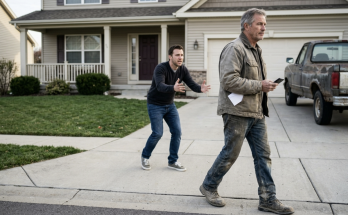
My dad walked out with me alone.
In fourth grade we had a day where every kid stood up and said what their parents did for work. Lori
Vogel’s mother was a nurse at the hospital in Odell. Somebody’s dad drove a truck for the co-op.
Somebody’s uncle sold seed.
When it was my turn, I said, “My mom answers the phone at the sheriff’s office.”
A boy in the back row said, “So she’s a secretary.”
And I said, “I guess.
I guessed that for about thirty years.
I left the county when I was nineteen and didn’t look back much. I sell commercial heating and
cooling systems out of an office up in Burnsville. I have a title with the word regional in it. I have a
company truck and a nice watch and a wife who went to college in the Cities. And somewhere along
the way, without ever saying it out loud, I decided that my mother had spent her whole life sitting in a
chair in a basement, and that I had done better.
The first time I met my wife’s parents, her father asked what my folks did. I told him my dad farmed. I
told him my mom worked for the county.
He asked, “Doing what?”
And I said, “Oh, she just answered phones.”
I said it like an apology. Like I was sorry to bring it up.
When she retired, they had a cake for her in the courthouse. I came late and I left early. I had a sales
dinner that night with a client from Rochester. I remember the room being a lot fuller than I expected.
Deputies. Firemen in their dress shirts. Nurses. Old men in seed caps. People standing out in the
hallway because they couldn’t fit.
I remember thinking that was a lot of people for a retirement party for a dispatcher.
I remember not asking why.
So I will tell you exactly what I was thinking on County Road 6 at the thirty-five-minute mark. And it
was not noble. It was not even close.
I was thinking she was nobody to this kid. Just an old woman with a paper license and a pan of bars.
I was thinking that I was the one with the good job and the good shoes, so it was up to me to fix it. I
had my phone in my hand. I was going to call someone.
I did not know who to call.
That is the truth, and it sat in my stomach like a stone. I had been gone twenty-two years. I did not
know one single phone number in that whole county that wasn’t hers.
At forty minutes, he got out of his truck with his ticket book.
He took his time walking up. He stood in front of her with his feet planted wide and flipped the cover
of the book back.
All right, ma’am. I’m writing you for impeding traffic, and for no valid license in your possession.
The computer isn’t giving me what I want on this.” He flicked the yellow paper with his fingernail.
Flick. “And since I can’t verify you’re licensed to operate this vehicle, I’m going to have it towed.
Your son can call somebody to come pick the two of you up.”
Towed. In the middle of the corn. With an old woman and a pan of melted lemon bars and a grown
son who didn’t know a single phone number.
“I see,” my mother said.
“You have anything you want to tell me before I call the wrecker?”
No. But I wonder if I could ask you one thing first.”
“You can ask.”
Would you press the button on your radio and say my name to the dispatcher? Just my name.
Shirley Hagen. That’s all I’d like.”
He looked at her. Then he looked through the back window of the Buick, right at me, and he grinned.
Like the two of us were in on something together. Like I was supposed to grin back at him.
You think you’re somebody?”
“No,” she said. “I don’t think that at all.”
I wanted to crawl under the dashboard and stay there.
I thought, Mom, please don’t. I was sure she was about to tell a boy with a badge that she used to
work for the sheriff, and he was going to laugh at that too, the same little laugh through his nose, and
I was going to have to sit there and listen to it.
He did it for the joke. I am sure of that. He wanted it on the air so everybody could laugh with him.
He turned his chin to his shoulder and pressed his thumb on the microphone clipped there.
Kessler, Fourteen.
A young woman’s voice came back, quick and bright. “Fourteen, go ahead.”
“Yeah, I’m still out on Six with that traffic stop. I’ve got a lady out here with a homemade license
who wants me to say her name on the air for her.” He laughed into it. “Says it’s Shirley Hagen.”
He let go of the button and raised his eyebrows at my mother. There you go, grandma. Happy now? Nothing came back.
You know how a radio sounds when nobody’s talking on it. A soft hiss, like a faucet running two
rooms away. It hissed. It kept hissing. It hissed for what felt like a very long time.
The corn moved a little, finally, in some wind I couldn’t feel. There was a red-winged blackbird sitting
on the fence wire across the ditch. I remember it because it was the only living thing out there
making any sound at all.
Then the dispatcher came back.
And it was not the same voice. It was the same woman, but it was not the same voice. It was careful
now. Slow. Like someone walking across ice.
“Fourteen, say again that name.”
He rolled his eyes and reached for the button.
My mother took one step forward. She leaned in toward his shoulder, the way you lean in to smell a
lilac bush, and when his thumb pressed down, she spoke first.
“Good afternoon, Kessler. This is Shirley, out on County Six.”
Ten words. I counted them later, lying in bed. I counted them more than once.
It was not her kitchen voice. It was not the voice she used on the phone with my aunt, or the one she
used on me. It was lower. Slower. There was no hurry anywhere in it, and every word arrived whole
and complete, like it had been carried a long way and set down very carefully.
I had heard that voice maybe three times in my whole life. Every time was when I was small and sick
in the middle of the night, burning up with fever, and she sat on the edge of my bed and talked me
down until I could breathe.
It was the voice that left no room.
When I was fifteen, I hated that voice. Sitting in that Buick on County Road 6, I finally understood that
it had never been built for me at all. It was built for people on the worst night of their lives. I had only
ever gotten what was left over when she came home in the morning.
The dispatcher broke first.
Shirley?”
It came out of the little speaker cracked right down the middle. No call number. No procedure. Just a
name, like somebody calling across a yard.
Shirley, it’s Kim. Are you all right? Is that you? Are you the stop?”
The deputy still had his thumb on the button. I think he forgot it was there.
I’m just fine, Kim,” my mother said to his shoulder. “A little warm. You sound good today. I had my
scanner on this morning, and you sound real good.”
I learned later that Kim was twenty-two when the county hired her. I learned that my mother sat in the
chair beside her for her first ninety nights and never once took the headset out of her hands. Not
when the calls were bad. Not when Kim froze. Not when Kim cried in the bathroom at four in the
morning after a car went into the river. My mother sat next to her and let her do it, every single time,
and talked her through it under her breath.
The deputy pulled his thumb off the button like it had burned him.
But a radio doesn’t need your thumb to talk back.
‘Kessler Six.”
A man’s voice. Older. A voice like a gravel road.
Afternoon, Shirley.”
That was all he said.
My mother nodded at the little microphone, the way you nod at a man across the street on a Sunday.
Afternoon, Dennis,” she said, to nobody who could hear it except the deputy and me.