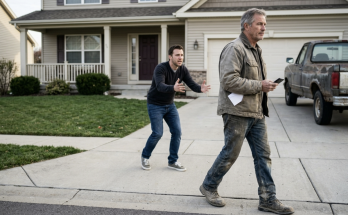
He wasn’t alone. Dennis pulled in right behind him in a squad car. Then a red pickup with a fire
department placard on the door. Then Gary in the orange county plow truck, which he parked half in
the ditch at an angle like he’d been in a hurry and didn’t care who saw. Cars headed to the ice cream
social came over the rise and slowed down and pulled off onto the grass, because nobody in Kessler
County was going to drive past that many light bars without finding out who it was for.
By the time it was over, there were fourteen or fifteen people standing on the shoulder of County
Road 6.
Tom Hanley was fifty-eight years old and built like a grain silo. He got out of his truck and took his
hat off.
He took his hat off to my mother on a county road, in front of everybody.
He bent down to her open car door.
‘You all right?”
“I’m fine, Tom. I’ve got my air on.”
He straightened back up and turned around. Deputy Brandt was standing there now, on his feet
again, with his hands hanging at his sides.
Ticket book,” the sheriff said.
Kyle handed it over.
Keys to that unit.”
He handed those over too.
“Eleven days,” the sheriff said.
He wasn’t loud. It was worse than loud. Every word came out flat and heavy, like stones set down one
at a time.
“I gave you a badge eleven days ago. And you took it out on a county road and used it on a woman
going to church. You’re done. You can ride back to town with Dennis, and you can leave the rest of it
on my desk.”
Tom.”
My mother hadn’t raised her voice. She’d only used the other one.
The sheriff stopped the way a loaded truck stops. All at once and with a lot of weight.
“I’d like to ask for one thing,” she said. “Then I’d like to get these bars to the church, such as they
are.
Anything, Shirley.
Don’t say anything until you’ve heard it.”
She got out of the car again. She didn’t have to. Nobody asked her to. But she did, and she stood up
straight in the sun one more time, and every person on that road went quiet.
“I don’t want his badge,” she said. “I want a month of his nights.”
Nobody said a word. I could hear the blackbird again.
Put him downstairs. Eleven to seven. In the second chair beside Kim. He doesn’t touch anything
and he doesn’t talk. He just wears a headset and listens to what comes in. I’ve still got my old one
in the closet. The county let me keep it. Jeffrey can run it into town tonight.”
Shirley, he stood you out here for-”
‘I know how long. I’ve stood longer.” Her voice didn’t move. “I stood at that console eleven hours
the night the Halvorsen place burned.”
She looked at Kyle Brandt then. And it wasn’t an unkind look. That was the thing that got me. It
wasn’t unkind at all.
“He’s only ever seen people on the side of a road,” she said. “Afterward. When they’re trying to hold
themselves together in front of a uniform. He thinks that’s who they are. He has never once heard
what a person sounds like when they call for help. He ought to hear that before he decides anything
else about anybody.”
The sheriff rubbed his jaw with one big hand.
‘And he’s somebody’s boy,” my mother said. “I know whose.”
Tom Hanley looked at her for a long time. Then he turned to the deputy, and to the rest of us standing
there in the heat, and he told it right there on the gravel.
“Let me tell you who you had standing on this shoulder,” he said. “March of ninety-eight. I was
thirty years old, and I’d been a deputy five years. I’d pulled people out of cars. I’d seen things. I
thought I was a pretty tough customer.”
He put his hat back on.
“We got that blizzard. This road, right here where we’re standing, was drifted shut from the elevator
to the church. My wife went into labor three weeks early at two in the morning. The ambulance went
in the ditch out by the Hagen place trying to get to us. I called it in. And I couldn’t hold the phone.
mean that. I dropped it on the kitchen linoleum twice.”
Nobody moved. Not one person.
“She said, Tom, I need you to wash your hands and get every towel in the house. Then I need you to
put the phone down on the floor by Connie’s head and tell me what you see.
His voice caught. He waited for it.
“Forty minutes. The cord was around the baby’s neck. Shirley told me to slip one finger under it and
lift it over, slow, like taking a necklace off somebody. I did it. And Amy cried.”
He looked straight at Kyle.
“Amy’s twenty-eight now. She teaches second grade in Odell. I have never once been able to pay
that back. Not once. And you had the woman standing in the sun because you didn’t like the look of
a piece of paper.”
Kyle Brandt was crying openly now. He didn’t try to hide it. He just stood there and let it run down his
sunburned face.
And I remembered that morning. I remembered it all at once, standing there.
I was thirteen. It had snowed so hard the school buses didn’t run. My mother came home three hours
late and sat down at the kitchen table without even taking her coat off. Dad made her eggs. She held
the fork and didn’t eat. Then she said, “Tom and Connie Hanley had a girl,” and she got up and went
to bed.
That was the whole report. That was all any of us ever got from her. Thirty-four years of nights, and
that was what came home. One sentence over cold eggs.
I had eaten my cereal and gone outside to build a snow fort.
“A month,” the sheriff said finally. “Nights. Starting tonight. And if Kim tells me you so much as
sighed, you’re finished.”
Yes, sir.”
The door of the red pickup opened then.
Walt Brandt walked with a hitch. One hip moved a beat behind the other, the way it would for the rest
of his life. He was a lean man in a seed cap and work boots, and he didn’t look at his son first.
He walked right past him to my mother.
Shirley.
Walt. You’re walking good.”
“I’m walking.”
Then he turned around to face his boy. I braced myself. I was sure he was going to shout.
He didn’t shout.
“You stood her in the sun,” he said.
Yes, sir.”
“She kept me talking fifty-one minutes with a tractor on top of me. You know what she kept me
talking about?”
Kyle shook his head.
You. She asked me your name, and she would not let me quit saying it. She asked what position
you played in summer league. She asked what you wanted for Christmas. Every time I shut my
eyes, she said, Walt, tell me about Kyle. Tell me about Kyle.”
His voice gave out. He stood there and waited for it to come back.
“You had a father at your graduation because of that woman. And I never told you her name,
because I figured it was mine to carry. That’s on me, son. That one’s on me.”
Kyle turned to my mother. He had to try twice before anything came out.
“Mrs. Hagen. I’m sorry.”
‘I know you are,” she said. “Right now you are. I want you sorry in a month. It’ll be worth something
then.”
Gary came over while people were getting back into their cars. He was a big, slow man with a gray
beard and forearms like fence posts. He looked down at the pan in my hands, and then he looked up
at me.
You’re Shirley’s boy,” he said.
I had spent most of my life trying to be something other than that. Something bigger. Something with
the word regional in it.
“Yes,” I said. “I am.”
We were thirty-five minutes late to the social.
She carried the pan into the fellowship hall herself. She wouldn’t let me take it. Half the people in that
church basement had a scanner sitting on their kitchen counter at home, and every one of them had
heard it.
The room went quiet when she came through the door. Completely quiet. Then, after a second, it
went right back to talking, because that’s how people there do things. They don’t make a fuss.
But there was a cup of coffee poured and a chair pulled out before she ever set that pan down.
Nobody cut those lemon bars. You couldn’t cut them. They ate them with spoons, standing around
the table, and the pan came home empty.
That night I went to her bedroom closet and took the headset down off the top shelf. It was in a
shoebox. The foam on one ear had been replaced at some point with a different color. There was
black electrical tape wound around the band where her hair had worn the plastic smooth over thirty-
four years.
I held it in my hands for a long time.
I drove it into Odell at a quarter to eleven that night.
I was forty-one years old, and I had never once seen the room where my mother worked.