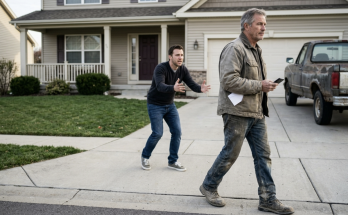
Dennis had been a deputy in that county for twenty-six years. During his very first winter on the job,
he was alone at a wreck out on the state highway, with a family trapped in the car and a long, long
wait for help. My mother stayed on the air with him for ninety minutes that night. She talked to him
about his dog. About its name and what it liked to eat. About anything that would keep his hands
steady.
I didn’t know that then. All I knew was that a grown man had said two words on the radio, and my
mother’s chin had come up half an inch.
The speaker hissed. Then it went again.
“Odell Fire One. Hello, Shirley.”
“Hello, Ron,” she said softly.
Hiss.
Medic Two. Hi, Shirley, it’s Deb. We’re up at the hospital. Brenda’s here, she says hi too. She’s
waving at the radio. I told her you can’t see it.”
My mother laughed. A small, real laugh. The first sound out of her in forty minutes that wasn’t
careful.
The deputy had turned and was staring down at his own shoulder like something had crawled up
onto it.
“Kessler, State Two Forty-One.”
That one was crisp. Clipped. A state trooper.
I’m up on Highway 14, and I’ve had you on scan the last half hour. Tell Shirley the State Patrol says
good afternoon. Tell her she talked me through that fog in oh-eight.”
“State Two Forty-One, she copies,” Kim said. And I could hear that Kim was crying and doing her job
at the exact same time.
Hiss.
“County Highway Nine. It’s Gary. Shirl, if you need a ride, I’m four miles off, and I’ve got the orange
truck.”
Gary drove a snowplow. For thirty-four winters, my mother called every single plow driver in that
county on the quarter hour, all night long, in every blizzard, to make sure each one of them answered
If one didn’t answer, she sent somebody. Every time.
I knew that part. I knew it because she used to say their names in her sleep. I used to hear her
through the wall on Saturday afternoons. Gary. Lyle. Pete. Answer me, Pete.
I had my door open by then. I don’t remember opening it. I was standing on the gravel with a pan of
ruined lemon bars in both hands, and nobody told me to sit down.
Hiss.
Kessler Nine.
This voice was young. Thirty, maybe. Then he stopped, and I could hear him breathing with the
button still held down. Breathing like it hurt.
“Shirley, it’s Mike. You sat on the phone with my wife.”
Then the click, and he was gone. That was all he could manage.
My mother closed her eyes for one second.
‘I remember,” she said.
Seven voices. Each one waited for the one before it to finish. Nobody stepped on anybody. Nobody
talked over anyone. It was the most orderly thing I have ever heard in my life, and I realized, standing
there sweating on the gravel, that they were doing it exactly the way she had taught them.
One at a time. Say who you are. Say what you need. Get off the air and let the next one in.
The deputy’s face had gone the color of the road.
“Ma’am,” he said. His voice had changed too. “Who are you?”
She didn’t get the chance to answer him.
“Kessler One.”
Everything else on that radio stopped. Even the hiss seemed to hold its breath.
It was a big man’s voice, in a moving vehicle, with the windows down. You could hear the wind
roaring through it.
“Shirley. It’s Tom.”
Sheriff Tom Hanley. I knew the name from the yard signs every election year.
“Where are you standing?”
She couldn’t answer unless the deputy pressed the button for her. She looked at him. She waited.
She didn’t reach for it. She just stood there with her hands folded over the clasp of her handbag and
waited.
He pressed it. His thumb was shaking.
“I’m at the back of my Buick, Tom. On the shoulder. About a half mile east of the elevator.”
How long?”
She looked at the deputy again. She gave him three full seconds to say it himself. I counted them.
One. Two. Three.
He didn’t.
A little while,” my mother said.
That was mercy. I didn’t understand it as mercy until much later. At the time I was furious with her for
it. I wanted her to say forty minutes. I wanted her to say it loud, for the whole county to hear.
“Fourteen,” the sheriff said.
The deputy swallowed hard. “Fourteen.’
How long has she been standing there?”
He looked down at the gravel. “About forty minutes, sir.”
The wind roared in the speaker. Nobody else said anything. Nobody on that whole channel.
“Put her in her car,” Sheriff Hanley said. “Turn her air on. You do not write one word. I’m six minutes
out.”
Then he said something I don’t think a sheriff is supposed to say on an open channel with the whole
county listening.
“Shirley, I’m sorry.”
The deputy opened the Buick’s door for her.
He did it badly. He almost caught her handbag in the hinge. He had taken his sunglasses off, and
without them he had a child’s face, sunburned pink across the nose, with eyes that were too wide.
She had one hand on the door frame when the radio came on one more time.
This voice was slower than all the others. It belonged to somebody who didn’t talk on a radio much in
the daytime. Somebody who had to work up to it.
“Kessler, Odell Fire Twelve.”
“Fire Twelve, go ahead,” Kim said.
“Was that Shirley Hagen I heard on there?”
That’s affirmative, Twelve.
A long breath, held with the button down.
“Shirley. It’s Walt Brandt.”
I looked at the deputy’s name tag. I had not read it once in forty minutes. It was a brass bar pinned
over his right shirt pocket, and it said BRANDT.
“I heard a Fourteen on there with you,” the voice said. “Shirley, is that my boy’s radio you’re on?”
The deputy went white under the sunburn. All the way white.
My mother looked at him. She didn’t look at the name tag. She didn’t have to.
That was the moment I understood it. She had read that brass bar the minute he walked up to her
window. She had known for the entire forty minutes whose son was making her stand in the sun. She
had carried that in her handbag the whole time, in the heat, with her hand burning on the trunk lid.
And she never once spent it.
He held his hand out, palm up. He unclipped the microphone from his shoulder and put it in her hand,
gently, like he was handing back something that had always been hers.
It is, Walt,” she said. “He’s right here. He’s just fine.”
“Kyle?”
She held the microphone toward the boy. He bent down to it.
Dad.”
“Son, do you know who that is?”
No, sir.”
It was quiet so long I thought the man had gone.
“October of oh-nine,” Walt Brandt said. “That’s who that is.”
I watched it land on him. I watched it go all the way through.
Kyle Brandt was seven years old in October of 2009. That was the night his father’s tractor rolled over
on the creek bank on the back eighty, after dark, and came down across his hips. Walt had a flip
phone in the bib pocket of his overalls and one bar of signal. He called 911.
He got my mother.
It took the fire department fifty-one minutes to find him, because Walt couldn’t tell them which field
he was in. He was pinned in the dark with no landmarks and a tractor on his legs, and every field on
that farm looked the same at night.
She found him anyway.
She asked him if he could see the light on top of the grain elevator. She asked him if it was on his left
or on his right. Then she asked him about the church steeple. Could he see it? Which side? She drew
a line across the county with a pencil from a chair in a basement, and she sent the trucks right down
it.
And for fifty-one minutes, every time Walt started to drift off, every time his voice went soft and far
away, she asked him about his boy.
I didn’t know any of that standing on the shoulder. Walt told me himself about twenty minutes later,
with his hand resting on the roof of my mother’s car.
All I knew right then was that the deputy had sat down.
He didn’t decide to. His legs just quit on him. He sat down on the back bumper of the Buick, right
where she’d been standing for forty minutes, and he pressed the heels of his hands against his eyes.
Ma’am,” he said. “I didn’t know.
‘I know you didn’t,” my mother said. “Get me out of this sun, and then you can tell me.”
The sheriff made it in five minutes.