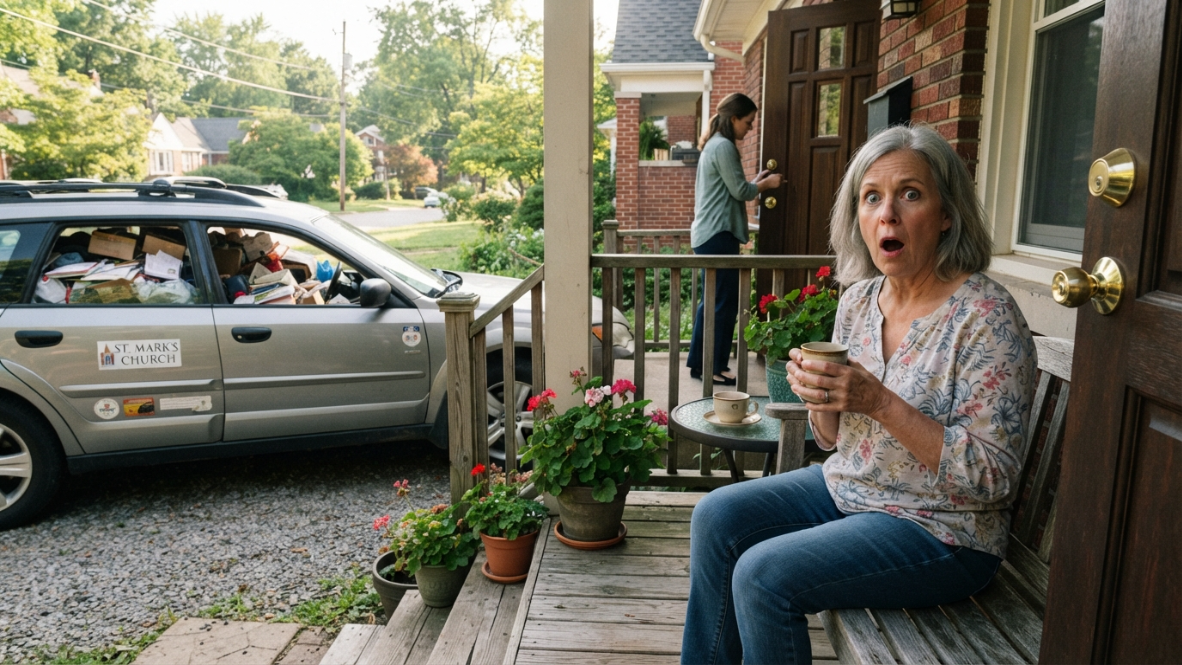
“I said I trusted you to help her. I did not say you could decide where she lives.”
The driveway went quiet.
I was nervous to admit this, even to the people who know me: part of me still wanted Curtis to come home and be my son before he was Bridget’s husband. I wanted him to be angry for me without needing to be convinced. Instead, he looked tired and uncertain, which was not the same thing, but it was at least honest.
“I am keeping this,” I said.
“You cannot keep my paperwork.”
“It has my name on it.”
“It is for your benefit.”
“Then Rosalind can read it to me.”
Curtis turned to Bridget. “Give her the rest of her things from the car.”
“I am not unpacking her entire house in the driveway.”
“No one asked you to unpack the house. Give her the chest.”
Bridget looked at him for a long moment. “You are taking her side now?”
“I am asking you to give her back what belongs to her.”
Bridget remained beside the car.
“I have nowhere to go,” she said.
Curtis looked at her. “You can come with me.”
I said, “I am not telling you what to do with your marriage. I am telling you that you are not going to bring me another paper and call it something else.”
Bridget’s mouth tightened. “You cannot manage this house alone.”
“Maybe not,” I said. “But I can decide who reads my papers.”
Curtis took a breath. “Mom, can I come back tomorrow with you and Rosalind?”
“If Rosalind agrees.”
“I will call her.”
“You can call her now.”
He took out his phone. Bridget stood beside him, but he walked a few steps away before dialing. I could not hear the conversation, and I did not try. For once, I did not need to hear every word to know what was happening. The decision that mattered had already been made.
Rosalind came over that afternoon. She read the folder at my dining room table, with the silver chest still beside the breakfront. The papers did not change because I was finally looking at them with someone who would tell me the truth. They were still documents connected to Fairview and to the arrangements Bridget had been making without my agreement.
Rosalind put the pages into a clean envelope.
“You did the right thing by not signing,” she said.
“I should have asked you sooner.”
“I mean before then.”
She reached across the table and tapped the envelope. “Do not punish yourself for trusting family. Just do not sign anything you have not had read.”
Curtis returned the next day without Bridget. He sat across from me while Rosalind read the documents aloud again. He asked questions, and she answered what she could. When something required advice beyond what any of us understood, we left it unsigned rather than guessing.
He did not sign the last piece.
Bridget did not move me to Fairview by Christmas. She also stopped putting papers in front of me and stopped taking my belongings out to her car. What happened between her and Curtis was theirs to handle, but she did not continue living in my house as if my consent were already settled.
I still need help reading the small print. I am no longer ashamed to say so, and nobody gets to mistake that need for permission.